
Commercial Brick Repair & Replacement Services
Expert diagnosis that addresses root causes—not just symptoms. Our union-trained craftsmen restore and protect your building’s masonry envelope with precision repairs backed by 25+ years of Midwest experience.
What Property Managers Need to Know
| ✓Water intrusion + freeze-thaw cycles | are the primary drivers of brick deterioration in Midwest climates, with water expanding 9% when frozen and generating up to 2,000 PSI of pressure inside masonry. |
| ✓Deferred maintenance compounds exponentially: | Every $1 in delayed brick repair typically costs $5+ when addressed later—a 5:1 multiplier that accelerates with each passing season. |
| ✓Minneapolis buildings 6+ stories | must comply with mandatory facade inspection ordinances, requiring periodic assessments and documented repair plans. |
| ✓Root cause diagnosis | separates effective repairs from temporary fixes. Surface-level repairs that ignore moisture sources, failing flashings, or corroding steel will fail again. |
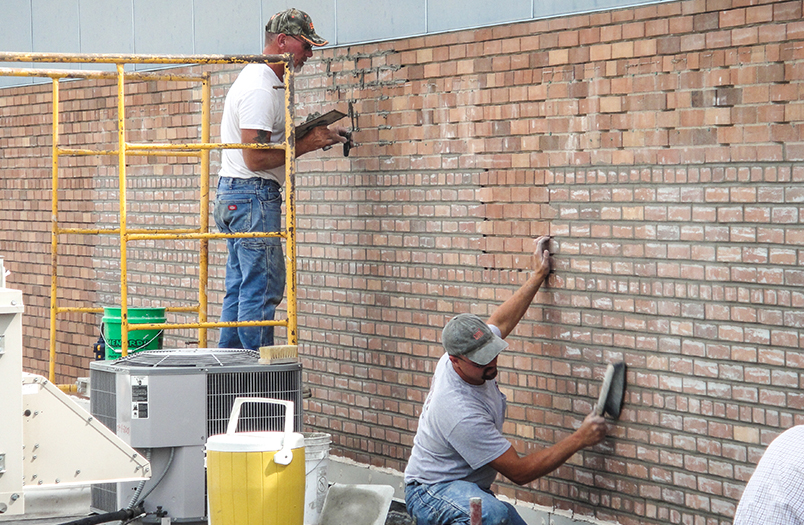
| ✓Proper tuckpointing depth matters: | Industry standards (BIA Technical Note 46) require mortar removal to 2-2.5x joint width. Shallow “joint skimming” leads to premature failure. |
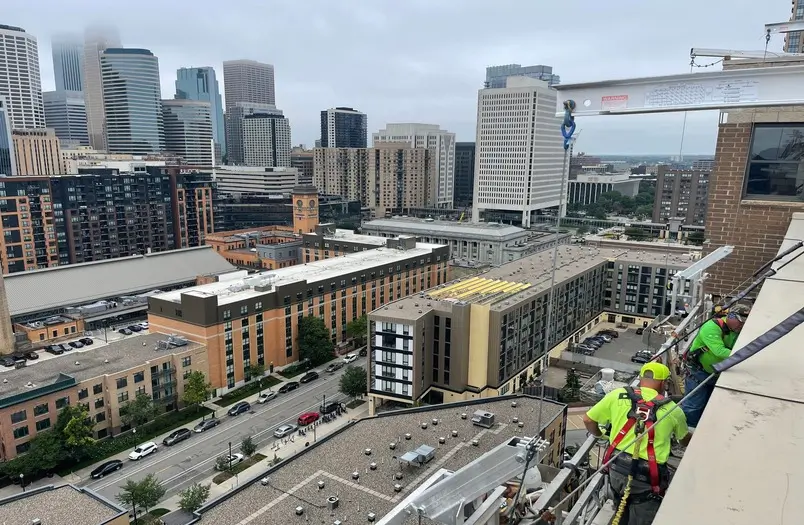
| ✓RSI offers free comprehensive assessments | including swing stage access for multi-story buildings, detailed failure mapping, and scope development—before you commit to any work. |
Warning Signs Your Building Needs Brick Repair
Recognizing deterioration early can save thousands in repair costs. Here’s what property managers should look for during routine inspections.
Visible Damage Signs
- Spalling Brick Flaking, chipping, or crumbling brick faces indicate freeze-thaw damage. The brick’s protective outer layer has failed, exposing the softer interior to accelerated weathering.
- Efflorescence (White Powder Deposits) Those white crystalline deposits aren’t just cosmetic—they’re salt residue left behind as moisture evaporates through your masonry. This signals chronic water infiltration.
- Cracked or Deteriorated Mortar Joints Mortar that’s recessed more than ¼” from the brick face, or showing visible cracks, has lost its weatherproofing function and allows water penetration.
- Stair-Step Cracking Above Windows & Doors Diagonal cracks following the mortar joint pattern often indicate structural movement, settling, or—critically—corroding steel lintels above openings.
- Rust Staining on Brick Faces Brown or orange streaks running down from mortar joints signal corroding embedded steel, typically shelf angles or lintels that are expanding and damaging surrounding masonry.
- Bulging or Bowing Walls Walls that no longer lie flat indicate serious structural issues, often from corroded wall ties, failed anchors, or moisture-driven expansion behind the facade.
Hidden Damage Indicators
- Corroding Shelf Angles & Lintels These hidden steel supports bear the weight of masonry above openings. When they corrode, they expand up to 10x their original volume, cracking and displacing brick courses.
- Failing Flashings Flashings are your first defense against water infiltration at roof lines, window heads, and wall penetrations. Degraded or improperly installed flashings channel water into the wall cavity.
- Chronic Moisture Sources Clogged weep holes, failed sealant joints, deteriorated coping stones, and improper drainage all create persistent moisture conditions that accelerate masonry deterioration.
- Subtle Wall Movement Small cracks that reappear after repair, doors and windows that stick seasonally, or gaps between the facade and structural frame indicate ongoing movement that requires investigation.
- Interior Water Damage Staining, peeling paint, or efflorescence on interior walls adjacent to exterior masonry often indicates water is migrating through the building envelope.
- Deteriorated Backup Wall Systems Water infiltration can cause hidden damage to sheathing, insulation, and structural elements behind the brick veneer—damage that’s invisible until the facade is examined closely.
Understanding Why Brick Fails
Brick masonry is remarkably durable—many historic buildings have stood for over a century. But durability isn’t invincibility. Understanding the four primary mechanisms that cause brick deterioration helps property managers recognize problems early and make informed repair decisions.
In Midwest climates, the combination of moisture infiltration and extreme temperature swings creates uniquely challenging conditions for masonry. Water finds its way in through failing mortar joints, deteriorated sealants, and compromised flashings. Once inside, that water becomes an agent of destruction—expanding when it freezes, carrying damaging salts, and accelerating the corrosion of embedded steel.
The following sections examine each damage mechanism in detail, providing the technical context you need to understand why certain repairs are necessary and what happens when problems are left unaddressed.
The Freeze-Thaw Factor
Minnesota’s climate subjects masonry to extreme thermal cycling. Each freeze-thaw event damages saturated brick and mortar from the inside out—and our winters deliver dozens of these destructive cycles annually.
Rust Jacking: The Hidden Threat
Behind the visible brick facade, steel components do critical structural work. Shelf angles support masonry at floor lines. Lintels span openings above windows and doors. Relief angles accommodate building movement. When these hidden steel elements corrode, the consequences are severe.
Steel corrosion is an expansive process. As iron oxidizes, it can expand to 2-10 times its original volume. This expansion—called “rust jacking”—generates enormous forces that crack mortar joints, displace entire brick courses, and can ultimately cause facade sections to separate from the building structure.
Warning Signs of Rust Jacking:
- → Stair-step cracking above windows, doors, and other openings
- → Horizontal cracking along mortar joints at floor lines
- → Displaced or rotated bricks pushed outward by expanding steel
- → Rust staining bleeding through mortar joints
- → Bulging or bowing of wall sections
Addressing rust jacking requires more than cosmetic repair. The corroded steel must be exposed, treated or replaced, and the surrounding masonry must be properly rebuilt with appropriate clearances for future movement.
“Our approach to rust jacking goes beyond replacing damaged brick. We expose the corroded steel, assess its condition, apply protective treatments or replace it entirely, then rebuild with proper clearances and flashings to prevent recurrence.”— Dylan Reynolds, Project Manager, RSI
The True Cost of Deferred Maintenance
Delaying necessary brick repairs isn’t just a short-term gamble—it’s an exponentially compounding liability. Understanding the financial impact helps justify proactive maintenance budgets.
“Building owners often view facade maintenance as cosmetic—something that can wait. But water infiltration doesn’t wait. Every season that passes, the damage spreads deeper into the wall system. By the time it becomes a visible emergency, you’re no longer dealing with masonry repair. You’re dealing with structural remediation.”— Dylan Reynolds, Project Manager, RSI
Minneapolis Facade Inspection Ordinance
Minneapolis, like many major cities, requires periodic facade inspections for buildings of a certain height. Understanding these requirements helps property managers plan maintenance budgets and avoid compliance issues.
Who Must Comply
Buildings six stories or taller within Minneapolis city limits are subject to mandatory facade inspection requirements. This includes commercial, residential, and mixed-use properties with exterior masonry, concrete, terra cotta, or other cladding systems.
Inspection Requirements
- Initial facade inspection by a qualified professional (licensed engineer or architect)
- Periodic re-inspections at intervals specified by the ordinance
- Documented assessment of facade condition and any observed deterioration
- Classification of conditions as safe, safe with repair program, or unsafe
- Submission of inspection reports to the city within required timeframes
What Happens After Inspection
If the inspection identifies conditions requiring repair, building owners must submit a repair plan and timeline to the city. Conditions classified as unsafe may require immediate remediation, protective measures (such as sidewalk sheds), or both.
How RSI Supports Ordinance Compliance
RSI works alongside inspection engineers to translate assessment findings into actionable repair plans. We provide detailed scoping, phased repair strategies that align with budget cycles, and comprehensive documentation that satisfies city reporting requirements. Our experience with historic preservation requirements and complex urban sites makes us a trusted partner for ordinance compliance projects throughout the Minneapolis-St. Paul metro.
Our Commercial Brick Repair Process
RSI’s diagnostic-first approach ensures we understand the full scope of deterioration before recommending repairs. Here’s how we work with commercial property managers from assessment through completion.
Assess
Comprehensive condition survey to document all visible and accessible damage.
- Multi-story swing stage access for high-rise buildings
- Detailed failure mapping and photography
- Moisture testing and thermal imaging where warranted
- Assessment of embedded steel conditions
Plan
Root cause diagnosis informs repair scope and sequencing strategy.
- Identify underlying causes (moisture, steel corrosion, movement)
- Develop detailed repair specifications
- Create phased approach aligned with budget cycles
- Coordinate with engineers and preservation consultants
Execute
Union-trained craftsmen deliver quality repairs with minimal disruption.
- Skilled masonry crews with historic restoration experience
- Material procurement and matching (including historic brick)
- Daily quality control and progress documentation
- Coordination to minimize tenant and operational impact
Document
Thorough closeout documentation supports future maintenance planning.
- Completion reports with before/after photography
- As-built documentation for ongoing reference
- Maintenance recommendations and schedules
- Warranty documentation and material records
What Sets RSI Apart
Not all brick repair is created equal. The difference between a repair that lasts and one that fails within a few years often comes down to diagnosis, materials, and craftsmanship standards.
What Others Miss
- Symptom-Only Repair Replacing damaged brick without investigating why it failed. The new brick will deteriorate the same way if the underlying moisture source or structural issue isn’t addressed.
- Joint Skimming Applying thin layers of mortar over deteriorated joints instead of cutting to proper depth. This cosmetic fix typically fails within 2-3 years.
- Ignoring Moisture Sources Completing masonry repairs without addressing failed flashings, clogged weep holes, or deteriorated sealants that will continue directing water into the wall.
- Improper Mortar Selection Using modern high-strength mortars on historic soft brick, which accelerates brick deterioration and can cause cracking.
- Inadequate Steel Assessment Failing to investigate embedded steel conditions when rust staining or cracking patterns suggest corrosion.
The RSI Approach
- Root Cause Diagnosis Every repair begins with understanding why the damage occurred. We don’t just fix what we see—we identify and address the conditions that caused the failure.
- 2x Joint Width Standard Per BIA Technical Note 46, we cut deteriorated mortar to at least 2-2.5 times the joint width (typically ¾” to 1″ deep) to ensure proper bond and longevity.
- Integrated Moisture Management Our scopes include flashings, sealants, and drainage components as integral parts of masonry repair—not afterthoughts or separate contracts.
- Historic-Appropriate Materials We match mortar composition to existing conditions, including lime-based mortars for pre-1920s buildings and careful brick matching for historic structures.
- Union-Trained Craftsmen Our crews undergo rigorous apprenticeship training and continuing education, ensuring consistent quality across every project.
“We get called regularly to fix work that other contractors did just a few years earlier. The repairs failed because they only addressed the surface damage—they skimmed joints, replaced a few brick, and moved on. The underlying moisture problem was still there, and within a couple of winters, the new work looked as bad as the old.”— Dylan Reynolds, Project Manager, RSI
Commercial Brick Restoration Case Studies
The best measure of a contractor’s capabilities is their completed work. These projects demonstrate RSI’s ability to handle complex commercial masonry restoration—from multi-year high-rise contracts to historic institutional buildings—with the diagnostic rigor, skilled craftsmanship, and project management that commercial property managers require.
RiverWest represents one of RSI’s most comprehensive multi-year facade restoration contracts. This Minneapolis high-rise required systematic restoration across multiple phases, addressing widespread deterioration while maintaining compliance with Minneapolis Historic Preservation Commission requirements.
The scope encompassed complete brick replacement in severely damaged areas, extensive tuckpointing across all elevations, replacement of failing flashings and sealants throughout the building envelope, and detailed restoration work on more than 385 balconies. RSI’s phased approach allowed the condominium association to budget repairs across multiple fiscal years while prioritizing the most critical areas first.
Historic brick matching was essential—our team sourced period-appropriate materials and lime-based mortars to maintain the building’s architectural integrity while delivering lasting weatherproofing performance.
Lourdes Hall – Winona State University
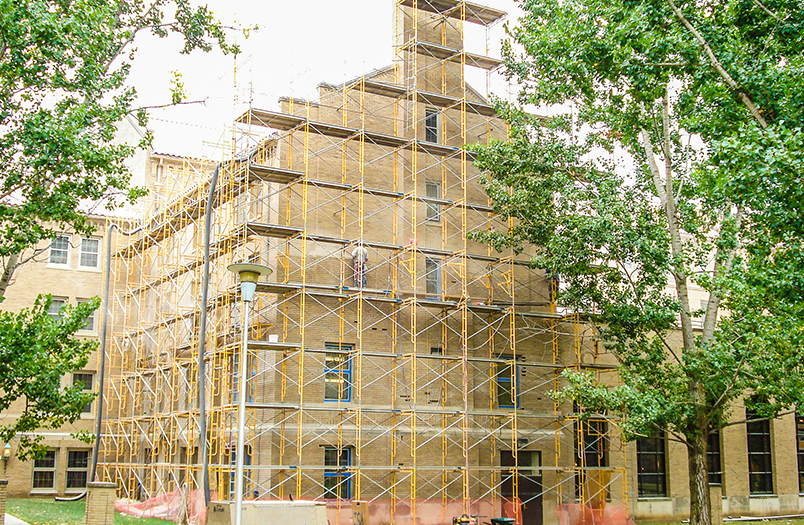
Winona, MinnesotaLourdes Hall at Winona State University presented a complex institutional restoration challenge. This historic campus building required extensive masonry rehabilitation across its substantial facade, combining large-scale tuckpointing with precision brick and limestone replacement.
The project demanded particular expertise in historic material matching. RSI sourced period-appropriate brick and worked with suppliers to obtain 150 pieces of Indiana Limestone for replacement elements that would integrate seamlessly with the existing historic fabric.
Our team executed 56,000 square feet of tuckpointing—removing deteriorated mortar to proper depth and repointing with historically compatible mortar mixes. This wasn’t cosmetic joint skimming; it was comprehensive repointing that will provide decades of weatherproofing performance. The 580 brick replacements addressed areas where freeze-thaw damage had progressed beyond repair, using carefully matched salvage and new brick to maintain visual continuity.
St. Cloud College
St. Cloud, Minnesota
The St. Cloud College project exemplifies RSI’s commitment to root cause diagnosis. Initial assessments revealed that the building’s brick deterioration wasn’t just a surface problem—underlying structural movement had compromised wall stability across significant portions of the facade.
Surface-level brick replacement alone would have been insufficient. The walls needed structural reinforcement before any cosmetic restoration could succeed. RSI installed 2,900 structural helical ties to mechanically reconnect the brick veneer to the backup structure, arresting ongoing movement and providing the stable foundation necessary for lasting repairs.
With the structural issues addressed, our team completed 1,650 brick replacements in areas where deterioration had progressed beyond salvage. This sequence—stabilize first, then restore—is essential for projects where movement or structural compromise underlies visible masonry damage. It’s more expensive than simply replacing brick, but it’s the only approach that delivers lasting results.
Frequently Asked Questions
Common questions about commercial brick repair, tuckpointing services, and working with RSI.
Commercial brick repair costs vary significantly based on scope, access requirements, and underlying conditions. Simple tuckpointing may run $8-15 per square foot, while comprehensive repairs involving brick replacement, steel remediation, or structural stabilization can range much higher.
The most accurate way to understand your costs is through a professional assessment. RSI provides free comprehensive assessments that include detailed scoping and cost estimates—giving you real numbers based on your building’s specific conditions, not generic ranges.
Project duration depends on scope, building size, and access complexity. Small-scale tuckpointing projects may complete in weeks, while comprehensive high-rise restoration can span multiple construction seasons.
RSI specializes in phased approaches that spread work across budget cycles while prioritizing critical repairs. We provide detailed schedules during project planning and coordinate closely with property management to minimize tenant disruption.
The decision depends on whether the brick can still perform its primary functions: carrying load and shedding water. Brick with surface spalling that hasn’t compromised structural integrity can often remain in place with tuckpointing and sealant work.
Brick should be replaced when:
- Spalling has progressed through more than half the brick depth
- The brick is cracked through its full thickness
- Freeze-thaw damage has caused the brick to delaminate
- The brick has been displaced by structural movement or rust jacking
RSI’s assessments identify which brick can be preserved and which must be replaced, helping you avoid unnecessary replacement costs while ensuring all compromised units are addressed.
Yes, if your building is six stories or taller. Minneapolis requires periodic facade inspections by qualified professionals (licensed engineers or architects) for buildings meeting this height threshold.
RSI works alongside inspection engineers to translate assessment findings into repair plans. We can help you understand inspection requirements, develop compliant repair programs, and provide the documentation the city requires.
Rust jacking occurs when embedded steel components (shelf angles, lintels, relief angles) corrode and expand. Steel can expand 2-10 times its original volume as it rusts, generating enormous pressure that cracks mortar joints and displaces brick.
It’s serious because the damage is progressive and often hidden until significant displacement has occurred. Signs include stair-step cracking above openings, horizontal cracking at floor lines, and rust staining on brick faces. Addressing rust jacking requires exposing the steel, treating or replacing it, and rebuilding surrounding masonry—not just replacing displaced brick.
Yes. RSI has extensive experience matching historic materials for restoration projects. We maintain relationships with salvage suppliers for period brick (including Chaska brick common to many Minneapolis-area historic buildings) and work with specialty mortar manufacturers for lime-based and other historic-appropriate mortar mixes.
For buildings pre-dating 1920, we typically specify Type O or lime-based mortars with compressive strength under 750 PSI. Using modern high-strength mortars on soft historic brick accelerates deterioration—the mortar must be softer than the brick it surrounds. Our team understands these requirements and sources materials accordingly.
Our free comprehensive assessments include:
- Visual inspection of all accessible facade areas
- Swing stage or lift access for multi-story buildings when needed
- Documentation of deterioration patterns and failure modes
- Assessment of moisture sources, flashings, and sealant conditions
- Evaluation of embedded steel where accessible or indicated
- Detailed scope development with quantities
- Cost estimate and phasing recommendations
The goal is to give you complete information about your building’s condition and repair needs before you commit to any work.
RSI is headquartered in the Minneapolis-St. Paul metro area and serves commercial clients throughout the broader Midwest region. Our primary service area includes Minnesota, Wisconsin, North Dakota, South Dakota, and Iowa, though we’ve completed projects across the region for clients who value our diagnostic approach and quality standards.
Permit requirements vary by municipality and scope of work. Minor tuckpointing may not require permits in many jurisdictions, while substantial masonry repair, structural work, or scaffolding/swing stage installation typically does.
RSI handles permit applications as part of our project management services. We’re familiar with requirements across the Twin Cities metro and can advise on what’s needed for your specific project and location.
Deferred masonry maintenance compounds exponentially. Industry data indicates a 5:1 cost multiplier—every $1 deferred typically costs $5 or more when finally addressed. This happens because:
- Water infiltration spreads damage to adjacent areas and underlying systems
- Minor mortar joint failures become major structural issues
- Steel corrosion accelerates once protective mortar is compromised
- Localized brick replacement becomes full-facade restoration
- Interior damage (insulation, sheathing, finishes) compounds exterior repair costs
Beyond direct costs, deferred maintenance can affect property values, tenant satisfaction, and—in cities with facade ordinances—regulatory compliance. Early intervention is almost always the more economical choice.
Ready to Assess Your Building’s Masonry?
RSI provides free comprehensive assessments for commercial properties throughout the Minneapolis-St. Paul metro and broader Midwest region. Our diagnostic-first approach means you’ll understand exactly what your building needs—and what it will cost—before committing to any work.