
Professional Tuckpointing Methods: How Commercial Projects Differ from Residential
Drawing on more than 1,000 commercial facade inspections across the Midwest, RSI’s Dylan Reynolds explains why commercial tuckpointing demands different equipment, different mortar science, and a fundamentally different assessment process than residential work — and why hiring the wrong crew puts your building at risk.

Key Takeaways
- Commercial tuckpointing requires swing stages, scaffolding, and mortar compatibility science that residential projects simply don’t encounter.
- Selecting the wrong mortar type causes accelerated deterioration of surrounding masonry — compatibility is non-negotiable on commercial facades.
- Hidden conditions — corroded embedded steel, failed flashings, chronic moisture sources — drive commercial scope far beyond surface-level mortar repairs.
- Midwest freeze-thaw cycles expand trapped water by approximately 9%, compounding masonry damage every year mortar joints go unmaintained.
What Makes Commercial Tuckpointing a Different Discipline
Commercial tuckpointing is not residential work scaled up. It is a fundamentally different discipline — one that demands specialized equipment, deeper investigative processes, and a scientific understanding of mortar compatibility that most residential contractors never encounter. When a commercial property manager hires a residential crew to address mortar failure on a multi-story building, the results are often costly, short-lived, and sometimes damaging to the structure itself.
A Note on Terminology Technically, “tuckpointing” refers to a decorative technique — filling mortar joints with a colored mortar that matches the brick, then scoring a fine line of contrasting mortar through the center to create the illusion of very thin joints. The functional repair is properly called “repointing.” However, as Dylan Reynolds notes, “Even in the International Concrete Repair Institute, engineers here are using tuckpointing as the repointing repair. It’s such an industry standard now.” Throughout this article, we use “tuckpointing” as it’s understood across the Midwest: the process of removing deteriorated mortar and replacing it with new, compatible mortar.
Scale & Access
A residential tuckpointing job might involve a few hundred square feet of mortar work, a ladder, and a weekend. Commercial projects operate on a completely different scale. Multi-story facades require engineered access plans involving swing stages, scaffolding systems, or aerial platforms — each with their own safety protocols, permitting requirements, and coordination timelines. Projects regularly span months, not days, and demand crews trained specifically for elevated commercial work.
Assessment Depth
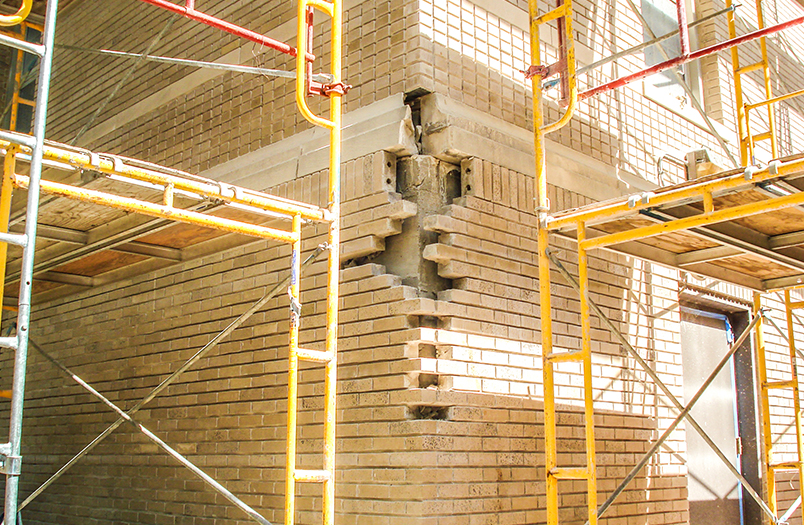
On a commercial building, mortar failure is rarely an isolated problem. RSI’s assessment process begins with a full exterior facade review — mapping distress patterns, documenting conditions with photos, and identifying the root cause behind the visible deterioration. “We document the distress that we find, provide on-site observations with photos and explanations to ownership groups on what we found, what the cause is, and what the repair procedure will be,” Reynolds explains. When deeper investigation is needed, RSI accesses the facade by swing stage or scaffold for a hands-on review that goes far beyond what’s visible from the sidewalk.
Hidden Conditions
The scope of a commercial tuckpointing project almost always extends beyond mortar joints. Corroded steel embedded in or behind mortar joints, failing through-wall flashings, subtle wall movement, and chronic moisture pathways are conditions that residential projects rarely encounter — and that residential contractors aren’t trained to identify. As Reynolds puts it, these are “hidden conditions, like corroded steel behind or embedded in mortar joints that are not visible on an exterior investigation.” Addressing these conditions is what separates a repair that lasts from one that fails within a few seasons.
How Mortar Selection Can Make or Break a Commercial Facade
Mortar isn’t one-size-fits-all. RSI matches compressive strength and permeability to the existing masonry on every project — a process that requires understanding the age, composition, and structural role of the facade materials. On commercial buildings where facade elements may span decades of construction history, getting mortar selection right is the difference between a repair that lasts and one that accelerates deterioration.
A softer, lime-based mortar with lower compressive strength, designed for historic masonry, limestone, and older brick that are softer in nature. As Reynolds explains, Type O mortars are “extremely compatible and safe for the surrounding masonry” on buildings where original materials must be preserved.
A versatile, medium-strength mix that Reynolds calls “ideal for above-grade exterior walls and tuckpointing” on newer, non-historic construction. Type N is the standard choice for general commercial masonry repair where historic compatibility isn’t a primary concern.
Specified for structural load-bearing walls, concrete masonry units, and below-grade applications. Type S delivers higher water impermeability — a critical property in the Midwest, where below-grade masonry faces relentless hydrostatic pressure from saturated soils and snowmelt.
When Mortar Compatibility Gets It Wrong
On a commercial facade, the consequences of incompatible mortar are severe and frequently irreversible. A mortar that’s too hard for the surrounding masonry doesn’t just fail in the joint — it forces the softer brick or stone to absorb all the stress from building movement and thermal cycling. Instead of the mortar joint flexing as designed, the masonry itself cracks, spalls, and deteriorates at an accelerated rate.
This risk is especially acute on historic buildings where original materials — hand-formed brick, carved limestone, or irreplaceable architectural terra cotta — cannot simply be sourced and swapped. A residential tuckpointer unfamiliar with mortar compatibility science could cause permanent damage to materials that have survived over a century of Midwest weather, turning a maintenance project into a preservation crisis.
“Choosing the incorrect mortar can cause significant impacts in the building. Choosing a mortar type that is too hard in compressive strength for the surrounding masonry will cause rapid deterioration of the masonry facade materials themselves.” — Dylan Reynolds, RSI
Midwest Freeze-Thaw: Why Climate Drives Commercial Tuckpointing Urgency
In the Midwest, mortar deterioration isn’t just a maintenance issue — it’s a climate-driven inevitability. “Water infiltration issues and the freeze-thaw cycle is extremely detrimental to masonry and concrete materials in the Midwest, because we live in such a moisture-filled climate,” Reynolds explains. That combination of abundant moisture and dramatic temperature swings creates a compounding cycle of damage that worsens every winter it goes unaddressed.
The Minneapolis–St. Paul metro area experiences roughly 145 freeze-thaw cycles per year. Each cycle drives water deeper into compromised mortar joints, widening cracks and creating new pathways for moisture infiltration. Over a single winter, what began as minor mortar erosion can escalate into spalling brick faces, corroded embedded steel, and compromised wall cavities.
One of the clearest warning signs is efflorescence — the white, powdery residue that appears on masonry surfaces. Reynolds describes the mechanism: “Masonry is porous. When water escapes or evaporates out the face of that masonry, it leaves behind the chlorides and mineral deposits that were within that water.” Efflorescence signals that moisture is moving through the wall system without a proper exit point — a strong indicator that flashings, weep systems, or mortar joints have failed.
This is precisely why proactive commercial assessment matters. Damage compounds through the winter and becomes visible in spring, but by then the scope of repair may have grown significantly. Buildings with regularly maintained mortar joints and functioning drainage systems weather the Midwest climate far more effectively than those where maintenance is reactive.
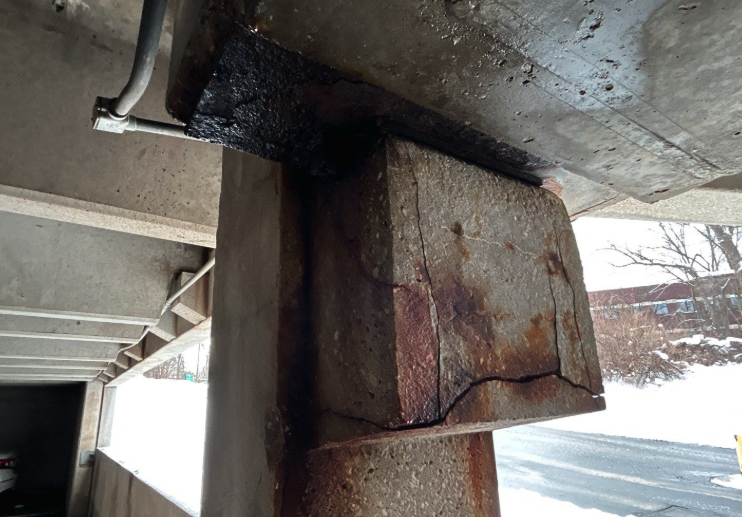
A beam-column connection on a Midwest parking structure showing severe freeze-thaw spalling with deep fracture planes and advanced rebar corrosion — visible evidence of multiple winters of compounding damage.
RSI Commercial Tuckpointing in Action
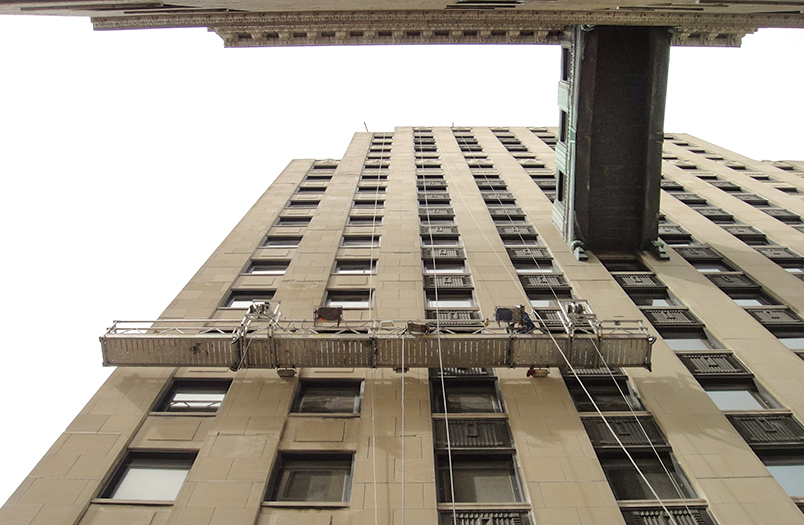
St. Paul, Minnesota
First National Bank Building
A typical residential tuckpointing job covers a few hundred square feet. This single commercial project required 108,000 SF of exterior mortar removal and tuckpointing, plus 1,000 SF of stone replacement, full sealant work, and a complete building wash — completed over an 8-month timeline with multi-trade coordination and engineered access systems throughout.
Winona, Minnesota
Lourdes Hall — Winona State University
This historic institutional facade required 56,000 SF of tuckpointing alongside 580 individual brick replacements and 150 pieces of Indiana Limestone replacement. Every mortar specification had to be compatible with the original historic materials — the kind of material-specific precision that separates commercial restoration from residential repair.
Minneapolis, Minnesota
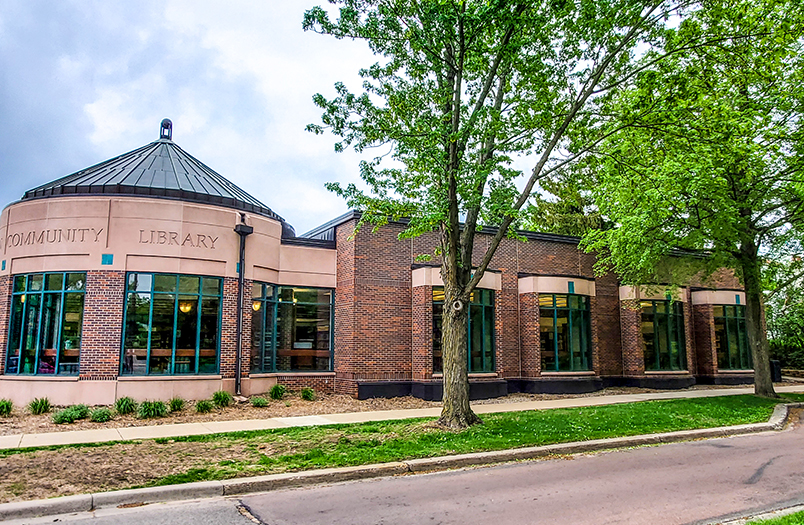
Hennepin County Library (Washburn Library)
A proactive, preventative maintenance project combining tuckpointing, brick replacement, sealant work, waterproofing, and decorative concrete repairs — catching mortar deterioration early before the Midwest freeze-thaw cycle could compound it into a far larger and more costly scope of work.
What to Expect from a Qualified Commercial Tuckpointing Contractor
A well-run commercial tuckpointing project starts long before anyone touches a mortar joint. Look for a contractor who leads with a thorough facade assessment — not just a visual estimate from ground level. They should demonstrate mortar analysis capability, matching compressive strength and permeability to your existing masonry. They need commercial-scale access equipment and crews trained to work safely at height. Their portfolio should include projects at 50,000 SF and above, proving they understand the coordination, timeline management, and multi-trade logistics that commercial facades demand. And if your building has historic materials, they should have documented experience with preservation-grade mortar selection. That’s the standard RSI holds on every project — organized communication, safety as a priority, minimal disruption to tenants, and durable repairs aligned with a long-term maintenance plan. If your commercial property needs a facade assessment, our team has the experience, equipment, and mortar science expertise to get it right.