


Freeze-Thaw Damage Explained: Why Midwest Concrete Fails Faster (and What’s Preventable)
RSI’s concrete, waterproofing, and masonry specialists explain the science behind freeze-thaw deterioration, the warning signs to watch for, and the prevention strategies that protect Midwest structures for the long term.
Key Takeaways
- Midwest structures endure 60–80 freeze-thaw cycles per year — 4 to 8 times more than southern or coastal regions.
- Water expands ~9% when it freezes, creating cumulative microcracking that compounds every winter season.
- Moisture intrusion is the root cause — freeze-thaw is the mechanism, but water getting in is the enabler of all damage.
- Deferred maintenance costs escalate exponentially — one RSI project saw a $500K estimate become $4M after freeze-thaw damage progressed during delays.
- Most freeze-thaw damage is preventable with proper waterproofing, sealants, drainage, and proactive maintenance planning.
Why Midwest Concrete Fails Faster Than You Think
Midwest cities like Minneapolis, Milwaukee, and Chicago experience 60 to 80 freeze-thaw cycles every year — four to eight times more than southern or coastal regions that rarely cross the freezing threshold. This isn’t just “winter weather.” It’s a relentless, cumulative assault on concrete and masonry that most building owners don’t fully appreciate until repair costs start climbing. According to ACI 201.2R-16, these conditions place Midwest structures squarely in the most severe exposure classifications for freeze-thaw damage to concrete.
What makes this region uniquely destructive is the combination: high ambient moisture, frequent temperature cycling above and below 32°F, and heavy deicer use on roads, sidewalks, and parking structures. Each factor alone is manageable. Together, they create conditions that accelerate concrete deterioration faster than most owners realize — and faster than many maintenance budgets account for.
“It all starts with moisture infiltration. Water infiltration issues and the freeze-thaw cycle is extremely detrimental to masonry and concrete materials in the Midwest, because we live in such a moisture-filled climate. That combination allows water and moisture infiltration issues to compound significantly through the winters.”
— Dylan Reynolds, Masonry & Facade Specialist, RSI
And here’s what catches many facility managers off guard: the damage done in winter often isn’t visible until spring thaw. As Dylan explains, the issues that were “at bay” during the coldest months reveal themselves as temperatures rise — crumbling mortar, spalling surfaces, widening cracks. By the time you see the warning signs, the deterioration has often been progressing for multiple seasons.
The Science Behind Freeze-Thaw Damage
Understanding why concrete fails starts with understanding how water, temperature, and chemistry interact inside the material itself. Here’s what’s actually happening at the structural level — and why the Midwest’s climate makes it so much worse.
How Water Gets In
Concrete is porous by nature. Water enters through surface cracks, failed sealant joints, deteriorated expansion joints, and gaps in waterproofing systems. As Dylan Reynolds notes from his field inspections, “If there are voids in sealant joints, we look for evidence of water-related issues within the masonry — that could be spalling mortar joints, cracked brick, or rust buildup on the lintels.”
Older structures are especially vulnerable. Buildings constructed before air-entrained concrete became standard lack the microscopic air voids engineered to relieve internal pressure during freezing. According to ACI guidelines, properly air-entrained concrete should contain roughly 6% air content with a water-cement ratio at or below 0.45 — specifications many legacy structures were never built to meet.
What Happens When It Freezes
When trapped water freezes, it expands by approximately ~9%, exerting immense internal pressure that creates microcracking. Each freeze-thaw cycle widens existing cracks, which allows more water in, which freezes and expands further. As Dylan puts it, “That 9% expansion, when freezing, exerts immense pressure that cracks and weakens brick, stone, and mortar.” Dan Lephardt reinforces the point: the result is “microcracking, scaling, and spalling that accelerates every season.” This isn’t a single event — it’s a compounding cycle that gets measurably worse each winter.
In a Midwest climate delivering 60–80 of these cycles annually, even small initial cracks can progress to visible concrete spalling within just a few seasons.
The Salt Multiplier
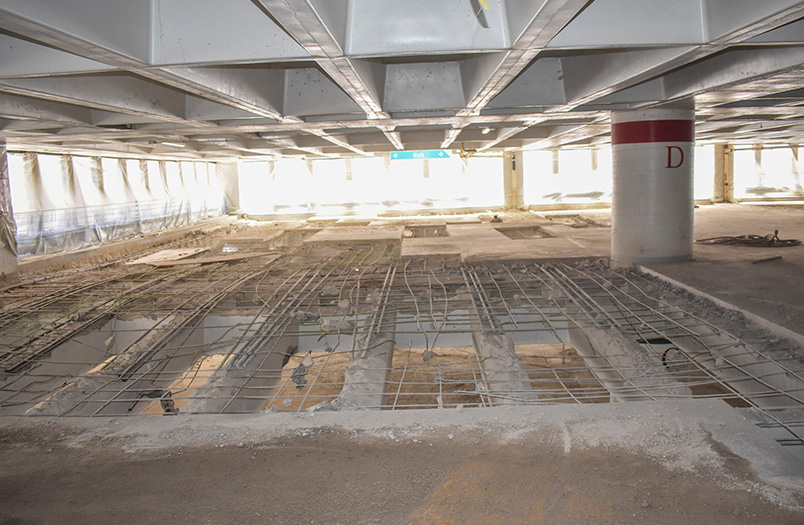
Chloride-laden deicers don’t just melt ice — they attack concrete from the inside out. Chlorides penetrate through cracks and pores, reach embedded reinforcing steel, and initiate corrosion once they exceed the critical threshold (roughly 1.0–1.5 lbs/yd³). Corroding rebar expands, creating even more internal pressure and accelerating concrete scaling and spalling. In parking structures where deicing salt exposure is constant, this chain reaction is especially aggressive.
“Moisture enables everything: freeze-thaw damage, rebar corrosion from chlorides combined with oxygen and water, and alkali-silica reaction risk in susceptible mixes. You can’t address the symptoms without addressing the water.”
— Dan Lephardt, Waterproofing & Building Envelope Specialist, RSI
The wear compounds further at the surface level. Sand applied to prevent slips and falls, combined with chemical deicers, degrades traffic coatings and exposed concrete surfaces — shortening the lifespan of protective systems and exposing the substrate to even more moisture infiltration.
Early Warning Signs You Shouldn’t Ignore
Freeze-thaw damage doesn’t announce itself with sudden failure — it gives warning signs that are easy to overlook if you don’t know what to look for. Here’s what RSI’s specialists watch for during assessments.
-
Surface Scaling & Sandiness
The concrete surface feels gritty underfoot or is flaking away in thin layers — an early sign that freeze-thaw cycling is eroding the surface paste.
-
Small Pop-Outs & Corner Loss
Shallow conical depressions where aggregate has broken free from the surface, often concentrated on exposed horizontal slabs and decks.
-
Hairline Map Cracking
A network of fine cracks spreading across the surface, indicating internal stress buildup and the beginning of deeper structural issues.
-
Rust Staining Near Rebar Locations
Orange or brown discoloration on the concrete surface signals active corrosion of embedded reinforcing steel — damage you can’t see is happening beneath.
-
Hollow-Sounding Delaminations
Areas that sound hollow when tapped indicate the concrete surface has separated from the substrate — a precursor to spalling and structural failure.
-
Mortar Deterioration & Loose Masonry Units
Crumbling mortar joints and shifting brick or stone units are clear evidence that freeze-thaw cycling is actively breaking down the masonry assembly.
-
Efflorescence Buildup
White crystalline deposits on surfaces indicate moisture is actively migrating through the material — a visible red flag for ongoing water intrusion problems.
-
Failed or Voided Sealant Joints
Gaps, cracks, or separation in caulked joints at transitions are direct moisture entry points that accelerate freeze-thaw damage to surrounding concrete and masonry.
Many of the most damaging conditions — hidden corrosion, subtle wall movement, failing flashings — aren’t visible from the sidewalk. If you’re seeing multiple signs from this list, the damage is compounding, not isolated. A professional assessment can reveal what’s happening beneath the surface.
What’s Actually Preventable (and What Isn’t)
Here’s the good news: freeze-thaw damage to concrete is largely preventable — but only if you address it as a system, not a product. As Dan Lephardt explains, “You can install the ‘best’ membrane made, but if the termination isn’t sealed, drainage is missing, or penetrations aren’t detailed — you still leak. Systems manage water, movement, and transitions.” Product-only thinking is why buildings get re-coated and still leak.
Waterproofing & Drainage
Effective concrete waterproofing starts at the system level: continuous membranes, intact flashing, proper slope corrections, clear drains, and functional drip edges. As Dan emphasizes, “Drainage is part of waterproofing — ignoring it shortens any system’s life.” Two things owners often overlook: drainage that doesn’t function compounds every other failure, and the best waterproofing is the planning and prep work that never makes it into photos. For masonry assemblies, breathable water-repellent sealers allow moisture vapor to escape while blocking bulk water intrusion.
Sealants & Joints
Sealants are the flexible connectors at every gap and transition in the building envelope — and most leaks start at joints, not field areas. Sealants fail prematurely when joint sizing is wrong (no backer rod, three-sided adhesion), surface prep is poor, chemistry doesn’t match the movement or exposure, or installation occurs outside recommended temperature windows. In the Midwest, the combination of UV exposure, wide thermal swings, and freeze-thaw movement accelerates sealant fatigue faster than in milder climates. Annual inspection of sealant joints is one of the simplest, most cost-effective maintenance steps an owner can take.
Traffic Coatings & Penetrating Sealers
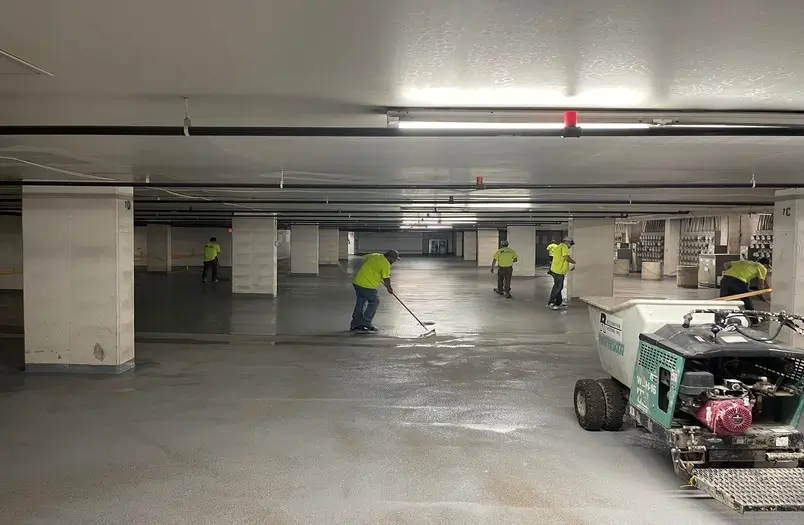
For parking structures, traffic-bearing membrane systems and penetrating sealers are the first line of defense against freeze-thaw damage. Proper surface preparation is the critical differentiator — RSI follows manufacturer specifications on the front end, which is why, as one project lead notes, “We don’t have failure issues because we’re doing the proper preparation per manufacturer specifications.” Coating lifespan depends on traffic volume, deicer exposure, and installation quality, but when done correctly, these systems deliver years of reliable protection.
Proactive Maintenance Planning
Dan Lephardt’s advice to building owners is straightforward: address small leaks early — they’re far cheaper to fix than structural damage. Budget for investigations, not just repairs. Inspect sealants, joints, and drainage annually. Ask how water moves through the assembly, not just where it leaks. And think in lifecycle costs, not patch-to-patch spending. The difference between proactive and reactive maintenance isn’t marginal — it’s exponential.
RSI’s Mike Hintsala recalls a Midwest parking ramp in such disrepair that the city required emergency action. The engineer estimated $500K to keep it open. But the owner delayed through winter, and freeze-thaw damage continued to progress. By the time work started, crews discovered the structure was far worse than anyone anticipated. That $500K estimate became a $4 million project — with emergency mobilization costs driving overhead to 30% instead of the typical 10%. “These things fail when things are not known or planned out correctly,” Mike says. “Time is money. Is money.”
— Mike Hintsala, RSI Expert
The question isn’t whether to invest in prevention — it’s whether you pay now or pay exponentially more later. Every season of deferral in a Midwest climate compounds both the damage and the cost.
RSI Concrete Restoration in Action
These projects demonstrate what systematic, expert-led parking structure concrete repair looks like when freeze-thaw damage demands more than patchwork.
St. Paul Parking Structure Rehabilitation
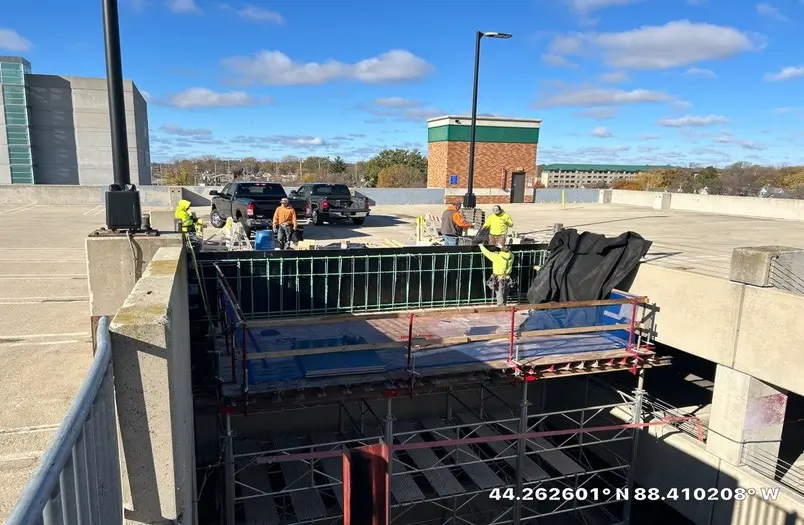
This comprehensive rehabilitation exemplifies what happens when an owner commits to system-level intervention rather than patchwork. The scope included 425,000+ SF of traffic-bearing membrane, structural concrete repairs, sealant installation, expansion joint replacement, and protective coatings — every layer of freeze-thaw defense working together as an integrated system.
RiverWest Parking Garage
RiverWest illustrates the traffic coating replacement cycle Midwest parking structures inevitably face. RSI removed the existing coating and installed 156,000+ SF of new high-solids polyurethane traffic-bearing membrane plus 65,000+ SF of penetrating water-repellent sealer — the layered protection approach where the membrane stops bulk water while the sealer defends exposed concrete. Completed in roughly one month.
When to Call a Specialist
If repairs keep recurring in the same areas, if you’re patching the same cracks season after season, or if you’ve deferred maintenance for more than two to three years in a Midwest climate — it’s time for a professional assessment, not another patch. RSI’s diagnostic process starts broad and narrows systematically: building history review, visual survey, moisture mapping, targeted testing, and a root-cause report with actionable repair options.
The result is a clear plan — organized communication, safety as a priority, minimal tenant disruption, and durable repairs aligned with a long-term maintenance strategy that accounts for the ~9% expansion cycle that never stops.
“The best waterproofing is often invisible — it’s the planning, prep, and sequencing that never make it into photos but determine success.” — Dan Lephardt, RSI