
2026 Commercial Concrete Repair Cost Guide: Budgeting for the Midwest Market
The honest conversation about repair costs that contractors don’t always have—with insights from 35 years of industry experience and ICRI standards development.

Blake Dronen
President, Restoration Systems Inc.
Blake Dronen is the President of Restoration Systems Inc., where he has spent over 27 years—starting as a laborer and working his way through project management and executive leadership. His hands-on experience at every level of the business gives him a unique understanding of commercial restoration from the ground up.
- Labor drives cost: 60% of commercial concrete repair costs are labor, 20% materials, and 5-10% equipment—explaining why skilled restoration work commands premium pricing.
- Three-tier pricing system: Minor repairs run $45-65/SF, partial depth repairs $65-85/SF, and full depth structural replacement $85-150+/SF.
- Midwest climate premium: Salt exposure and freeze-thaw cycles accelerate deterioration faster than warmer regions, making proactive maintenance essential.
- Budget for contingencies: Restoration is forensic work—plan for 10-20% contingency because problems often extend beyond what’s visible on the surface.
- 7% compounding rule: Deferred maintenance costs compound at 7%+ annually, meaning a $50,000 repair today could cost $100,000+ in 10 years.
Why That Estimate Looks Higher Than You Expected
We know that quote looks higher than you expected. If you’ve been managing commercial properties in Wisconsin, Minnesota, or Illinois, you’ve probably experienced that moment of sticker shock when a concrete repair estimate lands on your desk. The number doesn’t match what Google told you. It doesn’t align with what your colleague paid five years ago. And it definitely doesn’t compare to what the cheapest bidder promised.
Here’s the uncomfortable truth: most online cost guides are built for residential driveways, not commercial parking structures. They don’t account for the specialized access equipment needed to reach elevated decks. They ignore the engineering requirements for load-bearing repairs. And they certainly don’t factor in the Midwest’s brutal combination of road salt and freeze-thaw cycles that accelerate concrete deterioration faster than anywhere else in the country.
People often compare concrete repair to car maintenance—regular oil changes prevent engine failure. The analogy makes sense on the surface, but it breaks down quickly when you dig deeper. Car maintenance follows a predictable schedule with standardized parts and labor. Commercial concrete restoration is forensic work.
“Just like being a dentist, you can find more as soon as you start drilling. You might think you’re fixing one small area, but once we open it up, we often discover the deterioration extends further than what was visible. That’s not padding the bill—that’s the nature of restoration work.”— Mike Hintsala, RSI Expert
This guide exists to give you the honest conversation about commercial concrete repair costs that contractors don’t always have time to explain. We’ll break down exactly what drives pricing, why Midwest projects cost more than national averages, and how to budget intelligently so you’re not blindsided by unexpected expenses. Whether you’re planning immediate repairs or building a five-year capital budget, understanding these fundamentals will help you make informed decisions that protect both your structures and your bottom line.
The Three Tiers of Commercial Concrete Repair
Not all concrete damage is created equal, and understanding the difference between repair categories is essential for accurate budgeting. Commercial concrete repair falls into three distinct tiers, with costs increasing approximately 50% as you move up each level.
Tier 1: Minor Repairs ($45-65/SF)
These are surface-level issues—spalling on overhead surfaces, wall repairs, loose patches, and minor deterioration that hasn’t compromised the structural integrity. These repairs typically last 2-5 years and address cosmetic concerns or prevent further water infiltration. They’re maintenance work, not structural rehabilitation.
Tier 2: Partial Depth Repairs ($65-85/SF)
When deterioration extends into the concrete but hasn’t reached the reinforcing steel, partial depth repairs remove the damaged material and restore the surface. This is the most common category for parking structures experiencing pothole formation, surface delamination, or moderate freeze-thaw damage. Expect 5-15 year lifespans depending on traffic and exposure conditions.
Tier 3: Full Depth Repairs ($85-150+/SF)
When damage extends through the entire slab thickness—typically because corrosion has compromised the reinforcing steel—full depth replacement becomes necessary. This involves saw-cutting, removing the entire section, treating or replacing rebar, and pouring new concrete. These repairs can last 15-25 years but require the highest investment and often involve structural engineering oversight.
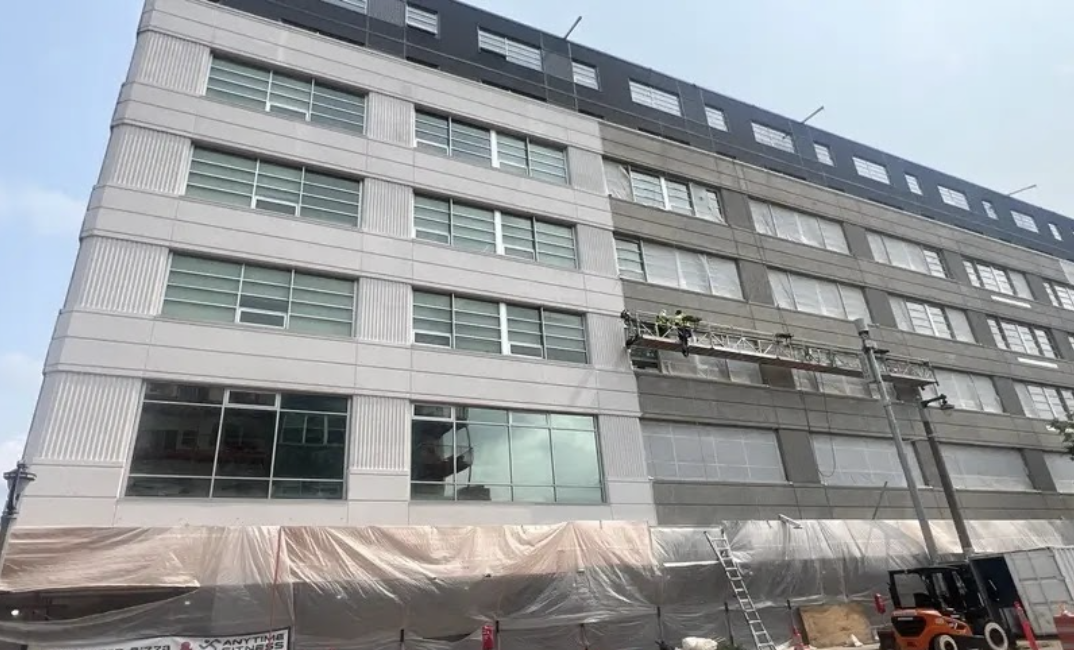
Commercial Concrete Repair Cost Breakdown
Current Midwest market rates for commercial concrete restoration projects. Ranges reflect variations in access requirements, scope, and site conditions.
| Repair Type | Cost Range (Per SF) | Typical Applications | Expected Lifespan |
|---|---|---|---|
| Small Repairs | $15 – $35 | Overhead surfaces, wall repairs, loose patches, minor spalling | 2-5 years |
| Partial Depth Repairs | $35 – $75 | Surface deterioration, potholes, delamination, freeze-thaw damage | 5-15 years |
| Full Depth Repairs | $75 – $150+ | Structural replacement, corroded rebar, through-slab damage | 15-25 years |
| Waterproofing (Traffic Coating) | $4 – $12 | Protective membrane systems, deck coatings, joint sealants | 5-10 years |
| Joint Repairs | $8 – $25/LF | Expansion joint replacement, control joint restoration | 5-10 years |
Note: Actual costs vary significantly based on access requirements (elevated decks require scaffolding or lifts), project scope (mobilization costs spread across larger projects), structural complexity, and current material/labor market conditions. These ranges represent 2026 Midwest market pricing and should be used for planning purposes only. Always obtain site-specific estimates for accurate budgeting.
The 60% Labor Reality: What Drives Commercial Concrete Repair Costs
This breakdown explains why the cheapest bid often becomes the most expensive decision. When a contractor significantly undercuts competitors, the cuts almost always come from labor quality—leading to repairs that fail prematurely and require costly rework.
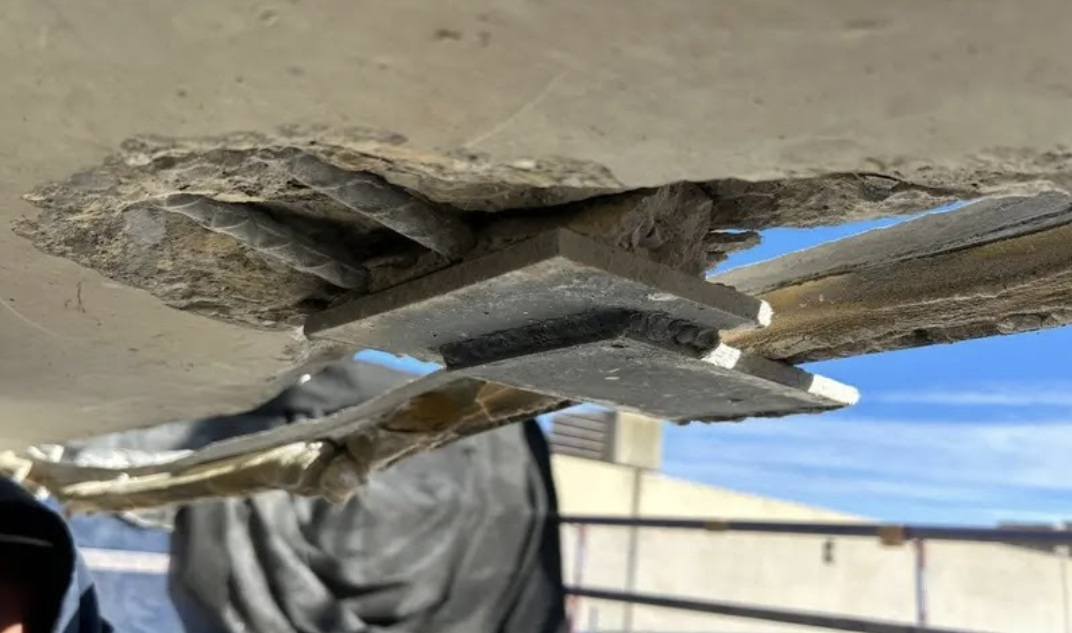
The Midwest Climate Factor: Why Our Concrete Fails Faster
If you’ve ever wondered why Midwest concrete repair costs more than you’ve seen quoted in national publications, climate is the number one factor. The combination of de-icing salts and freeze-thaw cycling creates conditions that accelerate concrete deterioration faster than almost any other environment in the country.
The science is straightforward but unforgiving. Water infiltrates microscopic pores in concrete, then expands as it freezes—creating internal pressure that leads to cracking and spalling. Repeat this cycle 50 to 100 times per winter, season after season, and even well-designed concrete begins to deteriorate. Add chloride-laden salts that penetrate the concrete and corrode the reinforcing steel, and you have a recipe for accelerated structural damage. To learn more about why Midwest concrete fails faster, explore the science of spalling in our detailed guide.
This is why spalling—those characteristic surface flakes and pop-outs—is so common in Midwest parking structures. As Mike Hintsala explains, spalling is caused by expansion: water freezing inside the concrete pushes the surface apart, while corroding rebar expands and pushes from within.
“Climate is the number one thing that affects concrete in the Midwest. You’re dealing with 50-100+ freeze-thaw cycles per year, plus salt exposure that would destroy concrete twice as fast as you’d see in warmer climates. That’s not an excuse for higher prices—it’s the reality of what the materials are up against.”— Mike Hintsala, RSI Expert
Putting Repair Costs in Perspective: The 400,000 SF Reality
When repair estimates arrive, it’s easy to focus on the total dollar amount without context. Consider this real-world example: a 400,000 square foot parking ramp needs repairs on approximately 1,000 square feet of damaged concrete. The repair estimate comes in at $40,000.
Is it really that much? When you calculate it out, you’re addressing less than a quarter of one percent of the total structure. You’re paying for skilled craftsmen, specialized equipment, quality materials, and the engineering oversight to ensure repairs integrate properly with the existing structure. Spread across the value and lifespan of a major parking asset, $40 per square foot for repairs that extend the structure’s useful life by 15-20 years starts to look very different.
The same perspective shift applies when comparing repair costs to replacement. A new parking structure in the Midwest typically costs $60-80 per square foot for surface lots and $80-120+ per square foot for structured parking. Investing $150,000 in strategic repairs over five years to preserve a structure worth $25 million makes straightforward financial sense.
The question isn’t “why does concrete repair cost so much?” It’s “what’s the cost of not repairing it?”—and that number compounds every year you wait.
Proactive vs. Reactive Maintenance: The 7% Compounding Rule
The most expensive concrete repair is the one you put off until next year—and the year after that. Understanding the true cost of deferred maintenance is essential for property owners who want to protect their investments.
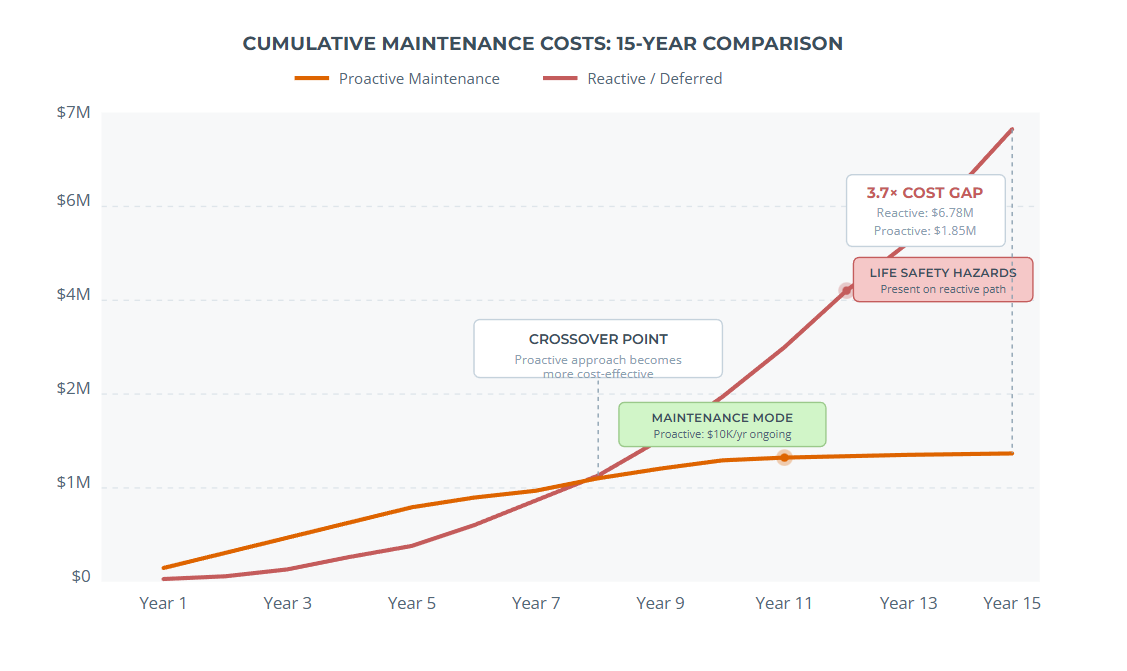
The chart above illustrates a principle that Dylan Reynolds, our Project Manager, emphasizes in every ownership presentation: deferred maintenance costs compound at approximately 7% or more annually. A repair that costs $50,000 today doesn’t simply cost $50,000 plus inflation in five years—it costs significantly more because the underlying damage continues to spread.
Here’s what that looks like in practice. Small cracks allow water infiltration. Water accelerates reinforcing steel corrosion. Corroding steel expands and creates larger cracks. Those larger cracks allow more water penetration. The cycle accelerates. What started as a $45/SF surface repair becomes a $85/SF structural replacement because the damage was allowed to progress through multiple deterioration stages. For a deeper understanding of this principle, review our analysis of the compounding cost of deferred maintenance.
“We always want to provide owners with enough information to make an informed decision. When we present 10-15 year cost projections, we’re showing them two paths: predictable spending now with regular maintenance, or paying exponentially more later when repairs become emergencies. The math always favors proactive maintenance.”— Dylan Reynolds, Project Manager, RSI
This is why RSI offers complimentary building evaluations for commercial property owners. Understanding your structure’s current condition—and developing a realistic timeline for future repairs—allows you to budget appropriately rather than scrambling when problems become urgent. The goal is moving from reactive crisis management to proactive asset preservation.
How to Evaluate Concrete Repair Bids Beyond Price
The lowest bid isn’t always the best value—and in concrete restoration, it’s often the most expensive choice in the long run. Here’s what to look for when comparing contractor proposals. For more insight, read our guide on why low-bid concrete repairs cost more long-term.
Verify Experience with Your Specific Repair Type
A contractor who excels at flatwork may lack the expertise for structural parking deck repairs. Ask for references on projects similar in scope, structure type, and complexity to yours. Request specific examples of partial depth and full depth repairs, not just general concrete work.
Examine the Scope of Work in Detail
Professional estimates should clearly itemize: square footage of each repair type, materials specified, surface preparation methods, access requirements, and any engineering or testing included. Vague line items like “concrete repairs as needed” are red flags.
Check Safety Records and Insurance
Request the contractor’s Experience Modification Rate (EMR)—a rating below 1.0 indicates better-than-average safety performance. Verify adequate liability insurance and workers’ compensation coverage. Restoration work often involves heights, heavy equipment, and hazardous materials.
Understand the Warranty Structure
Warranties vary significantly between contractors. Some cover only materials, others include workmanship. Understand what voids the warranty (improper maintenance, unauthorized modifications) and what the claims process looks like. A five-year warranty is meaningless if the contractor won’t be in business in five years.
Ask About Contingency Handling
How does the contractor handle discovered conditions that exceed the original scope? Reputable contractors explain their change order process upfront and document everything before proceeding. As Mike Hintsala notes: “We’re not building a house that’s going to last 100 years. We’re doing a repair that’s going to last about five years, and we want you to come back.”
Evaluate Communication and Professionalism
How responsive is the contractor during the bidding process? Do they ask thoughtful questions about your building? Are they willing to explain their approach in detail? The contractor who rushes to submit the lowest number often rushes through the work the same way.
What Quality Concrete Repair Looks Like
Knowing what to expect from a professional restoration project helps you evaluate both proposals and completed work. Quality concrete repair isn’t just about making surfaces look better—it’s about extending the functional lifespan of your structure through proper technique and materials.
A comprehensive concrete repair project from a qualified contractor should include:
- Thorough surface preparation: Sound concrete requires a clean, roughened surface for repair materials to bond properly. Expect hydrodemolition, sandblasting, or mechanical scarification—not just a quick pressure wash.
- Proper reinforcement treatment: Exposed rebar must be cleaned to bare metal and coated with corrosion inhibitor before new concrete is placed. Skipping this step guarantees premature failure.
- Appropriate cure time: Repair mortars and concrete require specific curing conditions to achieve design strength. Contractors who rush to reopen traffic often compromise long-term durability.
- Waterproofing integration: Surface repairs are only part of the solution. Traffic-bearing coatings, joint sealants, and drainage improvements prevent future water infiltration—the root cause of most concrete deterioration.
- Documentation: Before-and-after photos, material certifications, and detailed records of work performed. This documentation proves valuable for warranty claims and future maintenance planning.
Quality work from experienced contractors may cost more upfront but delivers significantly longer service life. Investing in proper waterproofing after repairs can extend concrete lifespan by years—learn more about whether waterproofing is worth the investment in our dedicated guide.
Frequently Asked Questions About Concrete Repair Costs
Commercial concrete repair costs are driven primarily by labor (60% of total cost), not materials. Unlike new construction with predictable workflows, restoration work is “forensic”—each project requires detailed assessment, specialized equipment for access, careful removal of deteriorated material without damaging sound concrete, and skilled craftsmen who understand how repairs integrate with existing structures. Add Midwest-specific factors like salt damage remediation and freeze-thaw considerations, and costs reflect the genuine complexity of the work.
Concrete deterioration often extends beyond what’s visible on the surface. As Mike Hintsala explains: “Just like being a dentist, you can find more as soon as you start drilling.” A professional contractor will document discovered conditions, explain why additional work is needed, and get approval before proceeding. This isn’t scope creep—it’s the nature of restoration work. Estimates should identify this possibility upfront, and reputable contractors maintain clear change order procedures.
Yes—10-20% contingency is standard industry practice for concrete restoration projects. The exact amount depends on how thoroughly the structure has been evaluated, the age and condition of the building, and your tolerance for project scope changes. Structures with known problems but limited testing should budget toward the higher end. Contingency protects your project timeline by allowing immediate response to discovered conditions rather than pausing for additional approvals.
Repair longevity depends on the type of repair, quality of execution, and ongoing maintenance. Small surface repairs typically last 2-5 years, partial depth repairs 5-15 years, and full depth structural repairs 15-25 years. These ranges assume proper waterproofing, regular joint sealant maintenance, and controlled salt exposure. Neglecting follow-up maintenance—particularly waterproofing reapplication—significantly shortens repair lifespan regardless of initial quality.
The determining factor is whether deterioration has reached the reinforcing steel. If damage is limited to the surface concrete above the rebar, partial depth repair removes the damaged material and restores the surface. If corrosion has compromised the steel or damage extends through the slab, full depth replacement becomes necessary. A qualified engineer can make this determination through visual inspection, sounding, and sometimes core sampling.
Midwest concrete faces a uniquely destructive combination: 50-100+ freeze-thaw cycles annually plus heavy de-icing salt application. This creates more severe and complex deterioration patterns than regions with either freeze-thaw OR salt exposure, but not both. Repairs must address chloride contamination (which continues corroding steel even after visible damage is fixed), deeper deterioration patterns, and more extensive waterproofing requirements. The work is genuinely more demanding than in warmer or less salted climates.
Absolutely. Water infiltration is the root cause of most concrete deterioration—it enables freeze-thaw damage, carries chlorides to reinforcing steel, and accelerates the expansion-cracking cycle. Quality waterproofing systems (traffic coatings, penetrating sealers, joint sealants) typically cost $4-12 per square foot and can extend concrete lifespan significantly while reducing future repair frequency. Think of it as insurance: modest ongoing investment to prevent major claims.
Focus on six key areas: experience with your specific repair type (ask for similar project references), detailed scope itemization (not vague “repairs as needed” line items), safety records (EMR below 1.0 is good), warranty structure (what’s covered, for how long, and how are claims handled), change order procedures (how discovered conditions are documented and priced), and communication quality during the bidding process. The contractor who asks thoughtful questions and explains their approach is usually the contractor who will execute carefully.
A complete professional estimate should include: itemized quantities (square footage by repair type, linear feet of joint work), specified materials and methods, access and equipment requirements, project timeline with milestones, payment schedule, warranty terms, exclusions and assumptions, and a clear process for handling discovered conditions. Estimates lacking this detail make apples-to-apples comparison impossible and often signal shortcuts in the actual work.
The general rule: when repair costs exceed 60-70% of replacement cost, or when deterioration is so widespread that repairs would need to address most of the structure, replacement may make more financial sense. However, this calculation must account for the full cost of replacement—not just demolition and new construction, but also lost revenue during closure, temporary accommodations, and the value of an extended building lifespan. A qualified engineer can provide condition assessment data to inform this decision.
Ready to Budget for Your Concrete Repair Project?
RSI offers complimentary building evaluations for commercial property owners throughout Wisconsin, Minnesota, and Illinois. Understand your structure’s condition, develop a realistic maintenance timeline, and get accurate cost projections—before problems become emergencies.
Since 1997, RSI has built a reputation for exceeding expectations through expert craftsmanship, transparent communication, and a commitment to safety. Our principals average more than 25 years of experience, and our team consistently maintains an EMR well below the national average.