
Rapid-Set Concrete Repair for Time-Sensitive Commercial Projects
When downtime isn’t an option, fast-cure products can keep your building operational — but speed always comes with trade-offs. Here’s what a 35-year industry veteran wants you to know before you decide.
Key Takeaways
- Rapid-set products can reach 3,000 psi in 1 hour vs. 7 days for standard concrete — but faster curing often means a shorter repair lifespan and higher risk of cracking.
- Bag mix is a band-aid; ready mix is a lasting repair. Know which you’re getting and why it matters for your building’s long-term performance.
- The 5-year rule: If you’re repairing the same area every 3–4 years, something is wrong. Quality repairs should last at least five years.
- In the Midwest, freeze-thaw and salt exposure make timing critical — but rushing the wrong repair in the wrong conditions makes it worse, not better.
- RSI phases time-sensitive projects to keep facilities operational without sacrificing the quality and durability that makes a repair worth doing.
Why Speed Matters in Commercial Concrete Repair
When a parking structure needs emergency repair, the costs aren’t just material — they’re lost revenue from closed levels, liability exposure from unsafe conditions, and cascading operational disruption for every tenant and customer who depends on that facility. The pressure to reopen fast is real, and it’s justified.
But speed without expertise creates its own disasters. Consider a scenario RSI’s Mike Hintsala has seen play out more than once: a parking ramp in tough shape goes into receivership. The city requires repairs. An engineer estimates $500,000 to keep the ramp open. Work doesn’t start until winter — and once crews begin, they discover conditions far worse than anyone anticipated. That $500,000 estimate balloons to $4 million. This isn’t hypothetical. It’s what happens when time-sensitive repairs aren’t scoped and managed by experienced teams.
“You can’t get something for nothing. If you want to cure faster, it’s either going to cost a lot more money or not last as long. All these solutions are available — you just have to put a number to what you’re after.”
Mike Hintsala · RSI Expert
The American Concrete Institute (ACI 546R) warns against selecting repair materials based solely on rapid strength gain — it’s a common cause of premature repair failure. Understanding what fast-cure products actually are, and what they’re not, is the first step toward making the right call for your building.
Fast-Cure Products and the Real Trade-Offs
Understanding the Product Landscape
Fast-cure concrete uses calcium sulfoaluminate (CSA) cement — an accelerated chemistry that achieves structural strength in a fraction of the time required by standard Type I/II Portland cement. For commercial property owners, this means repairs that would normally shut down a facility for a week can potentially be completed and reopened in hours.
Achievable in 1 hour with rapid-set products vs. 7 days for standard concrete (PCA research)
Bag Mix vs. Ready Mix
The distinction between bag mix (pre-packaged repair mortars) and ready mix (truck-delivered concrete) is one of the most misunderstood concepts in concrete repair. Bag mix products are convenient and fast — but they aren’t designed for the same structural performance as ready mix concrete.
“There’s a lot of bag mix available to patch concrete, but they will not last as long as ready mix. They wouldn’t pour the whole structure with bag mix.”
Mike Hintsala · RSI Expert
Rapid-set mortar for masonry applications uses similar accelerated chemistry but is formulated specifically for vertical and overhead joint work. These are specialized tools for specific situations — not universal replacements for standard materials.
What You Give Up for Speed
“You can’t get something for nothing. If you want to cure faster, it’s either going to cost a lot more money or not last as long.”
Mike Hintsala · RSI Expert
The core trade-off is straightforward: faster-curing materials generate more heat during hydration, which creates higher thermal stress and greater shrinkage. The result? They crack sooner, and the repair cycle starts over.
Industry Warning: According to ACI 546R, “selection of repair materials based solely on rapid strength gain is a common cause of premature repair failure.” Speed should never be the only criterion.
Mike confirms what the standards bodies warn about: “Faster materials cure so quickly that they crack quicker and the repair will end up being done sooner. That’s been an industry problem for a long time.”
“If you’re repairing the same area over and over again, something’s wrong. Repairs should last. What we shoot for is five years minimum. If you’re coming back sooner than that, something’s wrong.”
Mike Hintsala · RSI Expert
The math compounds against you: fast-cure materials cost more per unit and may need replacement sooner. Unless speed is genuinely non-negotiable — an emergency closure, a revenue-critical facility, a narrow weather window — standard-cure materials almost always deliver better long-term value.
When Fast-Cure Is the Right Call — And How RSI Manages It
Fast-cure isn’t inherently good or bad — it’s a tool. The question is whether you’re using it because the situation genuinely demands speed, or because someone wants to cut corners. Here’s how to tell the difference.
Fast-Cure Is the Right Call When:
- Emergency structural failures require immediate stabilization — vehicle impact, sudden spalling in high-traffic areas, or safety-critical barrier damage
- Revenue-critical facilities cannot absorb extended closures — parking structures, loading docks, retail entrances
- Phased maintenance programs where sections must return to service quickly while work continues elsewhere
- Closing cold-weather windows where standard cure times would expose fresh concrete to freeze damage before reaching the 500 psi minimum threshold (ACI 306R)
Fast-Cure Is Not the Right Call When:
- Routine maintenance where a standard 7-day cure is feasible — don’t pay a premium you don’t need
- Root causes haven’t been addressed — patching over active water infiltration or unchecked corrosion will fail regardless of cure speed
- Budget pressure is the only driver — fast-cure to save money almost always costs more long-term
“We can adjust our service to meet that goal. We can make this five-year repair actually plan for five years, and we’re going to shoot for ten, because there are so many different ways you can go about the repair.”
Mike Hintsala · RSI Expert
RSI manages this complexity with in-house crews — not subcontracted labor. “We’re controlling our output and our time and our cost,” Mike explains. Restoration is labor-intensive work where most failures happen not because of the material, but because the project turns out to be “much more steps, much more of a puzzle than anybody anticipated.” RSI’s team averages 25+ years of experience navigating exactly that kind of complexity.
Midwest Considerations: Freeze-Thaw, Cold Weather, and Seasonal Timing
In Minnesota, Wisconsin, and across the upper Midwest, climate isn’t just a factor in concrete deterioration — it’s the factor. As Mike puts it: “Climate is the number one thing. Without the freeze-thaw cycles, concrete will generally last quite a bit longer.”
The mechanism is straightforward but relentless: water enters through cracks, freezes and expands, causes spalling. Salt tracked in by parked vehicles accelerates rebar corrosion from the inside out. “Corrosion follows water, which follows cracks, which is caused by freeze-thaw,” Mike explains. “And just like being a dentist, you can find more as soon as you start drilling.”
Every 10°F temperature drop roughly doubles concrete cure time. Per ACI 306R, concrete must reach 500 psi before its first freeze cycle — a threshold that becomes increasingly difficult to hit as Midwest temperatures drop.
This creates a critical window problem. Owners face a narrow warm-weather season for standard repairs. When they miss that window — or when emergency damage occurs in October or November — fast-cure products become necessary rather than optional. But cold weather introduces its own limitations: primers, coatings, and sealants require cold-weather rated products and proper substrate conditioning to perform.
“What Restoration Systems sells is waterproofing. If the water doesn’t get in the concrete, it doesn’t cause that corrosion path to occur. Period. Without water, it ain’t gonna happen.”
Mike Hintsala · RSI Expert
That’s the essential insight: rapid-set concrete repair is the acute treatment for time-sensitive damage. But waterproofing — stopping water from entering the structure in the first place — is the long-term solution that prevents emergencies from happening at all.
RSI Fast-Cure Concrete Repair in Action
Every project is a speed-vs.-quality decision. Here’s how RSI has navigated that tension on real parking structures across the Midwest — from true emergencies to comprehensive, phased restorations.
Appleton Parking Ramp — Emergency Barrier Restoration
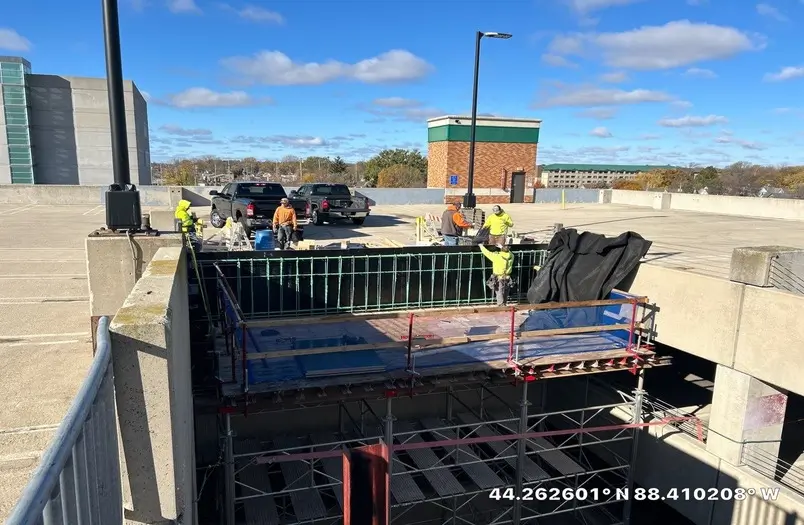
When a vehicle struck a barrier on the 5th story of a municipal parking structure, RSI mobilized for emergency temporary shoring of a 27,000 lb precast barrier panel — a safety-critical situation where structural integrity couldn’t wait. The team secured the structure immediately, then designed and executed a permanent retrofit: precast panel demolition, cast-in-place barrier wall with custom weld clips and anchorages, and structural concrete repairs. Completed in 3 months (September–November 2024). This is “fast but right” in action — speed where safety demands it, craftsmanship that lasts.
University of Minnesota Prospect Park Ramp — Comprehensive Structural Repair
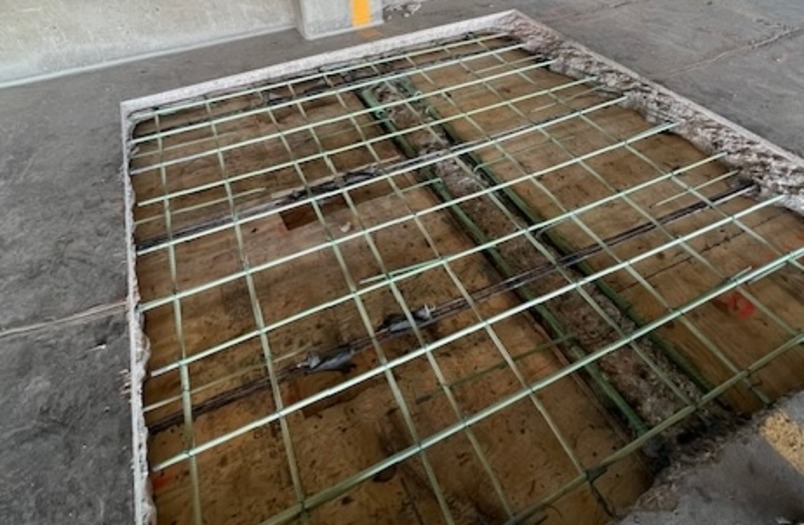
Not every time-sensitive project needs to be rushed. This 9-month institutional parking structure project demonstrates the alternative — a properly phased, comprehensive approach that addresses root causes (post-tension failures, structural deficiencies) rather than just symptoms. RSI completed post-tension system repairs, structural concrete and column repairs, polyurethane waterproofing, traffic-bearing membrane, floor drains, and sealant replacement — all while coordinating around university operations. Sometimes the “right speed” is methodical and complete.
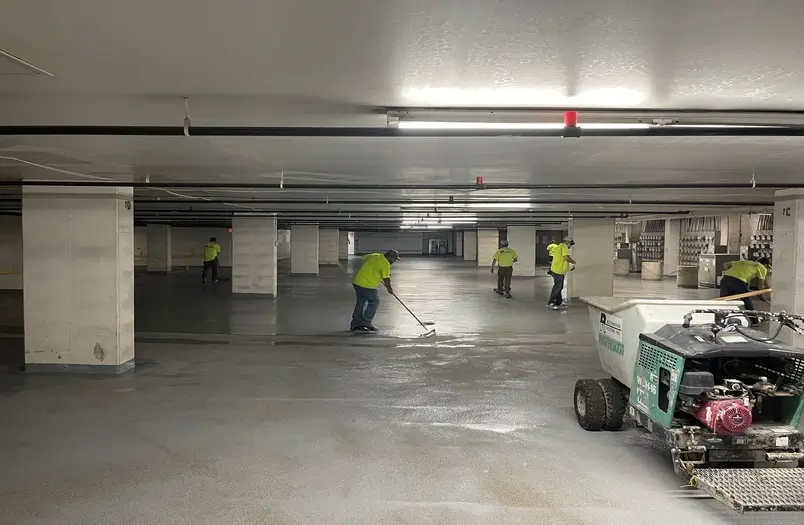
RiverWest Parking Garage — 156,000+ SF in One Month
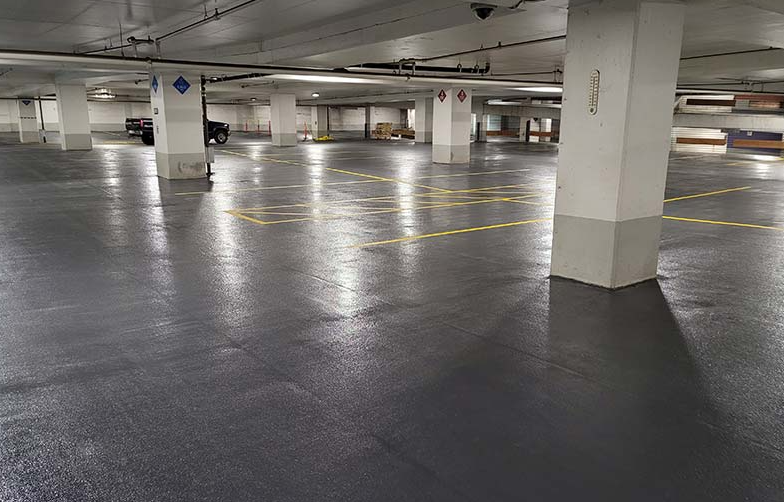
Proof that speed and quality aren’t mutually exclusive when you have the right team. RSI completed 156,000+ SF of traffic-bearing membrane, 65,000+ SF of penetrating sealer, and structural concrete repairs in approximately one month. The scale of this project — and the compressed timeline — demonstrates RSI’s capacity to mobilize experienced crews and execute large-scale parking structure work quickly without sacrificing the quality standards that make a repair worth doing.
Learn more about RSI’s capabilities: Concrete Repair Services · Parking Deck Restoration
What Property Owners Should Know Before Requesting Fast-Cure Repairs
Before you request a rapid-set concrete repair, here’s what an experienced contractor wants you to understand. The right questions up front can save you significant money — and prevent a repair that fails in half the time it should have lasted.
5 Questions to Ask Your Contractor
- What is the expected lifespan of this repair vs. a standard-cure alternative? Get specific numbers — not vague assurances. A quality repair should last at least five years.
- Are we addressing the root cause or just the symptom? If water infiltration or active corrosion isn’t being addressed, even the best fast-cure material will fail prematurely.
- What’s the realistic total cost — including potential re-repair in 3–5 years? Compare the lifecycle cost of fast-cure now vs. standard-cure with a slightly longer closure.
- Can this project be phased to keep the facility partially operational while using standard-cure materials on the closed sections?
- What cold-weather or environmental factors affect our timing options? A contractor who understands Midwest conditions will know when fast-cure is necessary and when it’s just more expensive.
“We’re doing a repair that’s going to last about five years and we want you to come back and use us again for those repairs. We’re not after one job, make money, move on to the next job. We’re after customers, maintenance contracts.”
Mike Hintsala · RSI Expert
That relationship-first approach is what separates a contractor who tells you what you want to hear from one who tells you what you need to know. RSI will tell you when fast-cure is the right tool — and when it isn’t — because the goal is a repair that lasts, not just a repair that’s fast. For help building a long-term maintenance strategy, explore our guides on parking structure condition assessments and capital planning for commercial concrete.
Need a Contractor Who Tells You the Truth About Fast-Cure Repairs?
RSI’s team has 25+ years of average experience managing time-sensitive commercial concrete and masonry repairs across Minnesota, Wisconsin, and the upper Midwest. Whether you’re facing an emergency or planning ahead, we’ll give you honest options — and craftsmanship that lasts.
Facing an emergency? Call us directly at 952-368-0463