
Traffic Coating vs. Penetrating Sealer: Making the Right Investment for Your Midwest Parking Structure
Choosing between traffic coatings and penetrating sealers involves more than upfront costs. This guide provides a practical framework to help you evaluate the true return on investment for your parking structure’s specific conditions and usage patterns.

Quick Summary
- Traffic coatings cost $3-24/sq ft with 10-25 year lifespans — best for high-traffic, exposed decks requiring abrasion resistance and waterproofing
- Penetrating sealers cost $0.50-2/sq ft but require reapplication every 5-10 years — ideal for lighter traffic areas and lower-cost preservation
- Midwest freeze-thaw cycles and road salt make this decision more consequential than in milder climates
- Surface preparation quality matters more than which product you choose — improper prep is the leading cause of coating failure
Why Midwest Conditions Demand Better Protection
Midwest parking structures face unique challenges that accelerate deterioration. With 50–100+ freeze-thaw cycles each winter, water repeatedly penetrates concrete, expands as ice, and creates internal pressure that leads to spalling, cracking, and structural damage over time.
“We use the analogy of a car. When you skip the $100 oil change, skip rotating your tires, skip replacing worn tires—you’re still going to have wear and tear on your vehicle. Eventually, that neglect is going to affect the engine.”
— Tayton Eggenberger, Branch Manager, Minnesota, RSIRoad salt compounds this problem dramatically. As RSI Project Manager Mike Ecker explains, “In the Midwest, parking structures take on vehicles that carry salt in, and salt corrodes concrete reinforcement faster than anything else.” Chloride ions from deicing salts penetrate concrete and attack embedded rebar, causing corrosion that can lead to expensive structural repairs — often 10-20 times the cost of preventive waterproofing.
Understanding Your Two Main Options
Both solutions protect concrete, but they work differently and serve different purposes
Traffic Coatings
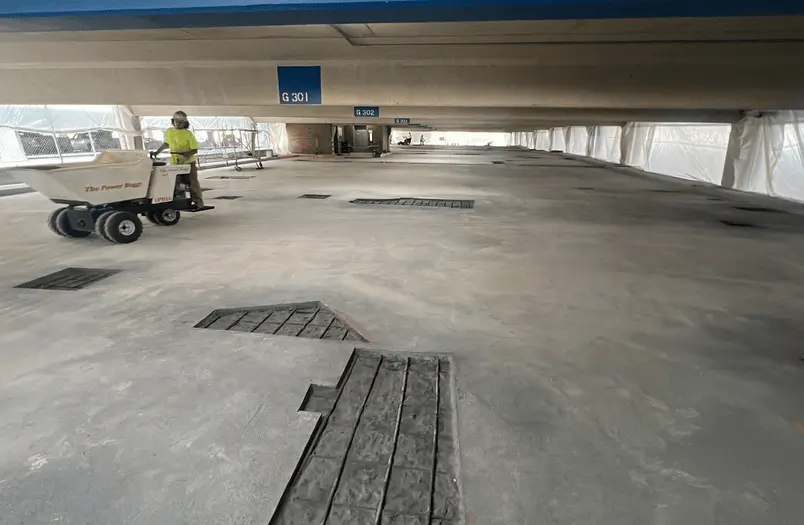
Traffic coatings create a continuous membrane barrier on top of the concrete surface. As Tayton Eggenberger explains, “This traffic coating is a waterproofing layer to stop water from entering.”
These systems provide both waterproofing and abrasion resistance. They’re available in different duty ratings:
- Light duty: Pedestrian traffic, light vehicles
- Medium duty: Standard passenger vehicles
- Heavy duty: Commercial vehicles, high turnover
- Extra heavy duty: Buses, trucks, emergency vehicles
Traffic coatings are typically polyurethane or epoxy-based systems applied in multiple layers with a textured wear surface.
Penetrating Sealers
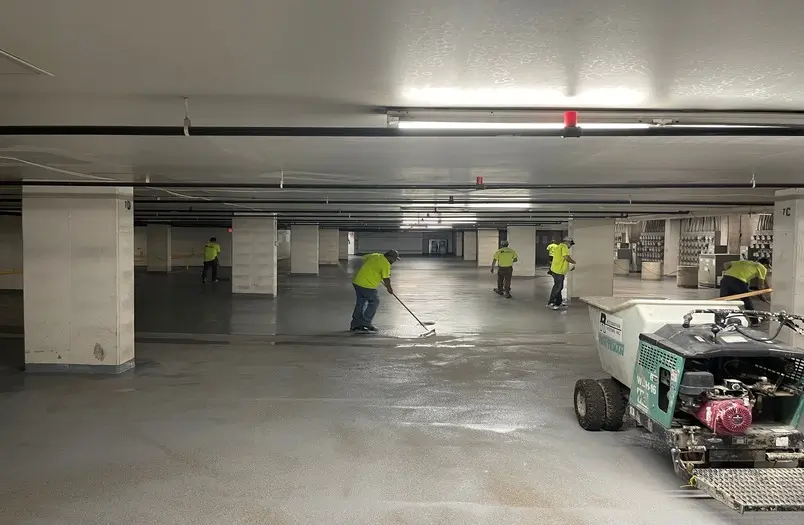
Penetrating sealers use silane or siloxane chemistry to soak into the concrete rather than sitting on top. They form a hydrophobic barrier within the concrete’s pore structure that repels water.
Key characteristics of penetrating sealers:
- Invisible after application — no color change
- Allow concrete to “breathe” (vapor transmission)
- No abrasion resistance — won’t protect against tire wear
- Reduce chloride ion penetration by up to 90%
- Lower initial cost but require periodic reapplication
Sealers work well for structures with lighter traffic where waterproofing, not wear resistance, is the primary concern.
Side-by-Side Comparison
| Factor | Traffic Coating | Penetrating Sealer |
|---|---|---|
| Installed Cost | $3 – $24 per sq ft | $0.50 – $2 per sq ft |
| Expected Lifespan | 10 – 25 years | 5 – 10 years (reapplication needed) |
| Protection Method | Surface membrane barrier | Internal hydrophobic barrier |
| Abrasion Resistance | Yes — protects against tire wear | No — offers no wear protection |
| Best Application | High-traffic, exposed drive lanes, ramps | Lighter traffic areas, protected decks |
| Midwest Performance | Excellent freeze-thaw and salt protection | Good chloride resistance, reapply more often |
Key Factors for Your Decision
Traffic Volume and Type: High-turnover parking with heavy vehicles demands the abrasion resistance of traffic coatings. Lower-traffic structures or those with primarily passenger vehicles may be well-served by penetrating sealers.
Current Structure Condition: Traffic coatings can bridge hairline cracks and provide a new driving surface. Penetrating sealers require sound concrete since they don’t fill or span existing damage.
Budget Horizon: If you’re planning 5-10 years ahead, sealer economics may favor your budget. For 15-25 year planning horizons, traffic coatings often deliver better lifecycle value.
Maintenance Capability: Penetrating sealers require periodic reapplication (typically every 5-10 years). If your organization struggles with scheduled maintenance, a longer-lasting traffic coating may reduce operational burden.
Calculating True ROI: A 15-Year Analysis
Initial price per square foot tells only part of the story. Here’s how the numbers play out over time.
Penetrating Sealer Scenario
50,000 sq ft at $1.25/sq ft = $62,500 per application. With three applications over 15 years, total cost reaches $187,500 — assuming no failures between applications.
Traffic Coating Scenario
50,000 sq ft at $5.50/sq ft = $275,000 for a single application lasting 15+ years. Higher upfront cost, but minimal maintenance required during the service life.
The Hidden Variable
These calculations assume proper installation. Premature coating failure due to inadequate preparation can triple costs through removal, repairs, and reapplication.
Beyond Material Costs
Factor in revenue loss during closures, tenant disruption, and repair costs if water infiltration damages structural elements. Prevention consistently costs less than repair.
Why Cost Complexity Matters More Than Unit Price
When evaluating quotes for waterproofing projects, facility managers often focus on the per-square-foot material cost. But experienced contractors know the real expense drivers are harder to see upfront.
“Most things are missed, not because of the material, not because of all these other numbers that I just told you, it’s because the work turns out to be much more steps, much more of a puzzle, much more everything than anybody anticipated.”
— RSI ExpertThis insight explains why two seemingly similar quotes can produce vastly different outcomes. The contractor who thoroughly assesses conditions — identifying delaminated concrete, corroded rebar, failed expansion joints, and drainage issues — will price the job accurately. The contractor who skips this step may deliver a lower bid but encounter costly change orders or, worse, premature system failure.
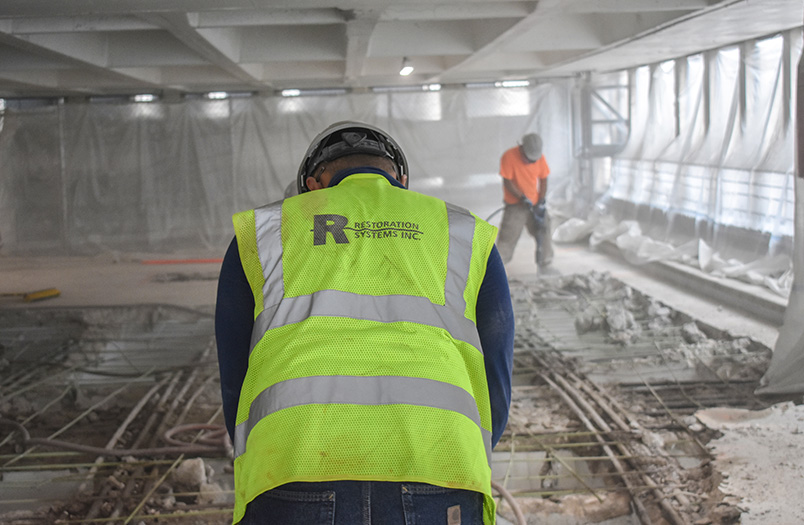
For traffic coatings specifically, surface preparation accounts for 60-80% of the work involved. ICRI (International Concrete Repair Institute) standards define specific surface profile requirements that must be achieved through methods like shot blasting, scarifying, or diamond grinding. Cutting corners here doesn’t reduce actual cost — it transfers the expense to future repairs.
The takeaway for budget planning: request detailed scopes of work that specify preparation methods, not just material specifications. The most durable installation comes from contractors who understand that proper preparation is the foundation of lasting performance.
Preparation Quality: The Difference Between 10 and 25 Years
The single greatest predictor of waterproofing system longevity isn’t the coating brand or the sealer chemistry — it’s the quality of surface preparation before application.
“One of the things that really differentiates Restoration Systems is we don’t have warranty issues. We don’t have failure issues because we’re doing the proper preparation per manufacturers specifications on the front end.”
— Tayton Eggenberger, Branch Manager, Minnesota, RSIThis zero-warranty-issue track record stems from RSI’s commitment to following ICRI standards for concrete surface preparation. These industry guidelines specify the exact surface profile, moisture content, and cleanliness requirements that coatings and sealers need to bond properly.
RSI’s team includes principals with more than 25 years of experience each — professionals who’ve seen the consequences of shortcuts and understand why proper preparation prevents callbacks, failures, and expensive re-work. When your coating lasts 20+ years instead of failing at 7, the ROI calculation changes dramatically.
Making Your Decision: A Quick Framework
Use these guidelines to determine which approach fits your situation
Choose Traffic Coating If…
- Your structure has exposed driving surfaces or ramps
- Traffic includes commercial vehicles, delivery trucks, or high turnover
- You need to bridge existing hairline cracks
- Your planning horizon is 15+ years
- You want to minimize maintenance interventions
- The deck shows wear patterns from tire abrasion
Choose Penetrating Sealer If…
- Traffic is primarily passenger vehicles with lower turnover
- The concrete is in good condition without significant cracking
- Budget constraints favor lower upfront costs
- Your organization can commit to reapplication schedules
- The area is covered or protected from direct weather exposure
- You need a quick-turnaround solution with minimal downtime
Get a Professional Assessment for Your Structure
Every parking structure is different. RSI’s parking deck restoration team will evaluate your specific conditions — traffic patterns, existing damage, exposure, and budget — to recommend the protection approach that delivers the best long-term value for your situation.
Request a ConsultationFrequently Asked Questions
A properly installed traffic coating system typically lasts 10-25 years in Midwest conditions, depending on traffic volume, coating type, and maintenance. Heavy-duty systems in high-traffic areas may need recoating sooner, while well-maintained systems in moderate-traffic structures often exceed 20 years. The key factor is surface preparation quality during initial installation.
Penetrating sealers typically require reapplication every 5-10 years, depending on traffic levels and exposure conditions. High-traffic areas or fully exposed decks may need more frequent treatment. Regular testing of water absorption can help determine when reapplication is necessary before protection degrades significantly.
The leading cause of premature failure is inadequate surface preparation — applying coatings over contaminated, damp, or improperly profiled concrete. Other common causes include applying products outside temperature specifications, insufficient coating thickness, and failing to address underlying concrete damage before coating. Proper preparation per ICRI standards eliminates most failure modes.
Yes, but the previous sealer treatment must be evaluated. Some silane/siloxane sealers can affect coating adhesion. A qualified contractor will test the existing surface, potentially using mechanical preparation methods like shot blasting to achieve the proper surface profile for coating adhesion. This is why assessment before specification is essential.
RSI’s assessment process evaluates multiple factors: current concrete condition, traffic patterns and vehicle types, exposure to weather and salt, existing waterproofing history, budget constraints, and planning horizons. We focus on recommending the solution that delivers the best long-term value for your specific situation — not simply the highest-margin option. Our goal is a lasting solution that meets both your performance requirements and budget reality.