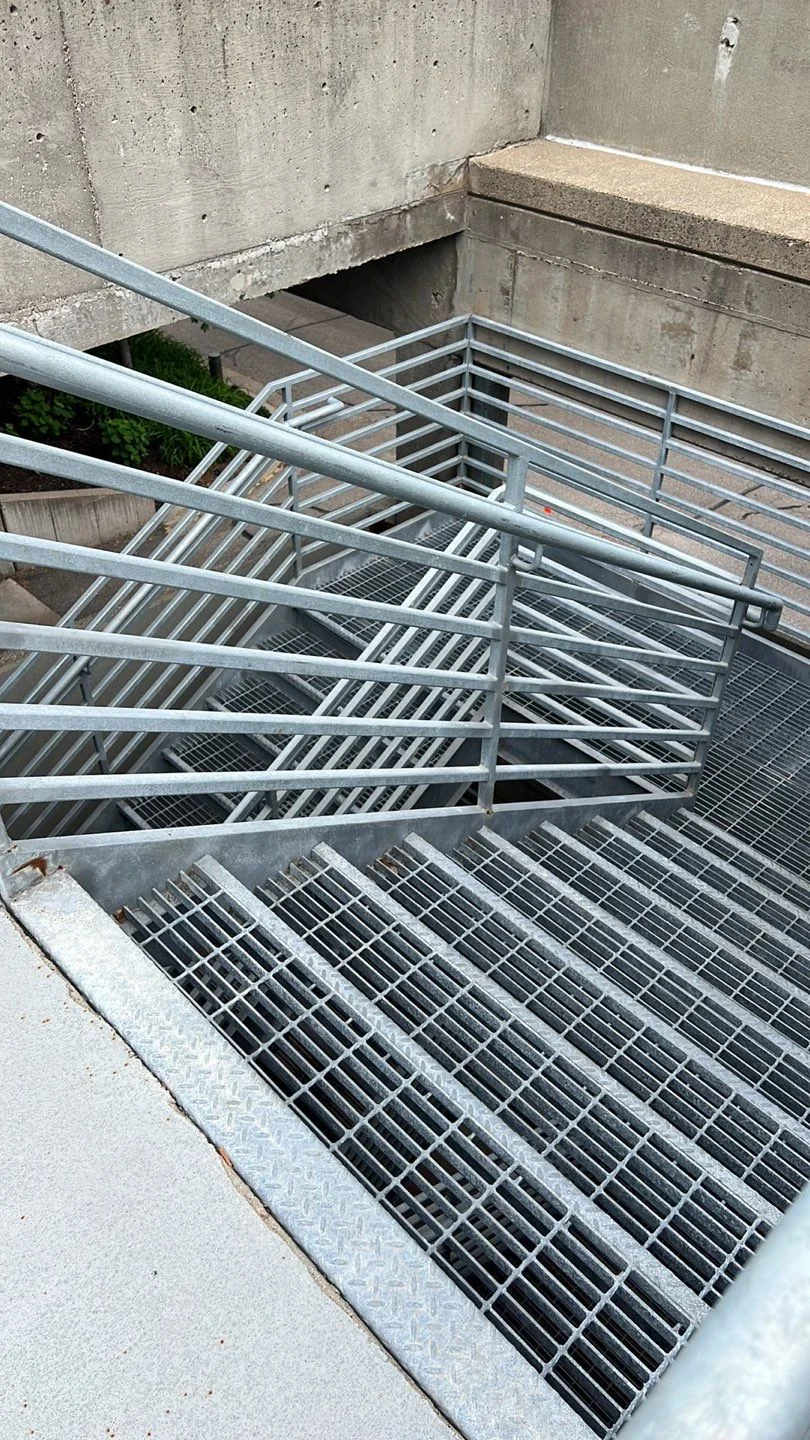
If the rail moves, the problem is often below the baseplate.
A loose guardrail, rusted balcony post, or cracked stair-rail embed usually points to corrosion at the connection and “water intrusion into surrounding concrete.” RSI repairs commercial railings by opening the anchor zone, rebuilding the substrate, addressing corrosion, and then resetting or replacing the metal system for the actual application.
Commercial railing repair starts at the connection, not the handrail
On commercial buildings and parking structures, the visible rail is rarely the whole problem. RSI repairs railing systems on balconies, parking ramps, stair towers, rooftops, parapets, and pedestrian areas across Minnesota and the Upper Midwest, and the first field question is whether the post, baseplate, embed, sleeve, or anchor pocket is still supported by sound concrete or masonry.
Common repair scopes include steel railings, aluminum systems, guardrails, pipe rail, and decorative or specialty fabricated metal systems tied into concrete or masonry. The failure pattern is often practical and familiar: water reaches the connection, corrosion expands, anchors loosen, freeze-thaw movement opens the surrounding substrate, and a small maintenance issue begins spreading into the structure around it.
That is why RSI evaluates railing repair as both a metalwork and substrate problem. If deterioration is isolated, re-anchoring, localized concrete repair, corrosion treatment, and recoating may be the right path. If the system is heavily corroded or no longer able to meet structural and code requirements, replacement may be the better long-term decision.
Balcony and facade rails where freeze-thaw movement has opened the anchor zone.
Parking ramp guardrails and embeds exposed to deicing salts and runoff.
Stair tower rails with corrosion at posts, landings, stringers, or embed plates.
Rooftop, parapet, and pedestrian rail systems tied into concrete or masonry edges.
When re-anchoring is needed, the surrounding concrete typically has to be repaired first. RSI removes deteriorated material, addresses corrosion, rebuilds the substrate, and installs anchorage suited to the application. For life-safety railings, the repair or replacement decision also has to account for height, spacing, loading, and accessibility requirements under applicable codes such as [IBC], local building codes, and [ADA 2010 Standards].
On parking structures, railing repair often belongs inside the larger logic of parking deck restoration. On balconies, parapets, and exposed building edges, it often intersects with building facade restoration, sealant work, and waterproofing details.
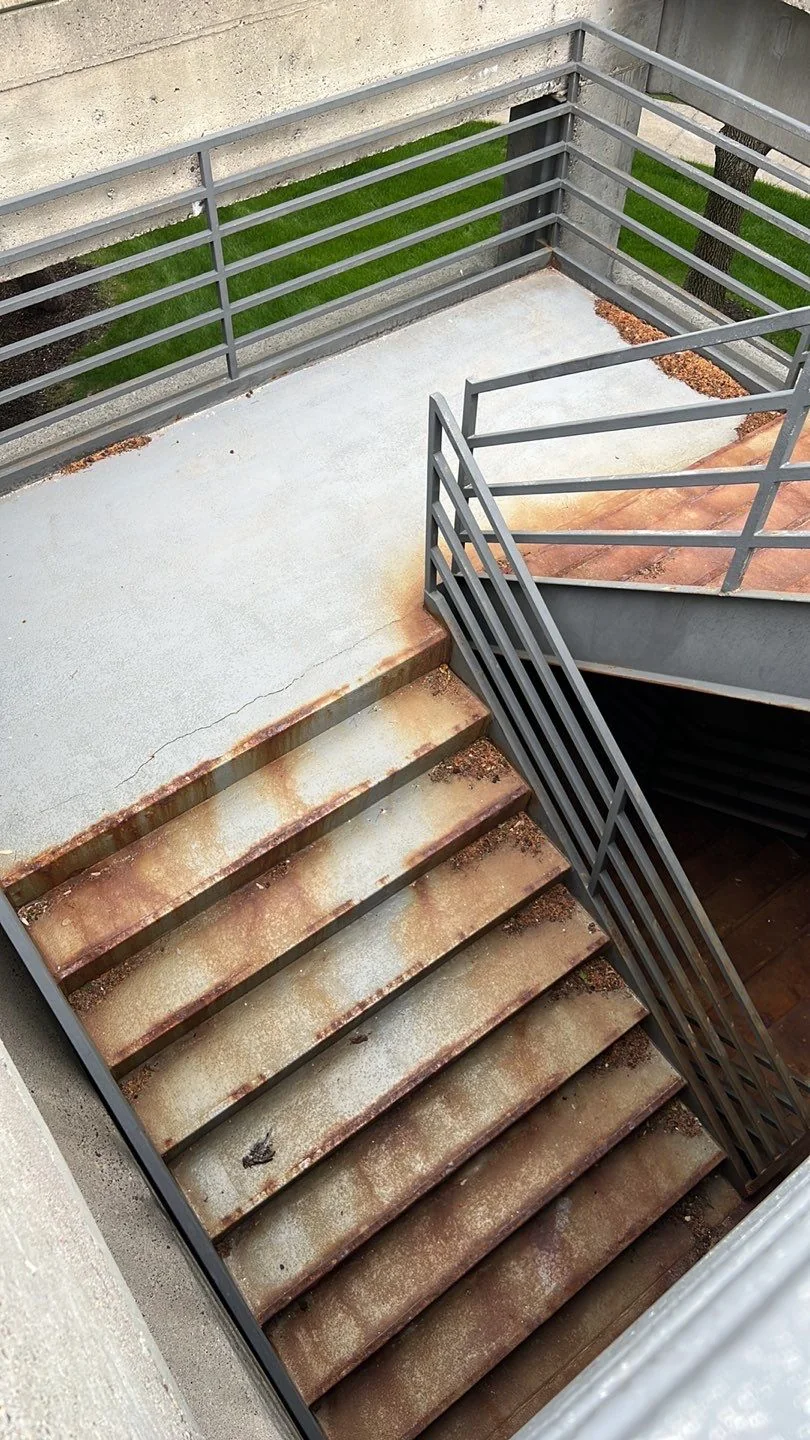
Rusted exterior stair with corroded handrails and stringers. The visible rail is only part of the condition; the connection and surrounding substrate decide whether the system can safely remain in service.
Specifications
Materials, anchorage, and field realities
A railing repair is not complete because the rail looks straight. The repaired assembly has to be appropriate for the use, the exposure, the substrate, and the governing code. In practice, that means checking “height, spacing, loading requirements, and accessibility” before locking the detail.
01
Guardrail and handrail loads
IBC requirements affect how guards and handrails are evaluated for commercial buildings, balconies, stairs, and parking structures. RSI coordinates repair details around the applicable loading requirements for the specific condition. [IBC]
02
Height and opening geometry
A repaired or replaced rail may need to address guard height, picket spacing, infill openings, and local building-code interpretation. Older railing layouts are reviewed before RSI assumes a like-for-like reset is acceptable. [IBC]
03
Accessibility coordination
Stair rails, pedestrian routes, ramps, and public access points can involve ADA considerations. Handrail continuity, clearances, and approach conditions are checked against the application rather than treated as an afterthought. [ADA 2010 Standards]
04
Metal and substrate compatibility
RSI commonly works with steel and aluminum railings, plus ornamental and specialty fabricated systems. The right repair depends on the rail material, fastener metal, surrounding concrete or masonry, and exposure to water and salts.
Repair options RSI considers
Substrate diagnosis Sound the concrete or masonry at the post, look for cracks, rust staining, spalls, movement, and previous patching, then determine whether the rail can be repaired in place or needs removal.
Concrete and corrosion repair Remove deteriorated concrete, expose the embed or anchor, clean and address corrosion, and rebuild the pocket before the rail is reset.
Re-anchoring Install new anchorage systems designed for the application, matching the fastener, embedment, baseplate, sleeve, or bracket detail to the structure that will carry the rail.
Repair, fabricate, or replace Isolated deterioration may call for welding, post replacement, recoating, or localized fabrication. Heavily corroded or noncompliant systems may be better handled as full replacement.
Failure starts at the connection
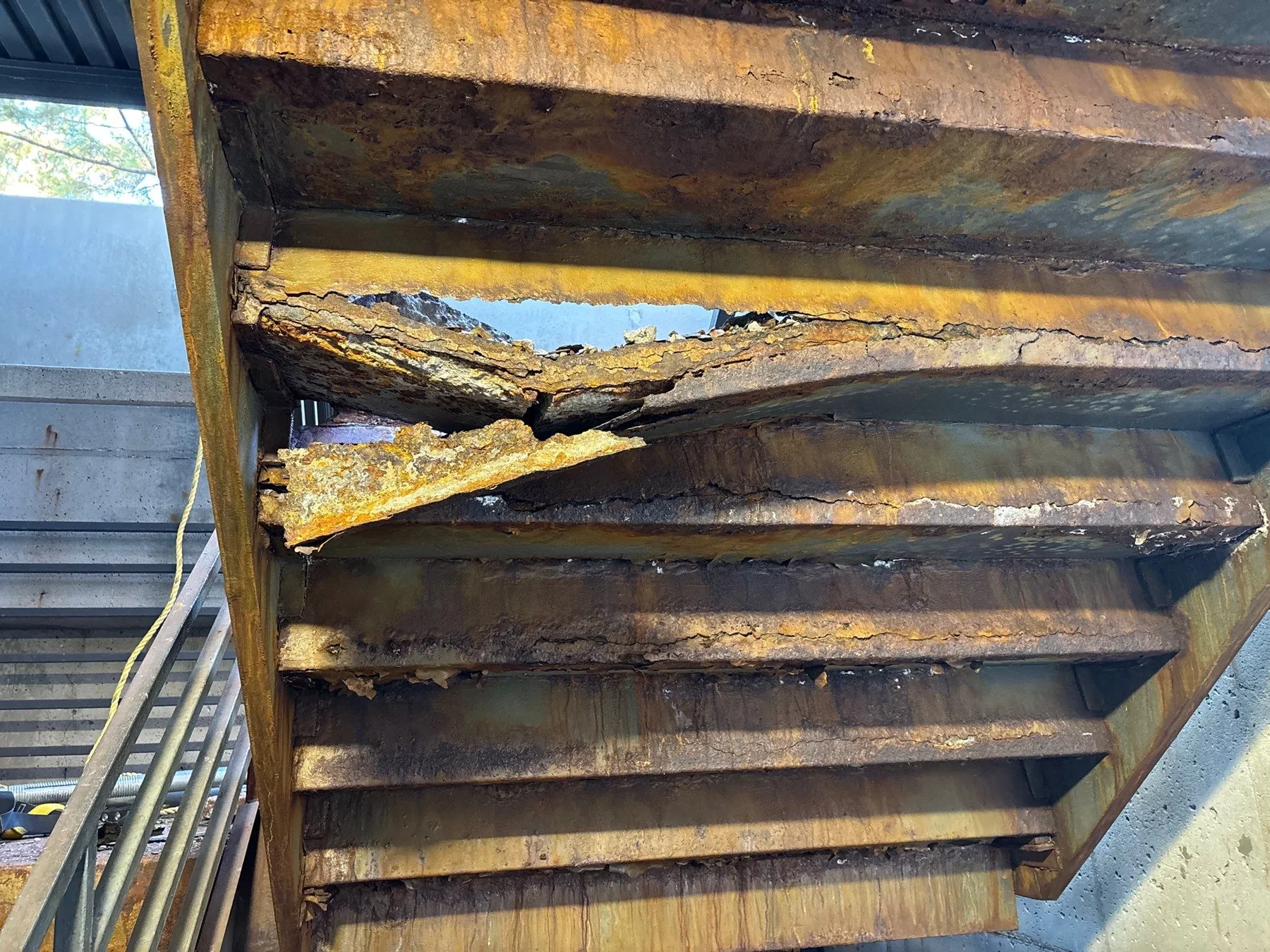
This is the kind of anchor-zone condition that turns a simple rail reset into a structural substrate repair. Once corrosion has consumed the connection or broken the surrounding concrete, adding new bolts to the same pocket only hides the risk. The repair has to rebuild what the railing depends on.
“
Typically the surrounding concrete needs to be repaired first. We remove deteriorated concrete, address corrosion, rebuild the substrate, and then install new anchorage systems designed for the application.
Tayton EggenbergerRSI Minnesota Branch Manager
Regional Reality
Why railing connections fail in the Upper Midwest
Upper Midwest railings live in a hard exposure cycle: freeze-thaw movement, deicing salt, wind-driven rain, snow storage, and long wet periods at the base of posts. The rail may look repairable from ten feet away, but the decision is made at the anchor.
Where the repair is won or lost
Corrosion at connection points and water in the surrounding concrete create the movement, cracking, and section loss that eventually makes a rail unsafe.
01
The substrate gets skipped
A new post or rail section is only as reliable as the concrete or masonry it is fastened into. If delaminated material stays in place, the repair can look finished while the connection remains weak.
02
Salt reaches the embed
Parking ramps are especially vulnerable because chloride exposure attacks embedded metal and reinforcing at the railing pocket. What starts as rust staining can become “failed anchors” and broken concrete.
03
Wrong repair decision
If deterioration is isolated, repair and recoating can be a practical path. If corrosion is widespread or the rail cannot meet code, replacement is usually the cleaner long-term decision.
04
No water management
Water that sits against a rail base keeps feeding the next failure. Sealant, coating, slope, and drainage details matter because railing work often intersects with waterproofing work.
Where rail posts penetrate coated decks or parking surfaces, RSI coordinates base repairs with traffic coatings and commercial waterproofing to reduce water movement at anchors.
The RSI Approach
How RSI repairs commercial railings
RSI approaches railing repair as a connection problem first. The team determines whether the rail can be saved, whether localized “repairs and recoating” make sense, or whether the corrosion and code condition point to replacement.
Inspect the railing and substrate
Document movement, corrosion, impact damage, post spacing, failed coating, cracked concrete, deteriorated masonry, and any prior patching around the connection.
Remove deterioration
Open the pocket or base area, remove unsound concrete, address corrosion, and rebuild the substrate so the new anchor is not set into compromised material.
Set the right anchorage
Select an anchorage detail for the application: steel or aluminum rail, concrete or masonry substrate, exposed or interior condition, pedestrian or vehicle-adjacent use.
Reinstall and protect
Reset, weld, bolt, fabricate, or replace rail components as needed, then coordinate coatings, sealants, and waterproofing details that keep water away from the repaired connection.
Failed rail pockets, broken embeds, and deteriorated concrete around posts are repaired under the same practical standards RSI uses for commercial concrete repair.
FAQ
Frequently asked questions
RSI repairs railings on balconies, parking ramps, stair towers, rooftops, parapets, and pedestrian areas. That can include steel railings, aluminum systems, guardrails, pipe rail, and decorative metal systems tied into concrete or masonry structures.
If deterioration is isolated and the system can still meet code and structural requirements, localized repair and recoating may be the right approach. If the rail is heavily corroded, the anchorage is failing in many locations, or the system is no longer code compliant, “replacement is often the better long-term option.”
Parking ramps expose rail embeds and baseplates to salt, runoff, freeze-thaw movement, and repeated wetting. Corrosion at the connection expands, cracks the surrounding concrete, loosens anchors, and spreads into the structure if maintenance is deferred.
Yes. That is often the reason to bring RSI into the project. Railing failures commonly begin with deteriorated concrete or masonry around the anchor, so the substrate repair, corrosion treatment, anchorage, metal work, and waterproofing details need to be coordinated together.
RSI phases work areas, coordinates access, and uses temporary safety measures where required. On an occupied parking structure with corroded railing embeds from years of salt exposure, the work had to be sequenced so portions of the ramp could remain available to tenants while repairs moved through the structure.
It depends on the jurisdiction, the scope, and the application. IBC requirements, local building codes, and ADA considerations can all affect the repair. Height, spacing, loading requirements, and accessibility are reviewed before RSI assumes that an older rail can simply be reinstalled as-is. [IBC] [ADA 2010 Standards]
Most commercial railing repair involves steel and aluminum, but RSI also works with ornamental metals and specialty fabricated systems depending on the building type. The material decision is tied to exposure, appearance, fastening method, and the condition of the surrounding concrete or masonry.
Sources & Field Inputs
Sources used for this page
RSI field input: Tayton Eggenberger, RSI Minnesota Branch Manager, provided service-specific guidance on railing applications, corrosion at connection points, water intrusion into surrounding concrete, re-anchoring after substrate repair, repair-versus-replacement decisions, and occupied parking-structure sequencing.
Standards referenced: International Building Code guard, handrail, height, spacing, and loading considerations [IBC]; accessibility considerations for routes, stairs, ramps, and handrails [ADA 2010 Standards]. Local building-code requirements may also apply by jurisdiction.
Project context: RSI parking-structure experience involving salt-exposed railing embeds, phased work, tenant access coordination, and temporary safety measures; related project pages linked above for broader occupied-ramp restoration context.
Check the railing connection before replacing the rail
RSI repairs commercial railing systems across the Upper Midwest by starting where failures usually begin: the anchor, embed, surrounding concrete or masonry, and the path water took to get there. We help owners decide what can be repaired and what needs replacement.