Temporary protection planned around the way people actually move through occupied buildings, downtown sidewalks, parking ramps, and active restoration work zones.
A stone comes loose over a public sidewalk. A parking ramp repair has to stay open in phases. A healthcare entrance cannot simply close because overhead work is starting above it. RSI treats barriers as part of the overall “site logistics and safety plan”: separate the public from the hazard, preserve access where possible, and adjust the perimeter as the work changes.
Downtown Properties, Parking Ramps, Healthcare, Active Commercial Buildings
Service Region
Entire Upper Midwest
Expert Insights By
Blake Dronen · RSI President
The Premise
Barrier rental only works when the layout follows the live site risk
Crowd control barrier rental and installation is not just a matter of dropping fencing at the edge of a work zone. On RSI restoration projects, barriers are planned around the actual hazard: overhead façade work, loose masonry, falling concrete, equipment movement, vehicle exposure, restricted access, or an unstable condition that needs immediate public protection.
That is why the right setup can look different from one property to the next. A downtown façade repair may need sidewalk canopies, perimeter fencing, and concrete jersey barriers. A parking ramp repair may use water-filled barriers to phase traffic while work areas shift. Inside an occupied facility, temporary walls or dust partitions may be needed to keep tenants and daily operations separated from the construction area.
For building owners and property managers, the practical issue is continuity. Entrances, ADA routes, emergency egress, loading zones, deliveries, tenant access, and vehicle flow all shape where barriers can be placed and when they need to be relocated. RSI treats the barrier plan as part of the overall site logistics and safety plan, not as a separate afterthought.
Façade restoration, stone repair, masonry work, scaffold installation, and overhead demolition where falling debris could affect sidewalks, entrances, or public right-of-way areas.
Concrete repair, waterproofing, and parking structure restoration where vehicle circulation, pedestrian routes, and phased closures have to remain clear and controlled.
Emergency stabilization after falling masonry, impact damage, water intrusion, or structural concerns create an immediate need to secure the property.
Safety requirements are often influenced by the building location, pedestrian density, occupancy level, engineer recommendations, municipal requirements, and applicable jobsite obligations such as worker protection, emergency access, and public separation under [OSHA 29 CFR 1926] and accessibility considerations under [ADA 2010 Standards]. In the Upper Midwest, where active commercial, healthcare, parking, and downtown properties often need to stay open during repair work, that planning has to be both protective and flexible.
A few of RSI’s Crowd Control Barrier Rental & Installation projects
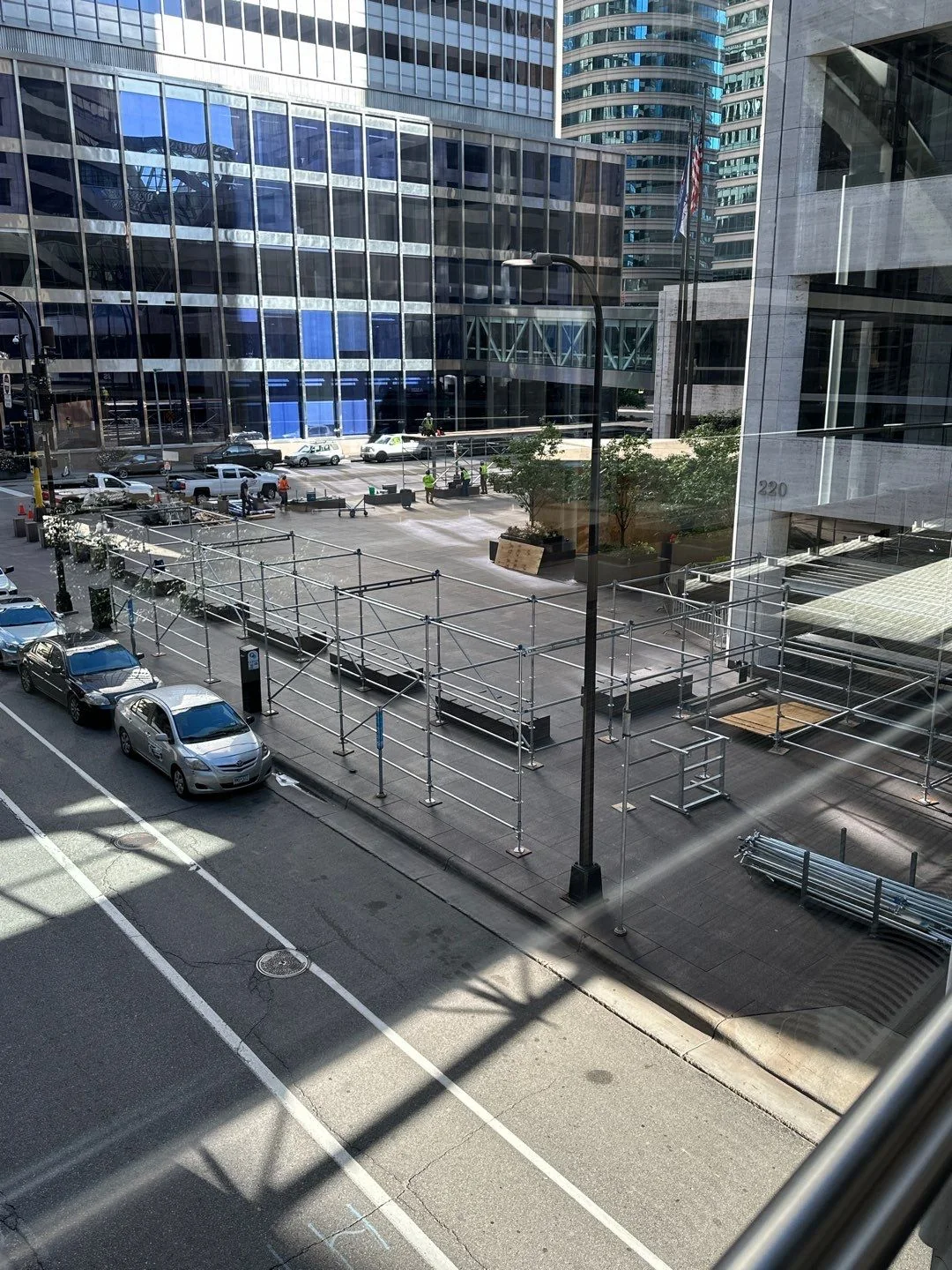
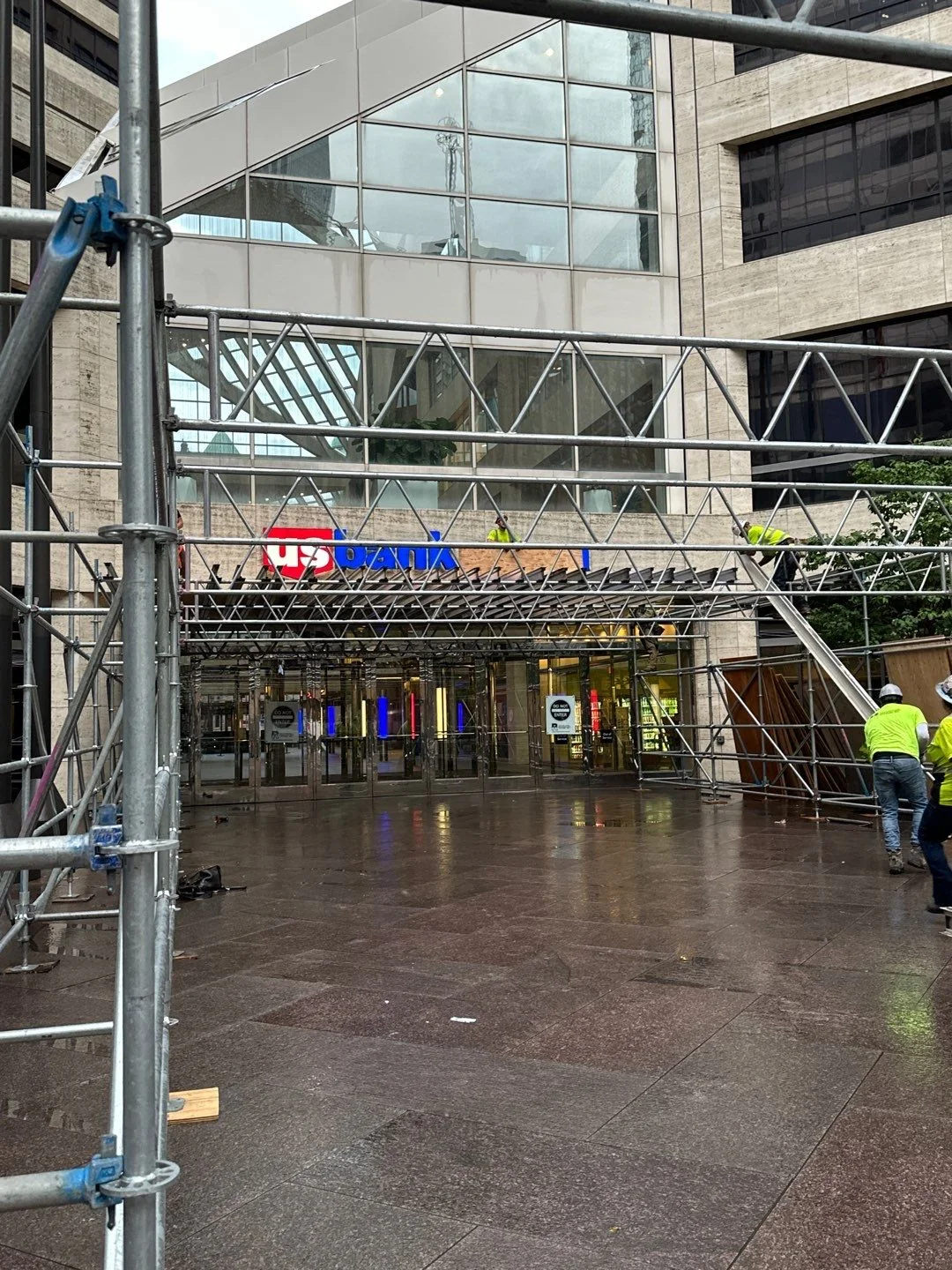
Pedestrian protection at a downtown high-rise entrance. The barrier line, overhead protection, and access route had to work together while the building remained active.
Specifications
Barrier systems selected for the site condition
Barrier requirements are driven by the hazard, the location, pedestrian density, vehicle exposure, occupancy, municipal expectations, and recommendations from the project team. Codes and standards matter, but they are applied to a real work zone: where people walk, where vehicles turn, where debris could fall, and which doors must stay open.
01
Public separation
Fencing, barricades, and controlled access points keep pedestrians, tenants, and visitors out of active work zones. OSHA requires employers to protect workers from recognized construction hazards, including struck-by and access hazards [OSHA 29 CFR 1926].
02
Overhead protection
Where façade repair, masonry work, concrete removal, or scaffold activity creates a falling-object risk, the plan may require sidewalk canopies, covered walkways, scaffold protection, safety netting, or debris containment [IBC].
03
Accessible routing
Temporary pedestrian routes still need to be understandable, continuous, and accessible. On public sidewalks and occupied properties, barrier placement must account for ADA access, detectable routing, and safe passage around the work [ADA 2010 Standards] [MUTCD].
04
Operational continuity
The plan also has to preserve emergency egress, deliveries, tenant access, parking circulation, and reopening sequences. If the work zone moves, the temporary protection usually moves with it.
Barrier systems RSI commonly provides
Concrete jersey barriersHigh-impact separation along sidewalks, streets, parking ramps, service drives, and other areas exposed to vehicle movement.
Water-filled barriersFlexible temporary traffic control and pedestrian routing where the layout may need to shift as phases open and close.
Temporary construction fencingSecure work-zone perimeters that prevent unauthorized access and make the construction boundary obvious to tenants and the public.
Pedestrian barricades and crowd-control fencingControlled routes around entrances, sidewalks, loading zones, elevator banks, and tenant access points.
Covered walkways, sidewalk canopies, netting, and debris containmentOverhead protection for façade restoration, masonry repair, scaffold installations, and concrete removal.
Temporary walls and dust partitionsInterior separation inside occupied facilities where dust, noise, and access control have to be managed without shutting down the building.
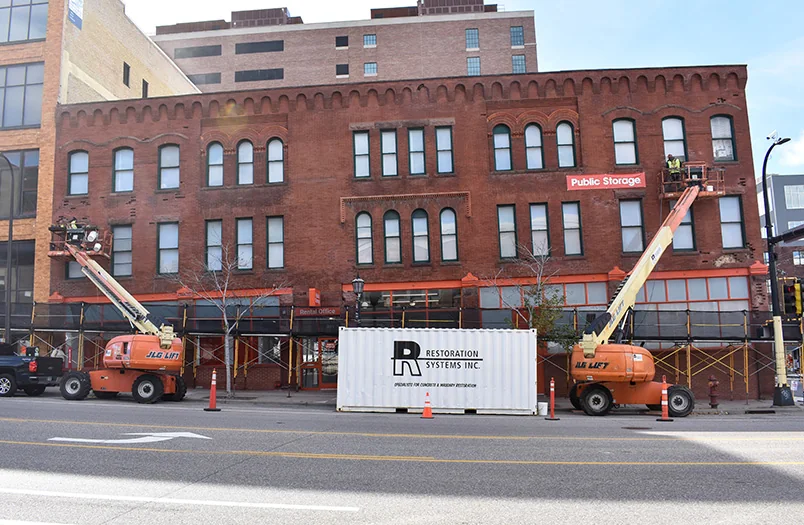
Sidewalk-side barrier line in service
A downtown façade setup may combine sidewalk protection, fencing, cones, signage, and a continuous pedestrian route. The useful question is practical: can a visitor understand the safe path at a glance, and does the system still protect them when the crew moves to the next elevation?
“
In dense downtown environments like Minneapolis, barriers become part of a comprehensive life safety and risk management plan – not just temporary fencing. Coordination with the city, engineers, and stakeholders is essential.
Blake DronenRSI President
Regional Reality
Why temporary protection fails on occupied Upper Midwest properties
Barrier problems usually show up in the gap between a drawing and a live property. Snow storage changes the route. A delivery truck clips the line. A tenant entrance has to reopen. Demolition reveals more loose material than expected. RSI plans for those changes because site conditions rarely stay still.
Field priority
The strongest barrier plan does two jobs at once: it keeps people away from the hazard and keeps the property operating as safely as the conditions allow.
01
The hazard changes after work begins
Restoration work can uncover additional deterioration once demolition, probing, or access work starts. Loose masonry, spalled concrete, or unstable material may expand the protected zone and require a revised line.
02
The barrier blocks the building
Owners still need emergency access, ADA access, deliveries, tenant entrances, and day-to-day circulation. A line that is safe on paper can fail operationally if it closes the wrong door or traps traffic in a ramp.
03
The barrier does not match the exposure
Temporary fencing can control foot traffic, but it is not the right answer for every condition. Vehicle exposure, overhead work, falling debris, and structural instability may require jersey barriers, canopies, scaffold protection, or full perimeter control.
04
The line is installed and forgotten
Barrier placement often needs to shift as restoration progresses. RSI field teams monitor the setup, reopen areas when it is safe, and adjust protection so the perimeter follows the active work rather than yesterday’s plan.
On parking decks and arrival lanes, temporary protection may need to phase around parking deck restoration, traffic coatings, concrete cure windows, and reopening dates.
The RSI Approach
How RSI handles crowd control barrier work
RSI manages barrier logistics from delivery through removal. The work may support a larger restoration scope, or it may be the first emergency measure after falling debris, impact damage, water intrusion, or a structural concern. Either way, the temporary protection is planned around the active building.
Read the site
Identify the work zones, overhead hazards, pedestrian traffic, tenant entrances, emergency egress, delivery points, and vehicle flow. The plan starts with where people naturally move through the property.
Build the logistics plan
Map barrier locations, pedestrian and vehicle routes, tenant access, deliveries, and the points where the line may need to shift. On high-traffic sites, RSI coordinates with property management, engineers, municipalities, and when needed local traffic-control authorities.
Deliver and install cleanly
Schedule equipment and materials to reduce disruption. Depending on the site, placement may involve forklifts, cranes, off-hour deliveries, traffic control crews, fencing, jersey barriers, water-filled barriers, canopies, or temporary interior partitions.
Relocate, reopen, remove
As restoration moves through different phases, RSI adjusts the protection to follow the work and reopens areas whenever conditions allow. When the hazard is resolved, removal is coordinated so normal access returns with minimal interruption.
Barriers are needed when construction or restoration creates a known hazard near the public, tenants, vehicles, or building occupants. Common triggers include façade restoration, concrete repair, parking ramp repairs, waterproofing work, scaffold installation, overhead work, falling debris, structural instability, or restricted access.
Most barrier systems are part of a larger restoration or repair scope. RSI also responds when owners need temporary protection first, such as after falling masonry, impact damage, water intrusion, or a structural concern, while the long-term repair plan is being developed.
It depends on the exposure. Jersey barriers are used where vehicle impact protection is needed. Water-filled barriers work well for flexible routing and phased layouts. Temporary fencing and pedestrian barricades control foot traffic. Covered walkways, canopies, netting, and debris containment are used when overhead work creates falling-debris risk.
Yes. Barrier placement has to account for accessible pedestrian routes, emergency egress, tenant entrances, deliveries, and vehicle movement. On public sidewalks and temporary pedestrian routes, ADA and traffic-control requirements may apply [ADA 2010 Standards] [MUTCD].
A covered walkway or sidewalk canopy may be needed when pedestrians must pass near or below overhead work such as façade repairs, masonry work, concrete removal, or scaffold activity. The ground-level barrier controls access; overhead protection addresses the falling-object hazard.
Yes. On restoration projects, barriers often need to move as work zones shift, areas reopen, or additional deterioration is discovered. RSI monitors the setup and adjusts the protection so the line follows the active work rather than remaining fixed in the first layout.
Yes. On downtown and high-traffic sites, RSI coordinates with property management, tenants, engineers, municipalities, and when needed local police or traffic-control authorities. That coordination helps protect the public while keeping access and operations as smooth as the site allows.
Sources & Field Inputs
Sources used for this page
RSI expert input: Blake Dronen, RSI President, provided service-specific guidance on temporary barriers, pedestrian protection, occupied-building logistics, emergency stabilization, public right-of-way coordination, and phasing around active restoration sites.
Standards referenced: [OSHA 29 CFR 1926], [ADA 2010 Standards], [MUTCD], and [IBC] where relevant to public protection, pedestrian routing, overhead hazards, and temporary construction-site safety.
Project context: RSI’s U.S. Bank Plaza life safety work, where public protection, fencing, pedestrian routing, and overhead protection were significant parts of the response after stone detached from a downtown Minneapolis façade.
Secure the work zone without shutting the property down
RSI provides crowd control barrier rental and installation across the Upper Midwest for occupied buildings, public sidewalks, parking ramps, emergency stabilization, and phased restoration work. We plan the barrier line around hazards, access routes, tenants, deliveries, and public safety.