
Traffic Coating Failure: Why Systems Fail and How to Prevent It
Surface preparation failures, installation shortcuts, and water infiltration cause the majority of traffic coating system failures in parking structures. Here’s what goes wrong, why costs escalate fast, and how to prevent it.

Key Takeaways
- According to AMPP (formerly NACE/SSPC), 60–80% of all coating failures trace back to inadequate surface preparation — making it the single most preventable cause of traffic coating failure.
- Traffic coatings are waterproofing systems, not standalone products — failure at any component (membrane, joints, drainage, terminations) means the entire system fails.
- Midwest freeze-thaw cycles (60–80+ per year) and road salt exposure compound coating damage exponentially, accelerating deterioration far beyond what other climates produce.
- Deferred maintenance escalates costs dramatically — what starts as a $500K repair can balloon to a $4M project when underlying failures go unaddressed.
- Persistent water leaks, repeated repairs in the same location, and expanding crack patterns are warning signs that your coating system is failing and requires professional assessment.
The Hidden Cost of Traffic Coating Failure
A traffic coating failure rarely announces itself with a single dramatic event. It starts quietly — hairline cracks that widen over a winter, small leaks that stain the deck below, patches that keep coming loose in the same spots. By the time most building owners recognize the pattern, the damage has been compounding for years and the repair costs have multiplied.
“Now you have a half a million dollar job with a hard cost that most people use the percentage of, okay, it’s about 10%. Well, it’s 10% on 4 million, it’s probably 20% on 2 million. Is probably 30% on half a million. So the work starts, and they find out the thing is way worse than anybody imagined. They’re up to a million dollars and are 30% through the emergency repairs. Now we’re doing a $4 million project to try and complete the repairs.”
— Mike Hintsala, RSI ExpertThat trajectory — from manageable repair to full-scale rehabilitation — is one Mike Hintsala has seen play out across more than 300 projects. His analogy is straightforward: “You can’t be mad at the engine if you never changed the oil.” Traffic coating systems require the same preventive attention as any critical building component. Skip the maintenance, and the structure pays the price.
According to AMPP (formerly NACE/SSPC), 60–80% of all coating failures are directly attributable to inadequate or improper surface preparation — not material defects, not age, not weather alone. Preparation is the single most preventable point of failure.
Understanding why traffic coating systems fail — and recognizing the warning signs early — is the difference between a routine maintenance investment and a seven-figure emergency. Below, we walk through the primary failure modes, the environmental factors that accelerate them in Midwest climates, and the diagnostic signals that tell you it’s time to act.
Why Traffic Coating Systems Fail
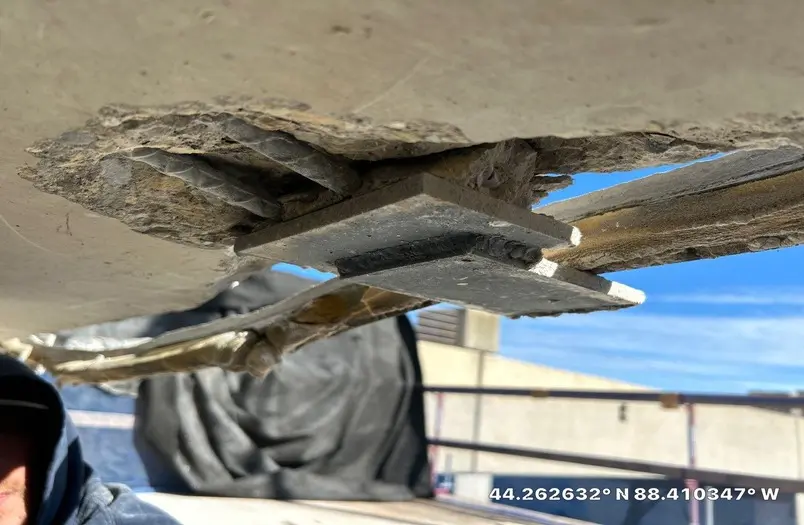
Surface Preparation Failures
−Surface preparation is the foundation every traffic coating system is built on — and it’s where 60–80% of all coating failures originate, according to AMPP. When the concrete substrate isn’t properly profiled, cleaned, and verified before coating application, the membrane cannot achieve the adhesion it needs to perform. The result: delamination, blistering, and a dramatically shortened service life.
“Using improper tools or not having the right understanding of how to remove traffic coating. The biggest risks are surface damage, adhesion failures, and then obviously a shortened system life for that new traffic coating.”
— Tayton Eggenberger, Branch Manager, RSI MinneapolisThe industry standard for measuring preparation quality is the ICRI Concrete Surface Profile (CSP) system — a 10-level scale ranging from near-smooth (CSP 1) to heavily chipped surfaces (CSP 10). Each coating system requires a specific CSP range for proper adhesion. RSI’s experts were directly involved in creating these standards, working to produce the physical reference molds that define acceptable prep levels across the industry.
RSI’s approach combines robotic grinders for existing coating removal with shot blasters to achieve the precise surface profile each manufacturer specifies. When projects carry warranty requirements, manufacturer representatives verify on-site that RSI’s preparation meets or exceeds the standard.
Installation Errors and Shortcuts
+Even with perfect surface preparation, installation errors can compromise an entire coating system. The most common installation failures include:
- Poor substrate conditioning — dust, residual moisture, or laitance left on the surface before application
- Improper membrane thickness — too thin means inadequate waterproofing; too thick creates curing and adhesion problems
- Inconsistent material temperatures — for hot-applied systems, kettle temperature variations cause material defects
- Skipped reinforcement at transitions — corners, drains, and expansion joints need additional membrane layers that get rushed or omitted
- Premature traffic exposure — allowing vehicles on the membrane before protection courses are installed
- Poor termination detailing — where the membrane ends at walls, curbs, and penetrations determines whether water finds a path in
“Most hot-applied failures are installation-related, not material failures. Hot-applied waterproofing is unforgiving: you can’t ‘fix it later’ once buried. Small mistakes become long-term failures.”
— Dan Lephardt, Branch Manager, RSI MilwaukeeThe areas where shortcuts happen most frequently are flashing and end dams, joint backing and backer rod installation, protection courses, and termination bar details. These are the components that take time and expertise to execute properly — and they’re the first things to suffer when crews prioritize speed over quality.
System Selection Errors (Duty Rating Mismatches)
+Traffic coating manufacturers produce systems in four duty ratings — light, medium, heavy, and extra heavy — each engineered for different levels of wear. Selecting the wrong duty rating for your structure’s actual traffic conditions is a common and costly mistake. A light-duty system installed on a high-volume commercial parking structure with heavy turning traffic will wear through far sooner than its expected service life.
Turn lanes and helixes see significantly more tire friction than straightaway sections, demanding heavier-duty systems. Vehicular traffic degrades coatings faster than pedestrian traffic. And operational choices matter too: structures that use sand for slip prevention on coated surfaces will experience accelerated abrasion and coating degradation, even with the correct duty rating.
Proper system selection requires evaluating the full range of traffic conditions — volume, vehicle weight, turning movements, and maintenance chemicals — not just choosing a product based on price or availability.
System Thinking vs. Product Thinking
+“Water only needs one weak link. You can install the ‘best’ membrane made, but if the termination isn’t sealed, a joint moves beyond capacity, drainage is missing or clogged, flashing is discontinuous, or penetrations aren’t detailed… you still leak.”
— Dan Lephardt, Branch Manager, RSI MilwaukeeA traffic coating is not a single product — it’s a system of interdependent components: surface preparation, primer, membrane, reinforcement at details, protection course, and drainage. Each element must perform for the system to work. When owners or contractors focus solely on the coating product — selecting a premium membrane but cutting corners on joint detailing, drainage, or terminations — the system fails despite the quality of any individual component.
This is exactly why “we re-coated it and it still leaks” is one of the most common complaints in parking structure maintenance. The coating itself may be excellent. But if the system around it has weak links — failed sealants, overwhelmed expansion joints, clogged drains — water will find the path of least resistance. Every time.
How Water Infiltration Compounds the Damage
The Freeze-Thaw Compounding Effect
Once water penetrates a compromised traffic coating, the real damage begins. Water expands approximately 9% when it freezes, generating internal pressures up to 30,000 psi inside concrete that has a tensile strength of only 300–700 psi. The math is unforgiving — and in the Midwest, it repeats 60–80+ times every winter.
“The freeze thaw cycle causes the expansion of the materials as water infiltrates those materials in the summer. In the fall, as that freezes, it expands and it causes cracks. Those cracks then in turn, compound and lead to further and more water intrusion, moisture intrusion, which can compound through several freeze thaw cycles to a completely unstable facade.”
— Tayton Eggenberger, Branch Manager, RSI MinneapolisSalt, Chlorides, and Corrosion Pathways
Freeze-thaw alone is damaging enough. Add road salt, and the deterioration accelerates dramatically. Vehicles carry chloride-laden slush directly onto parking structure decks, where it attacks both the concrete and the embedded steel reinforcement. As Mike Hintsala puts it: “Salt corrodes concrete reinforcement quicker than anything else.” Chloride-induced corrosion causes rebar to expand, cracking the concrete from within and creating new pathways for even more water intrusion.
Why Problems Show Up Years Later
Waterproofing failures rarely produce immediate, visible consequences. Materials can pass initial inspections but fail after years of UV exposure, thermal cycling, and structural movement. Early leaks hide behind finishes, insulation, or within the concrete slab itself. Drainage issues from clogging and settlement develop gradually. By the time damage becomes visible — spalling, staining, or interior water infiltration — it has been building for years. As Dan Lephardt summarizes: “UV plus wide thermal swings plus freeze-thaw movement equals faster fatigue.”
This lag effect is precisely why proactive assessment matters. In the Midwest, the combination of heavy salt use, wide temperature swings, and 60–80+ annual freeze-thaw cycles creates conditions that accelerate traffic coating failure faster than in most other regions of the country.
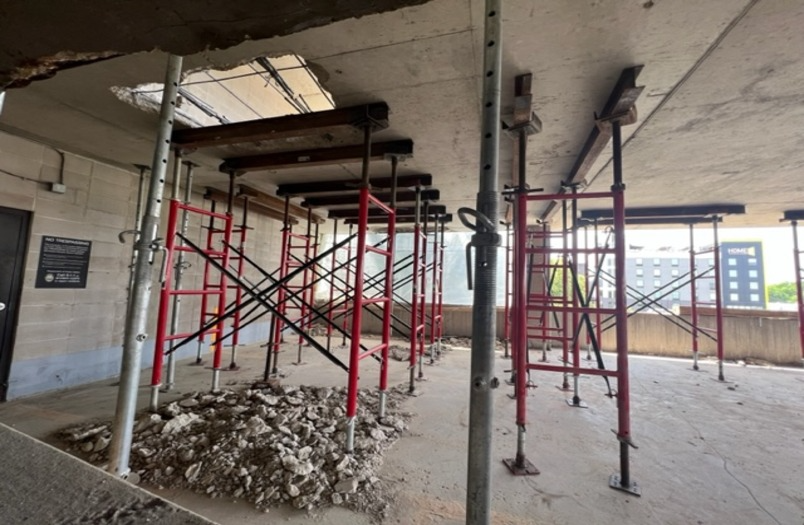
RSI Traffic Coating Systems in Action
These principles aren’t theoretical — here’s how RSI applies system-level thinking and rigorous surface preparation on real projects across the Midwest.
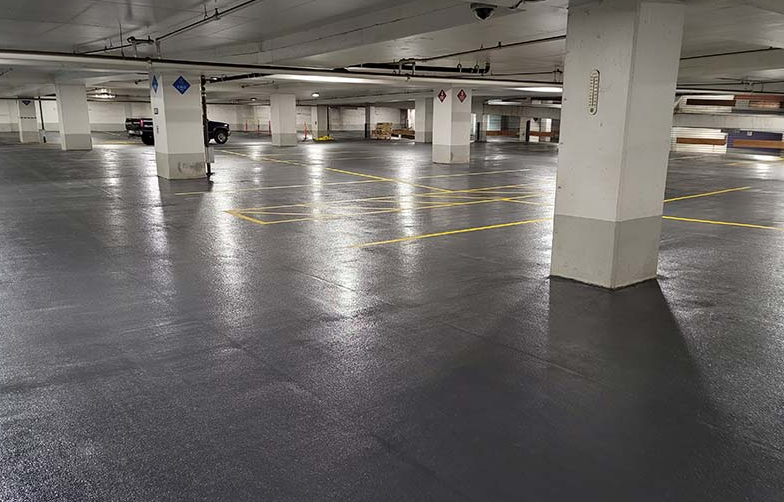
St. Paul, MN
St. Paul Parking Structure Rehabilitation
A multi-year municipal parking structure contract demonstrating full system thinking in practice. RSI addressed structural concrete repairs, sealant installation, expansion joint replacement, and 425,000+ SF of polyurethane waterproofing traffic-bearing membrane — an integrated approach, not just a re-coat.
View Project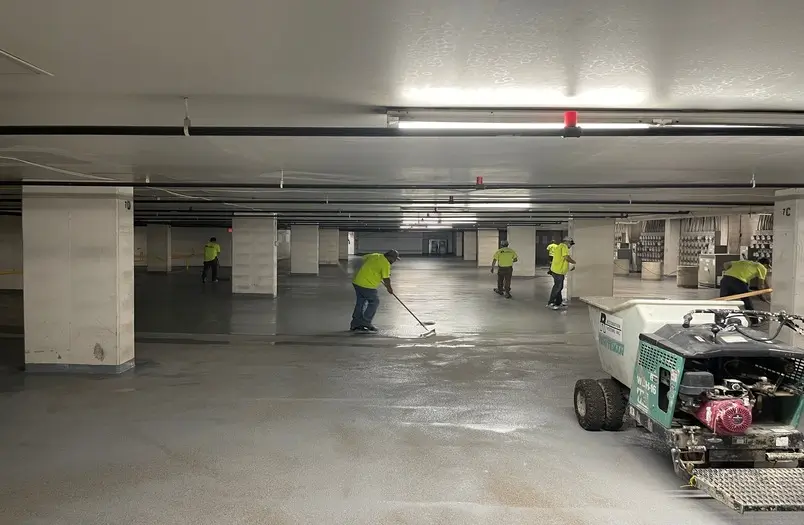
Minneapolis, MN
RiverWest Parking Garage
Full coating lifecycle completed in just one month: existing system removed, substrate properly prepared, then 156,000+ SF of new high-solids polyurethane membrane plus 65,000+ SF of silane penetrating sealer installed. Proof that doing it right doesn’t mean taking forever.
View ProjectRSI also applies this same systematic approach across the region, including parking ramp restoration in Appleton, WI and institutional projects like the University of Minnesota Prospect Park Ramp in Minneapolis — delivering traffic coating systems engineered for long-term performance regardless of structure type or scale.
Warning Signs Your Traffic Coating Is Failing
Here’s what to look for on your own structure. If you’re seeing multiple signs, your parking deck needs a professional assessment — not another patch job.
-
Persistent Water Leaks After Rain
If your parking structure is dripping water even well after it has rained, the coating system has failed. As Mike Hintsala describes it: “You’ll see diapers — plastic tarps to stop water from hitting the car directly. That tells you you have a bigger problem that you need to address.” Those tarps are a symptom, not a solution.
-
Repeated Repairs in the Same Area
Repairs should last. If you’re patching the same location more than once within five years, the repair isn’t addressing the underlying problem. As Hintsala notes: “If you’re repaired in the same area over and over again, something’s wrong.” Recurring failures typically indicate a systemic issue — not a localized one.
-
Expanding or Multiplying Crack Patterns
Cracks that are widening, branching, or appearing in new areas indicate excessive structural movement or progressive deterioration beneath the coating. “If you are seeing bigger cracks, more cracks, that indicates there’s some excessive movement or structural problem that they can’t identify without doing some investigation,” Hintsala explains.
-
Visible Coating Delamination or Peeling
When the traffic coating membrane is visibly separating from the concrete substrate — peeling, bubbling, or lifting at edges — adhesion has failed. This is frequently the result of improper original surface preparation and signals that the remaining coating is likely compromised as well.
-
Efflorescence or Staining on Undersides
White mineral deposits (efflorescence) or rust-colored staining on the underside of your deck indicates water is migrating through the concrete slab. Rust staining is particularly concerning, as it signals active corrosion of the embedded steel reinforcement — a structural issue that escalates rapidly.
-
Increased Trip Hazards or Surface Roughness
Sections of coating wearing through to bare substrate — particularly in turn lanes and helixes where tire friction is highest — indicate the coating system has exceeded its service life or was underspecified for the traffic conditions. Exposed concrete in these areas is now unprotected from water and chemical intrusion.
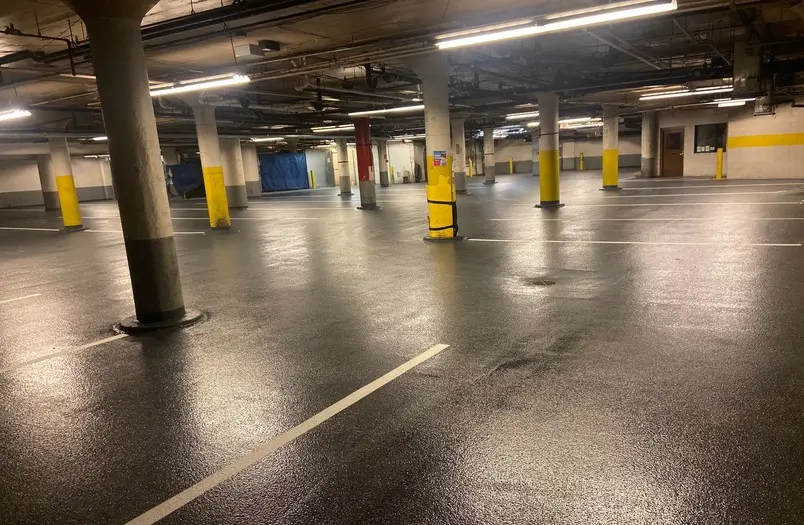
If you’re recognizing two or more of these warning signs on your parking structure, it’s time for a comprehensive professional assessment. Continued patching without addressing root causes only delays — and increases — the inevitable cost of proper system rehabilitation.
Prevent Failure Before It Starts
RSI doesn’t get called back to redo our own work — we get called to fix what other contractors did wrong. With a zero-warranty-failure track record and principals averaging more than 25 years’ experience, we deliver traffic coating systems that perform for the long term.
Whether you need a diagnostic assessment of an existing coating system or a comprehensive rehabilitation plan, RSI’s team has the expertise, equipment, and track record to protect your structure.