


The Science Behind Freeze-Thaw Damage
Understanding why concrete fails starts with understanding how water, temperature, and chemistry interact inside the material itself. Here’s what’s actually happening at the structural level — and why the Midwest’s climate makes it so much worse.
How Water Gets In
Concrete is porous by nature. Water enters through surface cracks, failed sealant joints, deteriorated expansion joints, and gaps in waterproofing systems. As Dylan Reynolds notes from his field inspections, “If there are voids in sealant joints, we look for evidence of water-related issues within the masonry — that could be spalling mortar joints, cracked brick, or rust buildup on the lintels.”
Older structures are especially vulnerable. Buildings constructed before air-entrained concrete became standard lack the microscopic air voids engineered to relieve internal pressure during freezing. According to ACI guidelines, properly air-entrained concrete should contain roughly 6% air content with a water-cement ratio at or below 0.45 — specifications many legacy structures were never built to meet.
What Happens When It Freezes
When trapped water freezes, it expands by approximately ~9%, exerting immense internal pressure that creates microcracking. Each freeze-thaw cycle widens existing cracks, which allows more water in, which freezes and expands further. As Dylan puts it, “That 9% expansion, when freezing, exerts immense pressure that cracks and weakens brick, stone, and mortar.” Dan Lephardt reinforces the point: the result is “microcracking, scaling, and spalling that accelerates every season.” This isn’t a single event — it’s a compounding cycle that gets measurably worse each winter.
In a Midwest climate delivering 60–80 of these cycles annually, even small initial cracks can progress to visible concrete spalling within just a few seasons.
The Salt Multiplier
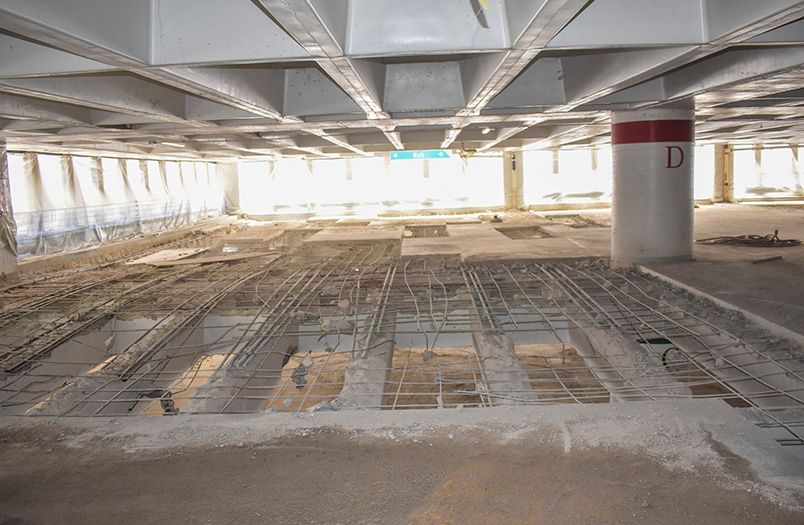
Chloride-laden deicers don’t just melt ice — they attack concrete from the inside out. Chlorides penetrate through cracks and pores, reach embedded reinforcing steel, and initiate corrosion once they exceed the critical threshold (roughly 1.0–1.5 lbs/yd³). Corroding rebar expands, creating even more internal pressure and accelerating concrete scaling and spalling. In parking structures where deicing salt exposure is constant, this chain reaction is especially aggressive.
“Moisture enables everything: freeze-thaw damage, rebar corrosion from chlorides combined with oxygen and water, and alkali-silica reaction risk in susceptible mixes. You can’t address the symptoms without addressing the water.”
— Dan Lephardt, Waterproofing & Building Envelope Specialist, RSI
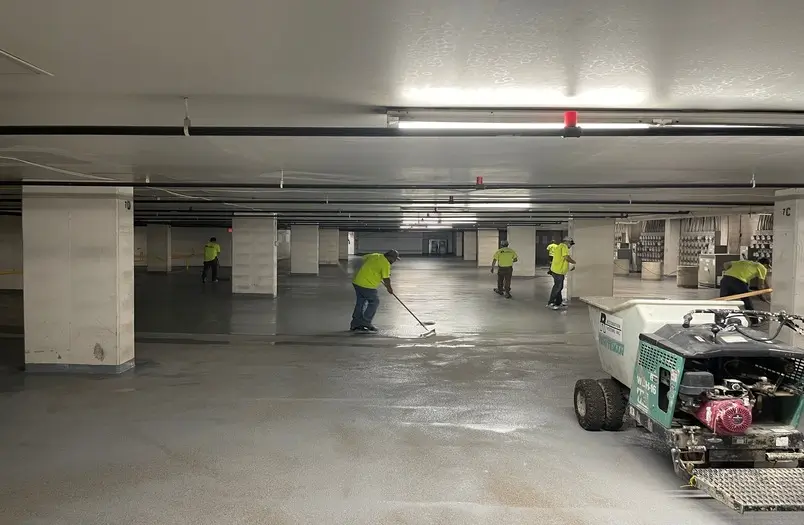
The wear compounds further at the surface level. Sand applied to prevent slips and falls, combined with chemical deicers, degrades traffic coatings and exposed concrete surfaces — shortening the lifespan of protective systems and exposing the substrate to even more moisture infiltration.