
Concrete Surface Preparation Methods: What Most Contractors Get Wrong
Industry data shows 60–80% of all coating failures trace back to one cause: improper surface preparation.
Not bad coatings. Not bad concrete. Bad prep. For parking structure owners in the Midwest, where freeze-thaw cycles, de-icing chemicals, and heavy vehicular traffic already push every system to its limits, concrete surface preparation methods aren’t a line item to minimize. They’re the foundation everything else depends on. Here’s how shot blasting, scarifying, and diamond grinding actually work, when each method is used, and why RSI’s approach has produced zero warranty failures across hundreds of projects.

The Real Cost of Cutting Corners
Key takeaways every building owner should know
- 60–80% of coating failures originate from improper surface preparation, not the coating material itself. Rushed or skipped prep leads to adhesion failure, surface damage, and dramatically shortened system life.
- Coating manufacturers specify required concrete surface profiles (typically ICRI CSP 3–5 for vehicular traffic coatings). Failing to meet these specifications voids warranty coverage and virtually guarantees premature failure.
- Shot blasting, scarifying/robotic grinding, and diamond grinding each achieve different profiles. The right method (or combination) depends on your project’s specifications, substrate condition, and coating system.
- RSI uses a two-step process: robotic grinders for coating removal and initial substrate preparation, followed by shot blasters to establish the precise manufacturer-specified surface profile.
- Across hundreds of projects, RSI has maintained zero warranty failures — a track record built on proper preparation per manufacturer specifications and verified by on-site manufacturer representative inspections.
RSI’s Two-Step Process: Robotic Grinding Meets Shot Blasting
Step 1
Robotic Grinding (Scarification)Most contractors still rely on hand-operated disc grinders for scarifying concrete — a labor-intensive process that produces inconsistent results. RSI takes a different approach. Our robotic grinders are a modern evolution of traditional scarification, controlled remotely to mill off existing traffic coatings and prepare the concrete substrate with consistent depth and uniform results across large areas.
“We utilize the robotic grinders… there’s really no one on their hands and knees grinding with a disc grinder. They’re standing up using a remote to remove that.” — Tayton, Branch Manager, RSI Minneapolis
Achieves ICRI CSP 4–9Step 2
Shot Blasting ConcreteAfter robotic grinding removes the existing coating, shot blasting delivers the final concrete surface profile. Steel shot is propelled at high velocity against the substrate, simultaneously cleaning residual material and creating the precise texture that the coating manufacturer specifies for proper adhesion.
Shot blasting operates as a closed-loop, self-contained system that collects spent media and debris for clean, efficient operation even in enclosed parking structures where dust containment and air quality are critical concerns.
Achieves ICRI CSP 3–7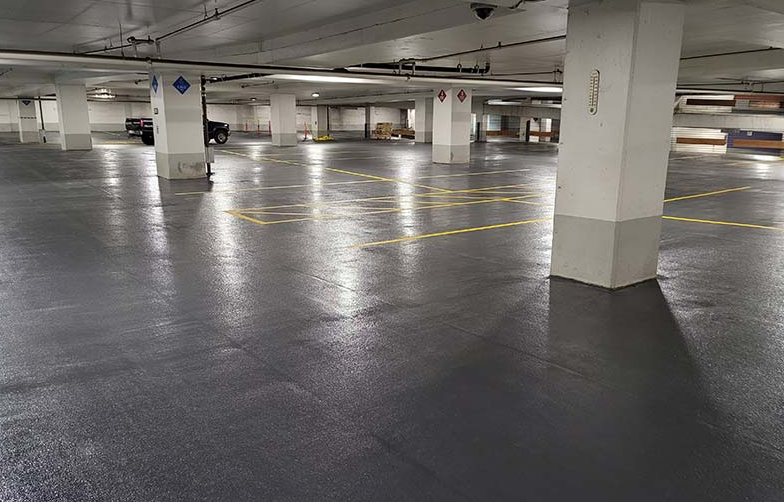
Diamond Grinding Concrete — Precision Surface Finishing
Not every surface calls for aggressive profiling. Diamond grinding uses diamond-impregnated segments for controlled, precise material removal, achieving smoother profiles in the ICRI CSP 1–3 range. It’s the method of choice for leveling uneven joints, preparing substrates for thin-film coating systems, or finishing localized areas that need a lighter touch. While not RSI’s primary method for full-deck traffic coating projects, diamond grinding plays a critical supporting role on projects with mixed surface conditions or specialty coating requirements. The key principle across all three methods: selection is always driven by manufacturer specifications, substrate condition, and the specific coating system being installed, never by convenience or cost-cutting.
Why Method Selection Is a Project-Specific Decision
Choosing the right concrete surface preparation method, or combination of methods, isn’t a generic decision. It depends on specific project conditions that RSI evaluates on every job before a single piece of equipment hits the deck.
Engineered Specifications
Plans and specs from the project engineer may dictate specific preparation methods and required ICRI concrete surface profiles. RSI’s team reviews every specification before mobilizing to ensure full compliance from day one.
Coating Manufacturer Requirements
Every traffic coating system specifies a required CSP range — typically CSP 3–5 for vehicular traffic membranes. Failing to meet these specifications voids warranty coverage and sets the stage for premature system failure.
Existing Coating Type & Thickness
Thicker or multi-layered failed coatings demand more aggressive initial removal before profiling can begin. RSI assesses existing coating conditions to determine the right sequencing: robotic grinding first, then shot blasting for final profile.
Substrate Condition
New concrete, previously coated concrete, and repaired concrete each require different preparation approaches. On projects like RSI’s Minneapolis Parking Structure, crews prepared both 15,000 SF of newly repaired concrete and original substrate on the same deck — each with distinct profile, moisture, and cure-time requirements.
Environmental & Site Constraints
Proximity to occupied spaces, noise restrictions, dust containment requirements, and seasonal temperature limitations all influence method selection. Most coating materials require 40°F+ ambient and overnight temperatures — making timing critical in the Midwest.
Midwest Climate Factors
Freeze-thaw cycling, chloride penetration from de-icing salts, and sand abrasion create a triple threat unique to Midwest parking structures. As RSI Branch Manager Tayton puts it: “The biggest thing we see is the wear and tear… the type of materials and chemicals being put on that parking structure” — all of which accelerate coating degradation and demand preparation methods that account for compromised substrates.
Quality Verification: How RSI Ensures Every Surface Is Ready
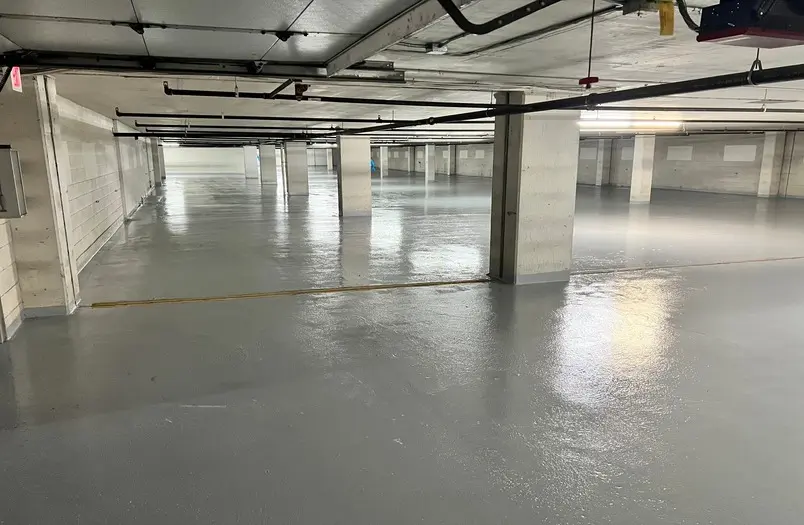
Getting the right concrete surface profile isn’t a single checkpoint at the end of the job. It’s a multi-layered verification system that runs throughout the entire process. At RSI, that system starts with our people. Every superintendent, project manager, and field crew member understands the manufacturer specifications and ICRI profile requirements for the coating system being installed. This knowledge isn’t siloed in an office. It lives in the hands of every person on the deck.
On warranty projects, RSI takes verification further by bringing coating manufacturer representatives on-site for visual inspection and formal sign-off. This isn’t a box-checking exercise. It’s a direct confirmation that the substrate meets every specification before a single coat of material goes down.
“We will have the manufacturer’s representative on site, just to verify… they know that we know the standard and we meet and exceed that standard.”
— Tayton, Branch Manager, RSI MinneapolisRSI’s institutional depth runs decades deep. Several team members have 30–40 years of experience in parking deck restoration — and some are literally returning to projects they originally installed to perform the next generation of coating removal and surface preparation. That kind of institutional memory means RSI’s crews recognize substrate conditions, hidden deterioration, and project-specific challenges that less experienced contractors would miss entirely.
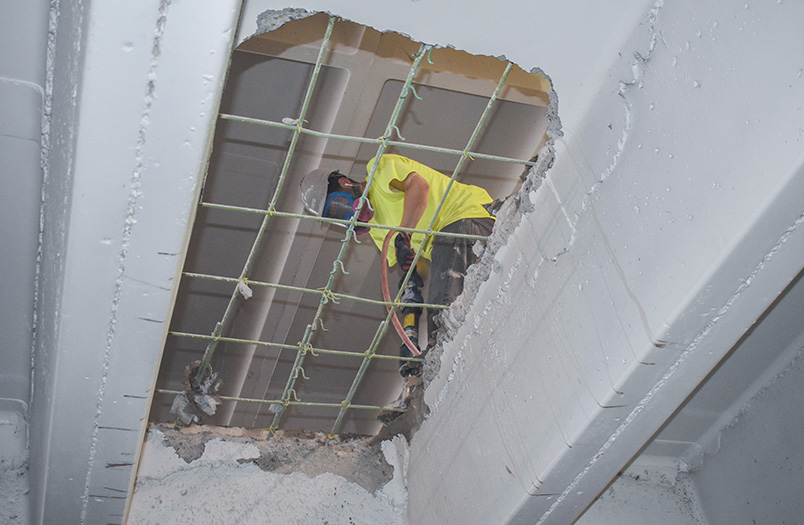
This experience matters because coating removal and surface prep frequently reveal conditions that were invisible beneath the old system — concrete deterioration, structural steel corrosion, and post-tension cable degradation that no one knew existed until the old coating came off. Experienced crews know how to identify, document, and address these hidden issues rather than coating over problems that will resurface as expensive failures down the road.
This multi-layer QA process (trained field teams, manufacturer on-site verification, and decades of institutional knowledge) is directly why RSI maintains a zero-warranty-failure track record. As Tayton explains: “We don’t have warranty issues. We don’t have failure issues because we’re doing the proper preparation per manufacturer’s specifications on the front end.” When preparation is done right from the start, failures on the back end simply don’t happen.
RSI Surface Preparation in Action
RSI’s surface preparation methodology has been proven across hundreds of Midwest projects — from targeted repairs to multi-million dollar rehabilitations. Here’s what proper parking deck surface prep looks like at scale.
Multi-year traffic bearing membrane installation requiring consistent surface preparation across an entire parking structure. RSI’s robotic grinder-to-shot-blaster process ensured uniform coating adhesion at massive scale. Learn more about RSI’s St. Paul operations.
Full coating removal and new traffic bearing membrane plus 65,000+ SF of penetrating sealer — two different coating systems requiring two different surface profiles, all completed within a single month. See RSI’s Minneapolis projects.
Traffic coating installation on both 15,000 SF of newly repaired concrete and original substrate — demonstrating how surface preparation adapts to mixed conditions on a single deck.
Surface Prep Done Right From Day One
Your traffic coating system is only as strong as the surface beneath it. RSI’s combination of robotic grinding technology, manufacturer-verified quality assurance, and decades of Midwest parking structure expertise means your project gets the concrete surface preparation it needs, done right, the first time. Whether you’re planning a coating replacement or assessing a parking structure for future work, our team is ready to help.