

The Standard, From a Practitioner Who Helped Build Its Benchmarks
Most articles about a repair code are written from the outside looking in. This one is not. Our RSI expert is ACI-certified for concrete work and was involved early with ICRI, the International Concrete Repair Institute, back when the field still lacked the field-verifiable benchmarks specifiers now take for granted.
“I’m ACI-certified for concrete work, and I was involved early with ICRI. I actually helped create some of the concrete-prep standards that are part of it.”
— RSI Expert
That history matters because of where that expert sits today. He helped define what an acceptable repair is supposed to look like, and now he builds repairs to those same definitions on the contractor side.
“I was one of the people setting the standards for what an acceptable repair is supposed to look like, and now I’m on the contractor side, doing the work to those same standards.”
— RSI Expert
This RSI expert has spent a long career in restoration and construction, much of it with RSI, across a wide range of concrete and parking-structure projects. The pages that follow walk through what ACI 562 actually asks for, how it differs from the code that governs new construction, and why the gap between a referenced standard and a met standard comes down to who does the work.
What ACI 562 Actually Requires
At its center, ACI 562 sets minimum requirements for the assessment, repair, and rehabilitation of existing structural concrete. What makes it useful to a specifier is how it sets those requirements. The code is performance-based rather than prescriptive. Instead of dictating one fixed recipe for every condition, it defines the outcomes a repair has to achieve, including safety, durability, and serviceability, and leaves the licensed design professional room to select materials and strategies suited to a structure’s age and condition.
It is worth being precise about who the code is written for. ACI 562 is written for use by a licensed design professional. It is not a contractor’s manual and it is not a substitute for one. It frames the engineering decisions, and the contractor executes to the design that results.
The standard exists because the industry once lacked a shared baseline for repair. Without minimum standards, repair reliability varied widely, and the result was a documented pattern the code was meant to end: repairs to the repairs. ACI 562 was the first material-specific, performance-based repair standard built to work alongside the International Existing Building Code, giving owners and design professionals a common reference point for what an existing-concrete repair has to accomplish.
Where it fits: ACI 562 is flexible about where it applies. It can supplement the IEBC, supplement the code adopted by the authority having jurisdiction, or stand alone where no existing-building code has been adopted at all.
One practical note before you cite it in a specification. ACI 562 has been updated through several editions since its introduction, so confirm the current edition that applies in your jurisdiction with your design professional before referencing it. And a fair caution: this article explains how the standard works and why it matters to owners and specifiers. It is not legal or code-compliance advice, and not every concrete repair project is legally required to follow ACI 562. Whether and how it applies to a given building is a question for your design professional and the authority having jurisdiction.
ACI 562 vs. ACI 318
Specifiers sometimes reach for ACI 318 on a repair because it is the concrete code they already know. The two codes answer different questions. ACI 318 sets minimum requirements for designing new structural concrete. ACI 562 takes over once a building has earned its certificate of occupancy and the question shifts from how to build it to how to keep it standing.
| New ConstructionACI 318 | Existing StructuresACI 562 |
|---|---|
| Minimum requirements for the design of new structural concrete. The baseline for building it the first time. | Minimum requirements for assessing, repairing, and rehabilitating concrete that is already in service. |
The distinction is not academic. Defaulting to ACI 318 on a repair, treating an existing building as if it were new construction, can force overly costly repairs or even push a structure toward demolition decisions that ACI 562 was written specifically to prevent.
The Three-Layer Standards Stack, and the “Referenced, Not Required” Gap
ACI 562 does not operate alone. On a real repair it sits on top of two other layers of guidance, and a specifier who understands all three writes a sharper scope. Our RSI expert frames the stack plainly.
- ACI. The structural, engineering side. How concrete behaves and is handled correctly, including details like placing it properly in hot weather.
- ICRI. The engineer- and contractor-based guidance for doing the repair itself correctly. The techniques used to get it right.
- Manufacturer standards. The rules that govern how a specific product is supposed to be used on the wall, the deck, or the patch.
“ACI standards are the structural, engineering side. ICRI is the engineer- and contractor-based guidance for doing concrete repairs. And then there are manufacturer standards, which govern how a specific product is supposed to be used.”
— RSI Expert
Where the CSP Profiles Come In
The ICRI layer is where this expert’s own fingerprints are on the standards. ICRI guidance covers surface prep, removal techniques, and repair geometry: what a repair is actually supposed to look like for a given material. A square-edge chip for hand patching, a tapered edge for other methods, bonding requirements, inspections. The roughness side of that prep is captured in the concrete surface profiles, or CSPs, the field-verifiable benchmarks a specification points to when it calls for bond. They run from a nearly flat surface up to a heavily roughened one, and he helped make the physical molds that let crews and inspectors match a real surface to the standard.
“A colleague and I went out and made the molds of those different prep techniques so the industry could use them as standards. They’re called concrete surface profiles, CSP, and there are ten of them.”
— RSI Expert
The Gap That Contractor Selection Closes
Here is the point that matters most to an owner. ICRI guidance is central to the industry, but on many projects it is referenced, not required. A specification can name the profile and the geometry, yet whether the field crew actually achieves them depends on who is holding the tools. That is why our RSI expert draws a line many in the industry blur.
“There has to be a clear distinction between commercial concrete work and commercial concrete restoration. The two get treated as the same thing far too often, and they aren’t.”
— RSI Expert
Pouring concrete and restoring it are different disciplines. The code and the ICRI guidance describe the target. The contractor decides whether you hit it.
Why the Upper Midwest Can’t Skip Standards-Based Repair
A patch that survives in a mild climate can fail fast here. The reason is the weather, and our expert puts climate at the top of the list.
“Climate is the number one factor. Without freeze-thaw cycles, concrete lasts a lot longer, and without heavy salt, it doesn’t corrode nearly as fast. In the Midwest, parking structures take the worst of it, because vehicles carry salt in, and salt corrodes reinforcing steel faster than almost anything else.”
Upper Midwest decks endure dozens of freeze-thaw cycles each winter. Each cycle expands the water trapped in micro-cracks and fractures the concrete matrix a little further from the inside. The failure that follows is predictable, and it runs in a chain.
- Freeze-thaw opens cracks. Repeated freezing widens the small fissures already in the slab.
- Water infiltrates. Those cracks become paths straight into the concrete.
- Salt-laden water reaches the steel. Meltwater carries road salt down to the reinforcing bar.
- Corrosion spalls the cover. Rusting steel expands, and the pressure pops the concrete cover off the deck.
Much of that damage is hidden until you start opening it up, which is why a thorough condition assessment matters and why he describes restoration as forensic work.
“Corrosion follows water, water follows cracks, and cracks come from freeze-thaw, and a lot of that is hidden. It’s like being a dentist: you find more as soon as you start drilling. Part of our job is helping owners understand that restoration is forensic, and that some contingency is normal.”
That chain also points to the cheapest place to break it. Stop the water and the rest of the sequence never gets started.
“What restoration really sells is keeping water out. If water doesn’t get into the concrete, the corrosion path never starts. Without water, it doesn’t happen.”
Standards-based repair is what makes that protection last. RSI’s work addresses root causes rather than symptoms, the difference between repair, restoration, and preservation that genuinely extends service life and ensures safety. Our expert sets a clear benchmark for what lasting should mean.
“A repair should last. What we aim for is a minimum of five years, and if you’re coming back to the same spot sooner than that, something was done wrong.”
Where RSI’s Lane Begins and Ends
One clarification protects everyone involved. RSI performs repair assessments, meaning what it will cost to fix the conditions you have. It does not perform structural-capacity assessments. That work requires a licensed professional engineer, so RSI partners with engineers hand in hand to get that side addressed and then executes to the engineer’s design.
“We do repair assessments, what it will cost to fix the conditions you have. What we don’t do is structural-capacity assessments; that requires a licensed professional engineer, so we partner with engineers hand in hand to get that side addressed.”
Who Does the Work Determines Whether the Standard Is Met
If the ICRI guidance behind a repair is referenced but not always required, then the specification only describes the target. The contractor decides whether the field result actually reaches it. That is why RSI self-performs the restoration scope rather than working as a specialty sub buried under another firm’s schedule and budget.
“We operate as the general contractor on our work, not a specialty sub working under someone else. That means we control our own output, our schedule, and our cost, and that control is what protects the quality of the repair.”
— RSI Expert
That control is scoped to RSI’s own restoration work. It is not a claim to broad construction responsibility, and it is separate from the engineering side. RSI prices and executes the repair, while the licensed engineer owns the structural-capacity design that RSI builds to.
The reason control matters is that a repair is not an off-the-shelf product. It’s a service, not a commodity, and a good contractor treats it that way by walking owners through the trade-offs rather than handing over a single number with no explanation behind it.
“We can build a repair to last two years, ten years, or twenty-five. The real question is what the owner is actually after, and a good contractor walks you through those options instead of just handing you a number.”
— RSI Expert
The credentials behind that promise are not abstract:
- Union-trained craftsmen doing the surface prep, removal, and placement to the profile a specification calls for.
- An EMR well below the national average, a safety record built over decades of restoration work rather than a slogan.
- 28+ years of trusted restoration work across the Upper Midwest, focused on repair, restoration, and preservation.
RSI Projects in the Field
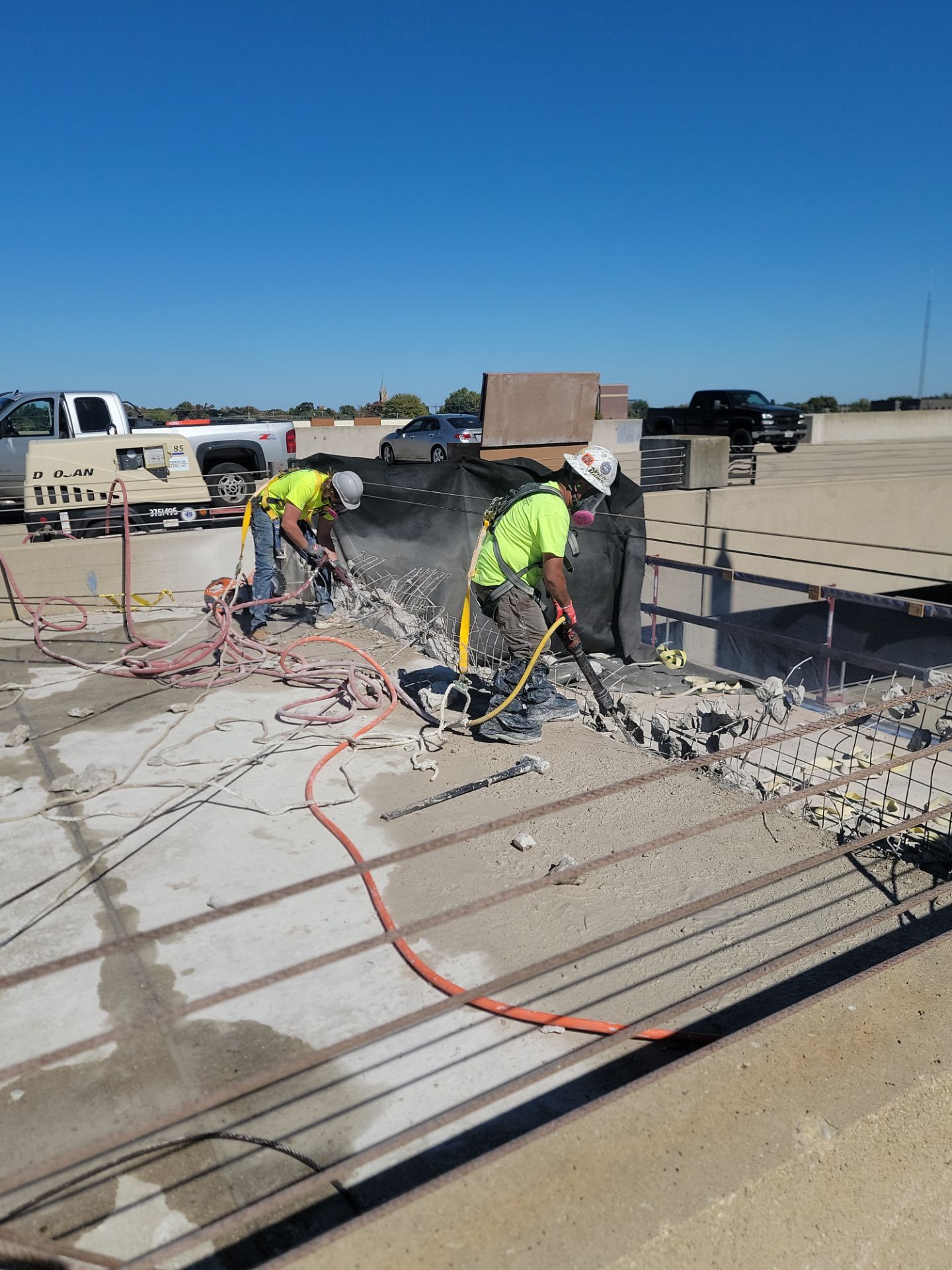
Standards only count when they survive a real parking structure. These are recent RSI restoration projects across the Upper Midwest, captured in the field as crews carried out coating, surface prep, and structural repair work.
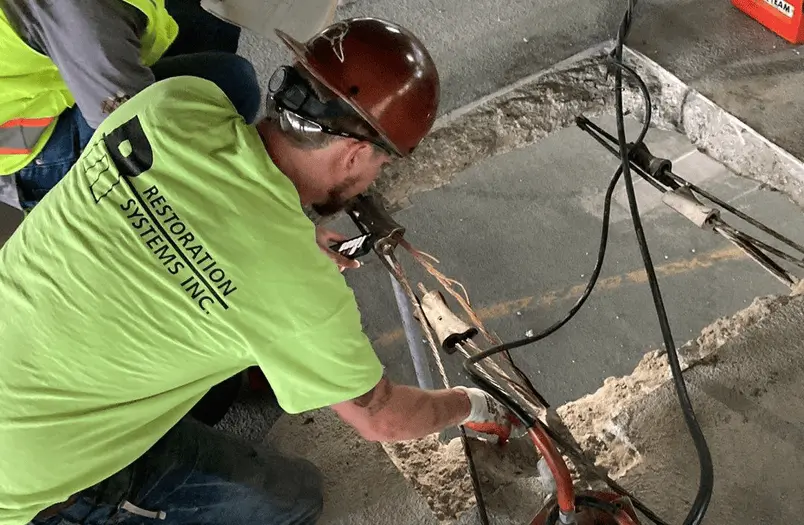
Parking structure restoration in Green Bay, WI.
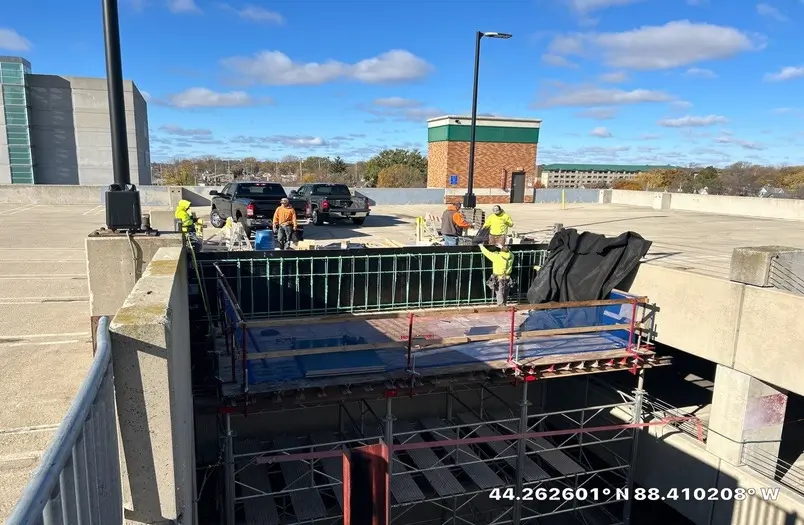
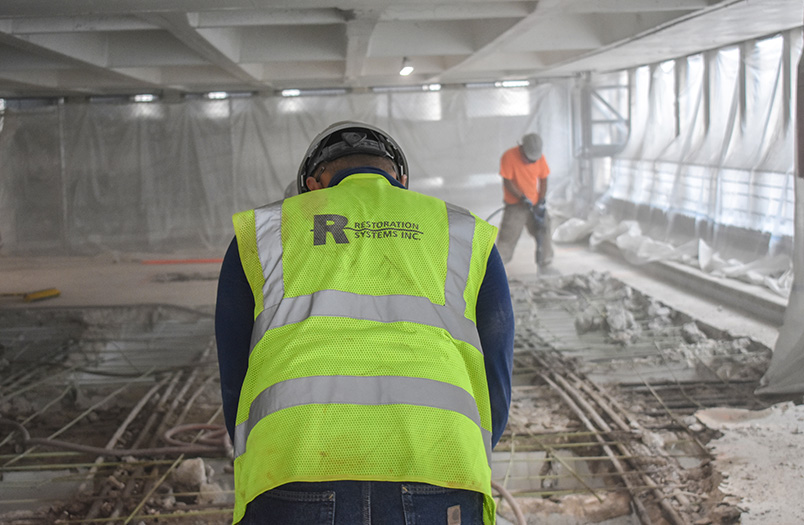
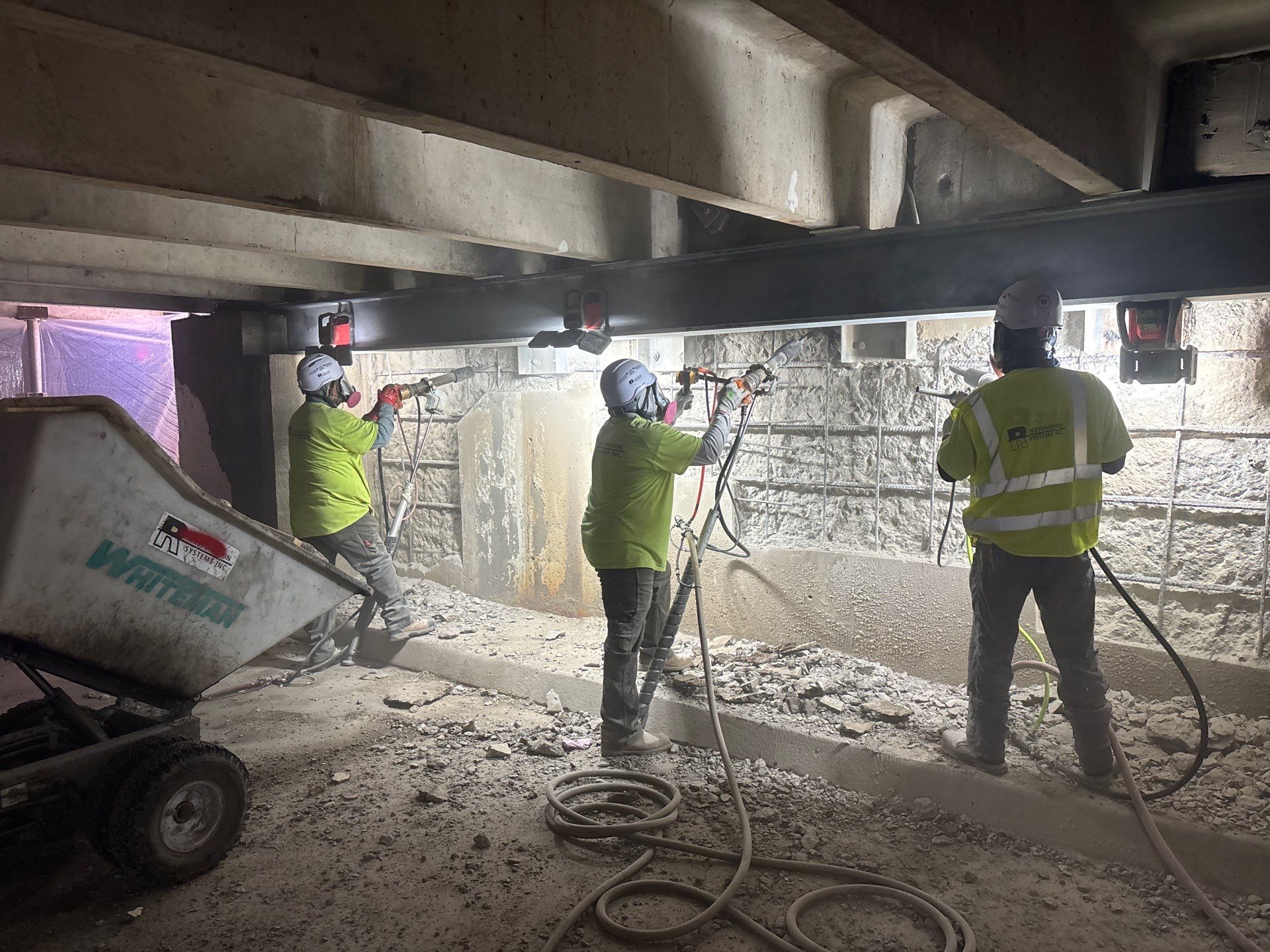
Appleton Parking Ramp
Emergency shoring of a 27,000 lb precast barrier panel on the 5th story, precast panel demolition, a retrofit cast-in-place barrier wall with custom weld clips and anchorages, and structural concrete repairs. Approximately three months (Sept–Nov 2024).
RiverWest Parking Garage
156,000+ SF of traffic-bearing membrane and 65,000+ SF of penetrating sealer alongside structural concrete repairs, completed in approximately one month.
Bloomington Parking Ramp
Supporting structural shoring work on a parking ramp, part of RSI’s ongoing restoration record across the Upper Midwest.
ACI 562 Concrete Repair Code: Common Questions
Quick answers for owners and specifiers weighing how the existing-structures repair code affects their next concrete project.
What is ACI 562 and what does it require?
ACI 562 sets minimum requirements for the assessment, repair, and rehabilitation of existing structural concrete. It is performance-based rather than prescriptive: instead of dictating one fixed recipe, it defines the outcomes a repair has to achieve, including safety, durability, and serviceability, and leaves the licensed design professional room to select materials and strategies suited to the structure’s age and condition. It was the first material-specific, performance-based repair standard built to work alongside the International Existing Building Code.
What’s the difference between ACI 562 and ACI 318?
ACI 318 sets minimum requirements for designing new structural concrete, while ACI 562 governs assessing, repairing, and rehabilitating concrete that is already in service. Defaulting to ACI 318 on a repair treats an existing building as if it were new construction, which can force overly costly repairs or even push a structure toward demolition decisions that ACI 562 was written specifically to prevent.
Is ACI 562 legally required for every concrete repair project?
No. ACI 562 can supplement the IEBC, supplement the code adopted by the authority having jurisdiction, or stand alone where no existing-building code has been adopted, and not every concrete repair project is legally required to follow it. The standard has also been updated through several editions, so confirm the current edition and whether it applies to your building with your design professional and the authority having jurisdiction.
What are concrete surface profiles (CSPs) and why do they matter?
Concrete surface profiles, or CSPs, are the field-verifiable roughness benchmarks a specification points to when it calls for bond between a repair material and the existing concrete. There are ten of them, running from a nearly flat surface up to a heavily roughened one, with physical molds that let crews and inspectors match a real surface to the standard. They are part of the ICRI guidance that governs surface prep, removal techniques, and repair geometry.
Why do concrete repairs fail faster in the Upper Midwest?
Climate is the number one factor. Upper Midwest decks endure dozens of freeze-thaw cycles each winter: freezing widens small cracks, water infiltrates, salt-laden meltwater reaches the reinforcing steel, and the rusting steel expands until it pops the concrete cover off the deck. Parking structures take the worst of it because vehicles carry salt in, and salt corrodes reinforcing steel faster than almost anything else.
How long should a standards-based concrete repair last?
RSI’s benchmark is a minimum of five years: if you’re coming back to the same spot sooner than that, something was done wrong. A repair can also be built to last two years, ten years, or twenty-five depending on what the owner is actually after, and a good contractor walks you through those options instead of just handing you a number. Restoration is a service, not a commodity.