
Commercial Waterproofing Systems: Below-Grade to Plaza Deck Solutions
Why the Midwest’s toughest waterproofing challenges demand systems thinking — not just better products.

TL;DR: What Property Managers Need to Know
Key takeaways from 25+ years of commercial waterproofing experience
- Roughly 90% of waterproofing failures occur at transitions, terminations, and penetrations — it’s a system problem, not a product problem.
- Commercial waterproofing spans below-grade foundations, plaza decks, and building envelope transitions — each with different strategies and trade-offs.
- Both hot-applied and cold fluid-applied systems deliver fully adhered, seamless, flexible membranes — selection depends on project conditions, not product superiority.
- Drainage is integral to every waterproofing system, not an optional add-on — design for water to leave, not for coatings to fight water.
- Midwest freeze-thaw cycling demands systems designed for movement and thermal stress — the wrong approach accelerates the deterioration you’re trying to prevent.
- Properly installed systems last 25–40+ years with minimal maintenance when drainage, details, and protection are done right.
Why Commercial Waterproofing Is a System, Not a Product
According to industry data from IIBEC (formerly RCI), roughly 90% of waterproofing failures occur at transitions, terminations, and penetrations — not in the field of the membrane itself. That statistic reframes the entire conversation. The membrane is rarely the problem. The details around it are.
“Because water only needs one weak link. You can install the best membrane made, but if the termination isn’t sealed, drainage is missing, or penetrations aren’t detailed… you still leak. Systems manage water, movement, and transitions — product-only thinking is why ‘we re-coated it and it still leaks.'”
— Dan Lephardt, RSI MilwaukeeWhen RSI says “commercial waterproofing systems,” we mean controlling bulk water and vapor across the entire building envelope using assemblies that tie together structure, drainage, and air/water barriers. In practice, that spans below-grade applications (foundations, elevator pits, tunnels, parking structures), above-grade work (façade transitions, curtainwall perimeters, sealants, flashing), horizontal surfaces (plaza decks, podiums, balconies, terraces), and every joint and penetration that connects them.
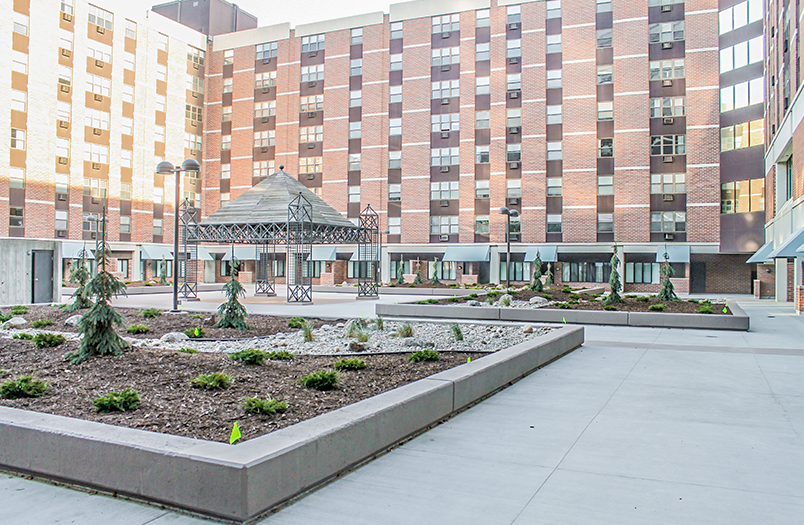
Think of it like a chain: membranes handle broad-area waterproofing, flashing directs water out at interruptions, sealants bridge gaps at perimeters and penetrations, and expansion joint systems absorb large movement without tearing. Each component must overlap and tie into the next with compatible chemistry and movement capacity. When one link fails, water finds its way in — and with an estimated 75% of building envelope warranty claims related to water infiltration, the stakes are significant.
The most vulnerable points on any commercial building? Transitions between wall and roof, wall and plaza, parapets, copings, and shelf angles. Openings at windows, curtainwall perimeters, and louvers. Horizontal surfaces subjected to traffic, movement, and weather. And below-grade, where cold joints, tie holes, and penetrations are buried and inaccessible after construction.
Understanding Below-Grade, Plaza Deck, and Above-Grade Applications
Every waterproofing decision starts with two questions: where is the water coming from, and can you access the source side?
Below-Grade Waterproofing
Access is limited, hydrostatic pressure is higher, and details matter exponentially more — because once the system is buried, you can’t inspect or maintain it. Positive-side membranes applied to exterior foundations before backfilling are always the preferred solution. Blind-side and negative-side options exist when excavation isn’t feasible.
- Foundations & retaining walls
- Elevator pits & tunnels
- Parking structures
- Positive-, blind-, or negative-side options
Plaza Deck & Podium Waterproofing
Plaza decks are the most demanding commercial waterproofing application — combining every variable simultaneously. When failures occur, the leak often appears far from the actual point of water entry, making diagnosis costly and repair disruptive.
- Constant thermal + structural movement
- Traffic wear & complex transitions
- Drainage sensitivity & ponding risk
- Leaks show far from entry point
Above-Grade Envelope Waterproofing
Above-grade, you can usually stop water on the positive side — the exterior face of the building. Membranes, flashing, sealants, and rainscreen principles intercept water before it enters the assembly, with the advantage of ongoing inspection access.
- Façade transitions & curtainwall perimeters
- Sealants, flashing & rainscreen
- Copings, parapets & shelf angles
- Positive-side exterior intervention
Positive-Side vs. Negative-Side Waterproofing
Positive-Side (Preferred)
Stops water on the outside — the source side — before it enters the structure. Applied to the exterior face of foundations, walls, or decks before backfilling or covering. Keeps both the interior dry and the structure itself protected from moisture-driven deterioration.
Negative-Side (When Access Is Limited)
Treats the inside after water has already passed through the structure. May reduce interior leakage, but doesn’t stop the structure from being wet — meaning corrosion, freeze-thaw damage, and long-term deterioration can still progress behind the treatment.
How Fluid-Applied Waterproofing Membranes Work
RSI specializes in both hot rubberized asphalt and cold fluid-applied waterproofing systems. Both deliver a fully adhered, seamless, flexible waterproof membrane that commonly incorporates a drainage system and protection course. The right choice depends on project conditions — access, fire restrictions, substrate readiness, and timeline — not on one system being inherently superior to the other. Both are proven, high-performance solutions for demanding commercial applications.
The 5-Layer Assembly
A fluid-applied waterproofing membrane is an assembly, not just a coating. Each layer serves a specific function, and skipping any one of them compromises the entire system:
- 1 Primer promotes adhesion between the substrate and membrane — skipping it is one of the most common construction shortcuts that leads to early failure.
- 2 Fluid-applied membrane is installed at a controlled thickness, creating a monolithic waterproof layer bonded directly to the concrete substrate.
- 3 Reinforcing fabric is embedded at transitions, terminations, and stress points — the exact locations where 90% of failures occur.
- 4 Protection course shields the membrane from damage during backfill, overburden installation, or work by subsequent trades.
- 5 Drainage and overburden manage water flow away from the membrane and protect the complete system for its full service life.
Key Performance Characteristics
- Seamless — no laps to fail
- Fully bonded — prevents lateral water migration
- High elongation — accommodates structural movement
- Self-sealing — around minor penetrations
Midwest Climate Demands
Water expands approximately 9% when it freezes — in saturated concrete and masonry, that expansion drives microcracking, scaling, and spalling that accelerates every season.
Midwest winters cycle above and below freezing repeatedly, and that cycling destroys waterproofing systems not designed for it. Moisture trapped in or behind an assembly enables the full deterioration cascade: freeze-thaw damage to concrete, rebar corrosion accelerated by chlorides and water, and efflorescence and bond loss in masonry systems. Cold weather also limits primers, coatings, and sealants — often requiring phased execution where you stop the water now and complete permanent repairs in proper conditions. In this region, drainage isn’t optional. It’s foundational.
“Good practice: design for water to leave, not for coatings to fight water forever.” — Dan Lephardt
What Separates Expert Installation from Costly Failures
Waterproofing that lasts 25–40+ years and waterproofing that fails within 5 often use the same materials. The difference is entirely in how those materials are installed, detailed, and protected.
What Quality Looks Like
- Surface prep is thorough and verified — dust, moisture, and laitance are addressed before membrane application begins
- Temperatures are controlled — material, substrate, and ambient conditions are monitored throughout installation
- Thickness is documented — coverage rates are tracked to ensure consistent, specified membrane depth
- Details are reinforced, not rushed — transitions, terminations, and penetrations get the time they require
- Protection is installed immediately — the membrane is shielded before other trades can damage it
- Drainage is treated as critical — not secondary, not optional, not value-engineered out
“Experience shows up in consistency, detail work, and problem-solving — not just speed.” — Dan Lephardt
Where Things Go Wrong
- Poor substrate prep — dust, moisture, or laitance left on the surface compromises adhesion from day one
- Improper membrane thickness — thin spots and holidays create failure points that surface months or years later
- Skipping reinforcement at transitions — the exact locations where movement and stress concentrate
- Membrane damaged before protection — subsequent trades puncture or abrade the membrane during construction
- Missing or incorrect flashing — through-wall flashing, end dams, and counterflashing omitted during original construction
- Value-engineering out the “boring parts” — drainage mats, primers, and end dams cut from scope to save cost
“Most hot-applied failures are installation-related, not material failures.” — Dan Lephardt
RSI Commercial Waterproofing in Action
From urban logistics to large-scale system replacement, these projects demonstrate systems thinking in practice.
Plaza Deck System Replaced
Concrete Pour Window
Expected System Life
Downtown Milwaukee Plaza Deck
Milwaukee, WI — Elevated Plaza, Urban Setting
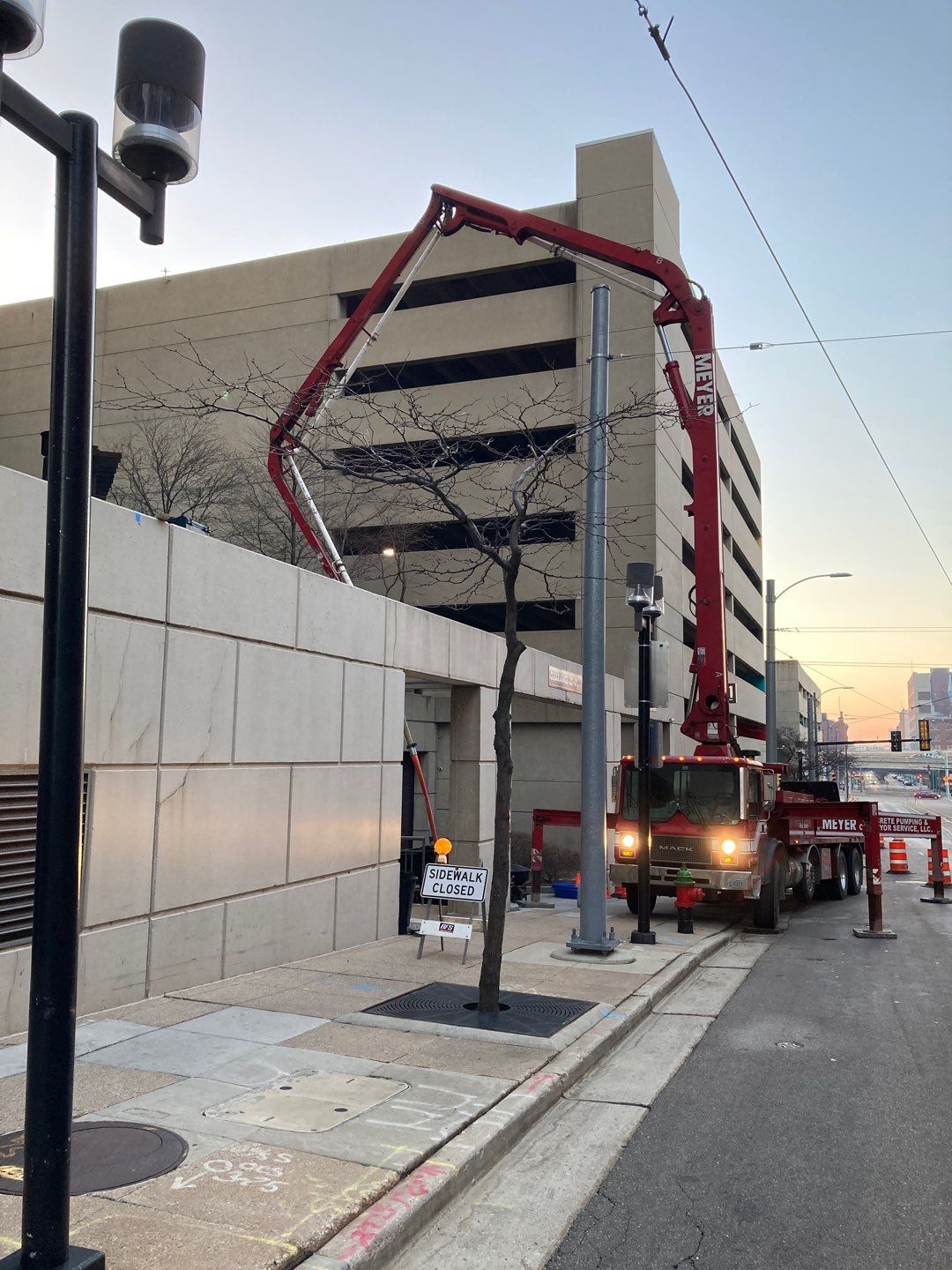
RSI completed a hot-applied waterproofing repair on an elevated plaza deck in downtown Milwaukee — directly adjacent to the city’s light rail, which prohibited long-term street closures. The team coordinated a debris chute to an off-street staging area, performed QA inspections at every phase (substrate prep, membrane thickness, termination detailing), and employed third-party Electric Field Vector Mapping (EFVM) testing per ASTM D7877 to verify the system was leak-free before burial. The concrete wearing slab re-pour required a city variance for a lane closure on N. Milwaukee St., a concrete pump threaded through high-voltage light rail lines, and three loads of ready-mix placed and finished within a 6-hour window. Completed on time and at budget.
Mears Park Place Apartments
St. Paul, MN — Multi-Family Residential
A multi-year, 56,000-square-foot full plaza deck waterproofing system replacement on occupied residential apartments. Scope included removal of the existing system, installation of Tremproof 6100, concrete overlay replacement, drain and drain pipe replacement, and planter rebuilding — demonstrating systems-level waterproofing at scale with phased execution that kept tenants operational throughout.
W Hotel at Foshay Tower
Minneapolis, MN — Historic Landmark
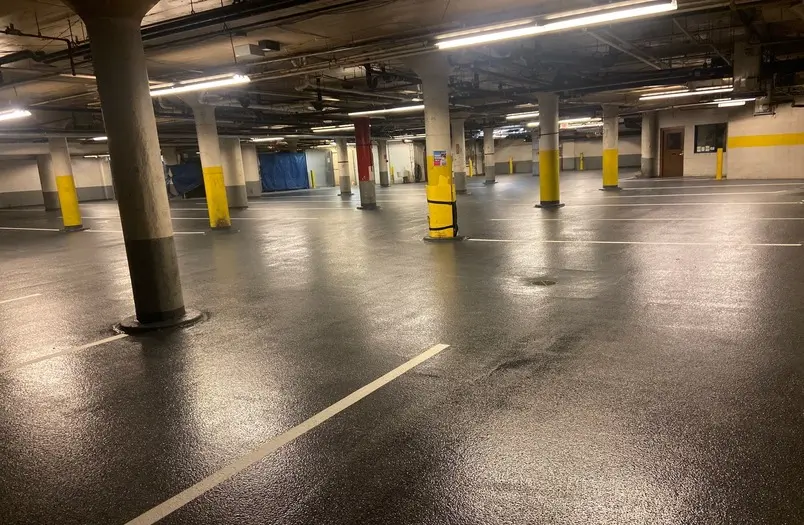
At this occupied historic landmark, RSI removed the existing waterproofing system to uncover hidden concrete distress — proving the principle that you can’t diagnose what’s buried without opening it up. Concrete repairs, plumbing work, and new waterproof traffic coating were completed in close coordination with hotel and restaurant operations over a 2-month window.
What to Look for in a Commercial Waterproofing Contractor
The difference between a waterproofing project that performs for decades and one that requires re-work within years almost always comes down to the contractor’s diagnostic approach and installation discipline. Before approving any scope of work, Dan recommends property managers ask five critical questions:
Questions to Ask Before Approving Repairs
- What is the root cause — and how do we know?
- Is this a system repair or a patch?
- How are terminations, transitions, and drainage being addressed?
- What is the expected service life and maintenance plan?
- What warranty is offered — and what voids it?
RSI approaches every project with a restoration mindset — we understand how buildings fail over time, and we scope accordingly. That means:
- Root-cause diagnostics — pathway mapping, not just symptom sealing
- Detail-driven scope — transitions, terminations, and drainage addressed explicitly in every project
- Phased options — urgent stabilization vs. full system rehabilitation, matched to budget and timeline
- Full documentation — findings, conditions, and prioritized recommendations for accountability
Properly installed commercial waterproofing systems last 25–40+ years with minimal maintenance. Most issues arise from damage above the membrane — pavers, concrete, landscaping — not the membrane itself. Address small leaks early, budget for investigations rather than just repairs, inspect sealants, joints, and drainage annually, inspect sealants, joints, and drainage annually, and think in lifecycle costs rather than patch-to-patch spending. The best waterproofing investment is the one that performs invisibly for decades.
Protect Your Building with RSI’s Waterproofing Expertise
From below-grade foundations to plaza decks, RSI’s waterproofing specialists diagnose root causes and deliver commercial waterproofing systems that last 25–40+ years. Let’s talk about your building.