
The 7% Rule: The Compounding Cost of Deferred Maintenance in Commercial Real Estate
Understanding the true cost of waiting on facade repairs – and why proactive planning protects both your building and your budget.

What Property Managers Need to Know
- Facade work is often viewed as cosmetic until a crisis occurs—leading to exponentially higher repair costs down the road.
- Industry data shows deferred maintenance compounds at 7% or more annually, turning manageable repairs into major capital projects.
- At the 15-year mark (when sealant joints reach end-of-life), accumulated damage can call building viability into question.
- Midwest freeze-thaw cycles accelerate deterioration—water expands 9% when it freezes, creating immense pressure inside masonry pores.
- Proactive planning delivers predictable budgets versus emergency spending that can cost up to 6.7 times more than planned maintenance.
Cosmetic Until Crisis
“Facade work is often viewed as cosmetic until a crisis occurs,” says Dylan Reynolds, Project Manager at Restoration Systems Inc. It’s a pattern he sees repeatedly across commercial properties throughout the Midwest—building owners and property managers who recognize the early signs of deterioration but struggle to prioritize repairs against competing demands.
The challenge isn’t ignorance. Smart property managers understand their buildings. They see the hairline cracks in mortar joints, notice the sealant pulling away from window frames, and recognize discoloration patterns that signal water intrusion. The problem is that facade maintenance rarely feels urgent—until it becomes an emergency.
“Projects that had they been identified five or six years prior would have been exponentially less invasive.”Dylan Reynolds, Project Manager, RSI
Think of it like vehicle maintenance. Skip one oil change, and nothing happens. Skip several, and you’ve set in motion a chain of consequences that ends with engine failure. Building envelopes work the same way. Water finds its way in through failed sealant joints. It saturates masonry. Steel reinforcement begins to corrode. The corrosion expands, spalling concrete or cracking brick. Each stage makes the next one worse, and more expensive to address.
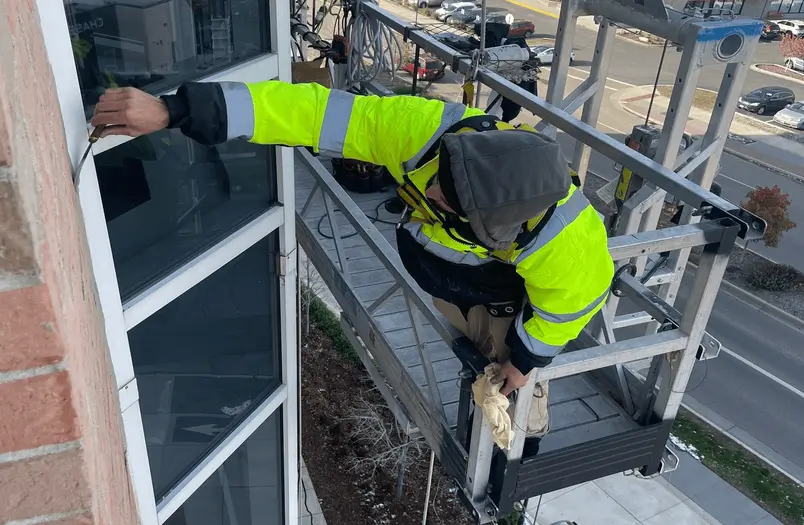
The real frustration for property managers is that they often know action is needed. They’re working within budget constraints, balancing capital requests across multiple building systems, and answering to ownership groups with competing priorities. When the roof needs attention and the HVAC is aging out, facade repairs can feel deferrable. They’re not, but understanding why requires looking at the math.
The Numbers Behind Deferred Maintenance
Industry data quantifies what property managers see in the field
Industry data shows deferred maintenance compounds costs significantly each year. What costs $50,000 today becomes $107,000 in ten years.
When water freezes in masonry pores, it expands with immense pressure—breaking apart brick, mortar, and concrete from the inside out.
Your first line of defense has a finite lifespan. Once sealant joints fail, water intrusion accelerates deterioration throughout the building envelope.
How Costs Compound Over Time
At RSI, we’ve developed an ROI methodology that shows clients exactly what they’re choosing between: predictable spending now versus paying exponentially more later when emergencies force them to act. The following illustrative example shows a typical scenario: a Midwest commercial property with approximately 100,000 square feet of facade, roughly 30-40 years old, deciding between a proactive maintenance plan and a reactive or deferred approach. The numbers tell a clear story across a typical 15-year building envelope cycle.
Years 1-3: The Warning Signs
Sealant joints begin failing. Minor cracks appear in mortar. A proactive plan identifies these issues and begins phased restoration work. On the deferred path, spot repairs mask symptoms without addressing root causes.
Years 5-6: The Divergence Point
On the proactive path, Phase 1 restoration is complete. The building envelope is sealed, water intrusion is stopped, and future phases are budgeted. On the deferred path, water has been entering the building for years, and corrosion is beginning.
Years 8-10: Structural Issues Emerge
Buildings on the deferred path begin showing serious problems: spalling concrete, corroding steel, compromised anchors. What started as sealant failure has cascaded into structural concerns. Meanwhile, proactive buildings are completing their restoration program and entering maintenance mode.
Years 12-15: The Reckoning
At this point, proactive buildings require only routine maintenance (approximately $10,000 annually). Deferred buildings face major reconstruction. The compounding effect has multiplied costs substantially. Some owners face a difficult question.
“By the time visible damage appears, the underlying issues have often been progressing for years. Early intervention isn’t just cost-effective; it preserves options that disappear once deterioration advances too far.”Dylan Reynolds, Project Manager, RSI
The question of whether accumulated damage has made restoration economically unfeasible is one no property manager wants to face. It’s also entirely avoidable with planning that begins early and proceeds systematically.
Proactive vs. Reactive: A 15-Year Comparison
Two approaches to the same building, dramatically different outcomes
| Factor | Proactive Approach | Reactive Approach |
|---|---|---|
| Years 1-5 | Phased restoration begins; sealant replacement and targeted repairs completed on schedule | Spot repairs only; visible problems patched without addressing underlying water intrusion |
| Years 6-10 | Major restoration phases complete; building envelope fully protected | Structural issues emerge; corrosion damage becomes visible; emergency repairs required |
| Years 11-15 | Maintenance mode (~$10K/year); routine inspections and minor touch-ups only | Major reconstruction required; steel replacement, concrete repairs, full facade work |
| Total Cost | Predictable, budgeted over 10 years | Up to 6.7x higher than proactive approach |
| Tenant Disruption | Minimal, planned around operations | Extensive emergency work; potential closures |
| Safety Risk | Addressed proactively before hazards develop | Life safety hazards possible; facade ordinance citations |
| Budget Control | Full control; phased capital planning | Emergency-driven; unpredictable capital demands |
The Midwest Factor: Freeze-Thaw Cycles
Everything described accelerates here in the Midwest. Our region’s climate creates conditions that are particularly punishing to building envelopes—and particularly unforgiving of deferred maintenance.
The mechanism is straightforward but relentless: water enters masonry through failed sealant joints, hairline cracks, or deteriorated mortar. In milder climates, that water might cause gradual damage over decades. Here in Minneapolis, Milwaukee, and throughout the Midwest where we service, it causes damage every single winter.
Water expands by approximately 9% when it freezes, generating thousands of pounds of pressure per square inch inside masonry pores. This pressure breaks apart brick, mortar, and concrete from the inside out.
The damage compounds with each freeze-thaw cycle. And in a typical Midwest winter, buildings experience dozens of these cycles. Each one widens existing cracks, creates new entry points for water, and pushes deterioration further along the cascade from surface damage to structural failure.
“Because of the extreme effects of the freeze-thaw cycle in the Midwest during our winters, spring and summer is when we see cracks and damage emerge.”Dylan Reynolds on why spring inspections reveal accumulated damage
Sealant joints serve as the first line of defense against water intrusion. When they’re intact, water runs off the building surface. When they fail, water enters—and in the Midwest, that water will freeze. The 12-15 year sealant lifecycle isn’t just a maintenance recommendation; it’s a clock counting down to accelerated deterioration.
Spring is when the accumulated damage becomes visible. Spalled brick faces, cracked mortar, efflorescence patterns, and rust staining all tell the story of water that entered during fall rains, froze and expanded throughout winter, and is now revealing the consequences. Property managers who schedule spring inspections consistently find more damage than they expected because freeze-thaw cycles work all winter while no one is watching.
Making the Case to Ownership
Property managers often find themselves in a difficult position: they understand what their buildings need, but they must make the case to ownership groups who are balancing multiple properties, competing priorities, and finite capital budgets. The key is providing the data that enables informed decisions.
“We always want to provide them with enough information to make an informed decision.”Dylan Reynolds on RSI’s consultative approach
Our approach is consultative: we help you present the math clearly to stakeholders—what does maintenance cost now, what will it cost in five years, and what are the risks of waiting? When owners see the compounding cost data and understand how water intrusion cascades into structural failure, they can make informed decisions about where to allocate capital. Our role is to provide the analysis; the decision is always yours.
RSI offers free building evaluations specifically to support this process. The assessment provides property managers with documented conditions, prioritized recommendations, and cost projections they can present to ownership. It’s ammunition for the budget conversation: objective data from experienced professionals who understand Midwest building science.
What a Building Evaluation Provides
A comprehensive assessment of your building envelope: sealant joint condition, masonry integrity, waterproofing status, and structural concerns. You’ll receive prioritized recommendations with cost estimates, giving you the documentation needed to make informed capital planning decisions.
The goal is simple: give property managers and owners the information they need to choose between predictable spending and emergency-driven costs. Most choose predictability once they see the numbers.
Frequently Asked Questions
Common questions about deferred maintenance costs and building preservation
What is the “7% rule” for deferred maintenance?
+The 7% rule is an industry guideline indicating that deferred maintenance costs compound at approximately 7% annually. This means a $100,000 repair postponed for five years doesn’t just cost $100,000 later—it typically costs $140,000 or more due to progressive deterioration. Water infiltration spreads, structural damage compounds, and what started as a surface repair becomes a systemic restoration project.
How do I know if my building has deferred maintenance issues?
+Common indicators include visible cracks in masonry or concrete, deteriorated sealant joints, water staining on interior or exterior surfaces, spalling concrete, efflorescence (white salt deposits) on brick, and mortar joint erosion. If your building is over 15 years old and hasn’t had a professional envelope assessment, scheduling one is a prudent first step. Many issues aren’t visible from ground level and require close inspection.
How much does a building envelope assessment cost?
+RSI offers complimentary building evaluations for commercial properties in our service area. The assessment provides documented conditions, prioritized recommendations, and cost projections—the data you need to make informed capital planning decisions. There’s no obligation; we believe informed building owners make better long-term partners.
What’s the difference between maintenance and capital improvement?
+Maintenance preserves existing conditions—resealing joints, replacing damaged mortar, patching concrete. Capital improvements upgrade or extend building systems—full facade restoration, new waterproofing membranes, structural reinforcement. The distinction matters for budgeting and tax treatment. When maintenance is deferred too long, what should have been routine maintenance escalates into capital improvement territory, with corresponding cost increases.
How do I make the case for building maintenance to ownership?
+Focus on the financial reality: present current repair costs versus projected costs if work is delayed, document the compounding nature of deterioration, and quantify risks (emergency repairs, tenant disruption, potential liability). A professional assessment provides objective third-party documentation. Owners respond to data: show them the math comparing proactive maintenance to reactive emergency repairs, and most will choose predictability.
What building systems should be prioritized for maintenance?
+Water management systems should always be the top priority—roofing, sealant joints, waterproofing membranes, and drainage. Water is the primary driver of building deterioration in the Midwest. Once water enters a building envelope, it triggers cascading damage: freeze-thaw cycling cracks concrete, moisture corrodes rebar, trapped water promotes mold, and structural integrity degrades. Keeping water out prevents the majority of costly repairs.
Schedule Your Free Building Assessment
We really specialize in working within people’s budgets to achieve the long-term health of their buildings. Let us evaluate your property and show you exactly where you stand: no pressure, just data.
The Midwest’s leading restoration company since 1997. Concrete repair, masonry repair, and waterproofing specialists with 25+ years of experience exceeding expectations.