
Limestone Restoration: Repair vs. Replacement for Historic Commercial Buildings
Limestone on historic Midwest buildings demands a preservation-first approach — but knowing when to repair versus replace requires field expertise most contractors lack. Here’s the decision framework RSI uses after reviewing over 1,000 facades and navigating 20+ Historic Preservation Committee projects across the region.

Key Takeaways
- Repair is always the default for historic limestone — replacement is only warranted when a stone can no longer carry load or shed water.
- Minor spalling and surface cracking can be patched; large cracks, displacement, or concentrated deterioration in a single piece require full replacement.
- Using repair materials harder than limestone — high-strength concrete patches or Type S mortar — triggers cascading damage to surrounding stones.
- Custom color matching is an iterative, multi-round process involving field samples, supplier coordination, and lab analysis — not a one-and-done pick from a catalog.
- Historic Preservation Committee navigation adds complexity most building owners don’t anticipate — partner with a contractor who has direct HPC experience.
Repair vs. Replacement: How to Make the Right Call on Historic Limestone
At RSI, the default on every historic limestone restoration project is preservation. As Dylan Reynolds puts it: “Replacement is only used when repair is unfeasible — just when the stone is beyond the point of being able to be structurally patched.” That philosophy isn’t just good stewardship. It’s backed by the same federal standards that govern historic preservation across the country.
The Secretary of the Interior’s Standards for Historic Preservation — Standard #6 — directs that deteriorated historic features be repaired rather than replaced wherever possible. NPS Preservation Brief #2 further warns that incompatible repair materials are among the primary causes of accelerated masonry failure on historic buildings. RSI’s repair-first approach isn’t just field wisdom — it’s aligned with the federal framework that governs historic building work nationwide.
So how does RSI determine when limestone repair vs. replacement is the right call? Dylan’s team evaluates four criteria on every stone piece: structural stability, material condition, safety risk, and long-term performance. Minor spalling and surface cracking can typically be patched with a specialized limestone patching mix while maintaining the structural integrity of the original stone. But it’s not just the quantity of cracks that matters — it’s their severity and concentration within a single piece.
“It comes down to the structural feasibility of the repair,” Dylan explains. “Large cracks or a significant amount of cracking in one piece of stone would require replacement at that point.” When a stone can no longer reliably carry load or shed water — due to large cracks, displacement, or significant concentrated deterioration — replacement becomes the right call. Visual inspection by experienced assessors is often sufficient to make this determination, though RSI also provides lab analysis reports documenting material composition and compatibility when projects involve Historic Preservation Committee oversight.
Critically, repair and replacement often happen on the same project. This is a per-piece decision, not an all-or-nothing choice. On a single facade, some stones may be patched while others require full replacement — each evaluated individually against the structural feasibility test. That distinction matters for property managers budgeting commercial stone restoration work: the goal is always to preserve as much original material as possible while ensuring lasting structural performance.
The Hidden Risk: Why Material Compatibility Makes or Breaks Limestone Repairs
One of the most damaging mistakes in limestone restoration is also the most common: treating stone like brick. “I think a lot of contractors treat stone just like brick,” Dylan says. “Treating stone like brick can cause cracking, staining, or accelerated decay within stone facades.” Stone is heavier, more variable in size, and often part of historic architecture that demands more delicate handling and engineering. The procedures that work for brick can destroy limestone.
The first critical error is using high-strength concrete patching material to repair limestone spalls. Because these patches are harder than the surrounding stone, they prevent natural flexing — and the result is a domino effect. “We have seen other contractors previously utilize a high-strength concrete patching material to repair small spalls in limestone,” Dylan explains. “That does lead to not only the need for further repair of that individual piece, but all of the surrounding and adjacent pieces deteriorating, cracking, spalling, and displacing from the facade.”
The second mistake is equally destructive: using the wrong mortar type. Limestone is an extremely soft, porous material that requires a soft-composition mortar — like Type O or historic lime mortar — allowing the stone to move without cracking. Per ASTM C270, Type S mortar has a compressive strength of approximately 1,800 psi — over 5× stronger than Type O at roughly 350 psi. When that rigid mortar is used around limestone, it becomes harder than the stone itself. “That can lead to displacement of the facade materials, because the mortar that’s utilized is actually harder and more rigid than the stone itself,” Dylan warns. NPS Preservation Brief #2 confirms that incompatible mortar is a primary cause of historic masonry failure.
The principle is straightforward: repair materials must be softer than or equal to the existing stone — never harder. One bad patch or one incompatible mortar joint doesn’t just damage that spot. It creates a chain reaction that can turn a minor limestone spalling repair into a major replacement project, compounding both cost and scope.
Custom Color Matching and Midwest Climate Protection
Historic limestone repair isn’t just structural — it’s visual. Much of the original limestone across Minneapolis likely came from the same quarries, but decades of weathering create natural color variation across a facade. Achieving a seamless repair requires what Dylan calls “an artistic piece” — custom color matching that blends new material invisibly with the original stone.
RSI’s process is iterative and client-centered. The team takes field samples directly from the building, then works with specialized suppliers through multiple rounds of physical custom color match samples. “We go through several rounds with our suppliers of receiving physical samples of custom color matches and blends,” Dylan explains. “We present those to ownership groups, and we’ll repeat that cycle until our clients are fully satisfied.” On a 2023 project involving decorative limestone panels damaged by decades of salt exposure, RSI developed three close color matches — all meeting Historic Preservation Committee standards — and ultimately used two different custom blends on different building elevations for optimal results. Lab analysis reports documenting material composition and compatibility are standard practice on these projects.
Protecting Limestone from Midwest Winters
Limestone is extremely vulnerable to the Midwest’s harshest elements. Water infiltration, freeze-thaw cycling — where trapped moisture expands by approximately 9% when it freezes, exerting immense pressure that cracks and weakens stone — and chloride exposure from road salt all accelerate deterioration. In the Minneapolis area, buildings can experience 60 to 80 freeze-thaw cycles per year, making this a relentless threat. Building bases adjacent to sidewalks are especially at risk, where limestone’s porosity makes it a magnet for salt and moisture damage.
That’s why RSI installs protective clear penetrating sealers after stone work, particularly at building bases. “Without that, you can see very early deterioration due to the moisture and salt exposure that you see around the bases of buildings,” Dylan notes. It’s a proactive lifecycle extension measure — not just a repair technique — and one that can significantly delay the next restoration cycle for historic limestone buildings across the region.
RSI Limestone Restoration in Action
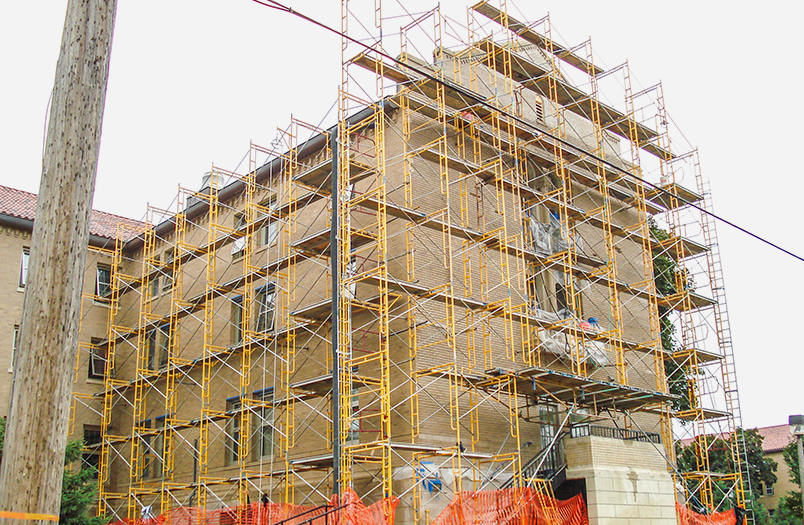
Lourdes Hall, Winona State University
Winona, MN · 6-Month Project
When limestone deterioration crosses the repair threshold, replacement at scale becomes necessary. Decades of deferred maintenance on this historic university building required 150 individual Indiana Limestone pieces to be replaced with compatible stone sourced to match the original construction — a clear case where the structural feasibility test pointed decisively toward replacement.
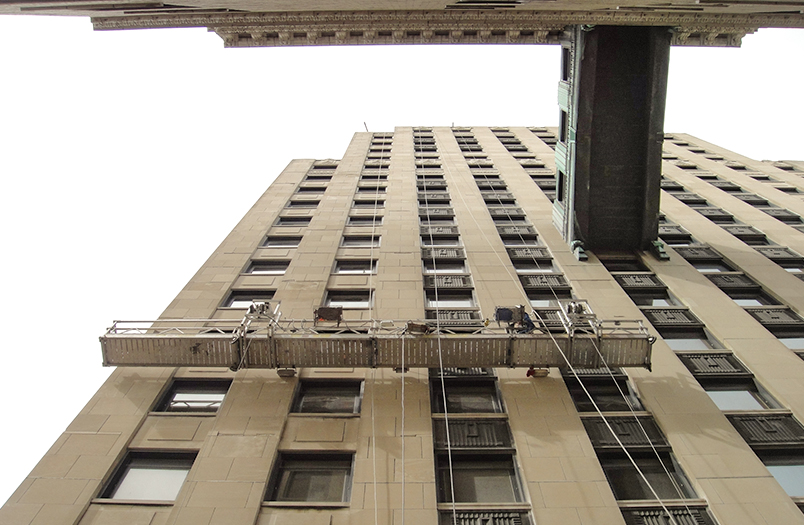
First National Bank Building
St. Paul, MN · 8-Month Project
This commercial landmark demonstrates the per-piece decision framework in practice. RSI evaluated each stone individually across 1,000 SF of facade — patching where structurally feasible and replacing where necessary. Repair and replacement coexisted on the same project, with each intervention chosen based on the structural condition of that specific piece.
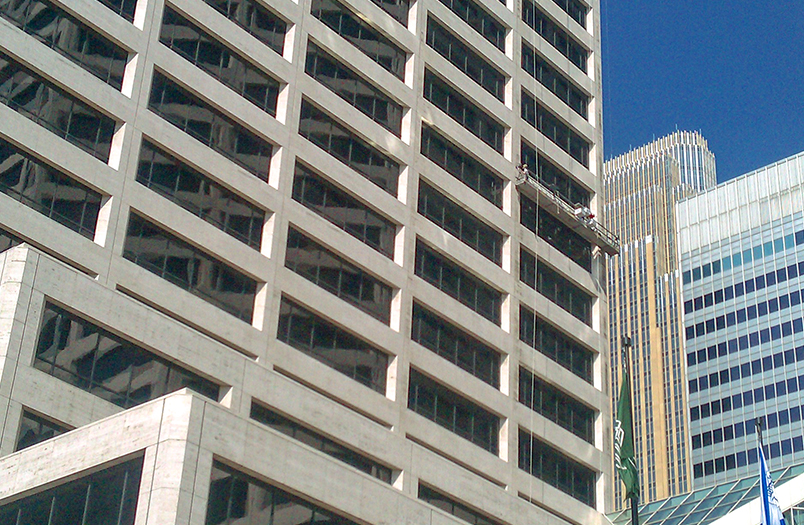
US Bank Plaza · Minneapolis, MN
Stone repair and replacement across 20-story and 40-story twin towers on a 5-year phased contract — proving RSI handles limestone restoration at any scale, with phased budgeting that makes large projects manageable.
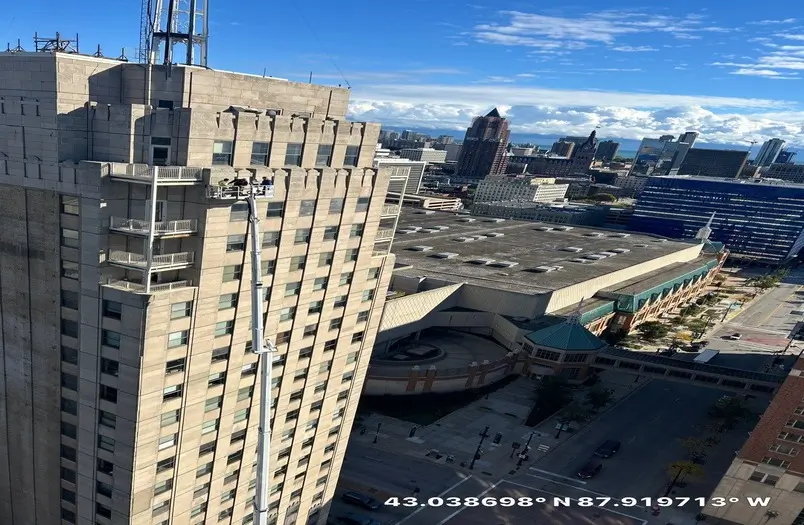
Wisconsin Tower Condominiums · Milwaukee, WI
Stone patching and anchoring on this Art Deco landmark’s 35,000 SF facade — illustrating the specialized technique of pinning heavier stone to substructure for secondary support, completed in just 20 days.
What to Look for in a Limestone Restoration Contractor
Not every masonry contractor has the specialized expertise that historic limestone demands. Use this checklist when evaluating potential partners for your next project.
-
Historic Preservation Committee Experience
Can they navigate the HPC approval process — including submittals, revision rounds, and public committee hearings? The process is labor-intensive and daunting for building owners. RSI has guided clients through 20+ HPC projects at no additional charge, turning a complex regulatory requirement into a manageable step.
-
Material Compatibility Knowledge
Ask what mortar type they’d use around limestone. The answer should be Type O or historic lime mortar — never Type S. If they can’t explain why material hardness matters for limestone spalling repair, they may not understand the stone well enough to work on your building safely.
-
Custom Color Matching Capabilities
Will they go through multiple rounds of physical samples with field sampling and supplier coordination, or just pick the closest off-the-shelf option? Lab analysis documenting material composition and compatibility should be standard — not an afterthought.
-
Repair-First Philosophy
Do they default to preservation, or jump straight to replacement? A qualified restoration contractor treats replacement as a last resort, aligning with the Secretary of the Interior’s Standards for historic building work. Every original stone preserved is a piece of your building’s history retained.
-
Phased Project Planning
Can they structure restoration work across multiple budget years? RSI has extended standard 12-month HPC permits to 4-year permits through additional documentation and permitting layers — helping budget-constrained clients get the limestone restoration they need on a manageable timeline.
Protect Your Building’s Legacy
Whether your historic limestone building needs targeted repairs or a comprehensive restoration plan, the right approach starts with an expert assessment. RSI’s team brings 25+ years of experience and deep Historic Preservation Committee knowledge to every project — so you can preserve your building’s legacy with confidence.