
The Science of Spalling: Why Midwest Concrete Fails Faster and How to Stop It
Midwest concrete endures 60–100+ freeze-thaw cycles every year, and each one compounds the damage from the last. Two distinct failure paths — both driven by expansion — are silently destroying parking structures, commercial buildings, and infrastructure across the region. Here’s the material science behind why it happens, and what you can do to stop it.

Key Takeaways
- All concrete spalling traces back to one root cause — expansion from water infiltration, whether through freeze-thaw cycling or rebar corrosion.
- Two paths, same failure: Freeze-thaw expansion bursts the concrete itself, while chloride corrosion expands rebar and breaks the concrete from within.
- Midwest concrete endures 60–100+ freeze-thaw cycles per year, each cycle compounding damage from the last — making our region uniquely destructive to concrete structures.
- Waterproofing is the single most effective prevention — “if the water doesn’t get in the concrete, the corrosion path doesn’t happen. Period.”
- Annual inspections are essential — by the time you notice trip hazards or falling concrete, the damage is already well advanced beneath the surface.
How Spalling Actually Works: The Expansion Mechanism
Every case of concrete spalling — whether it’s a flaking parking deck or a crumbling column — traces back to a single mechanism: expansion. Water gets into the concrete, and something inside expands with enough force to break it apart. There are two distinct paths this takes, but both lead to the same result. Understanding these paths is the first step toward stopping the damage before it compounds.
Freeze-Thaw Expansion
When water penetrates concrete — particularly concrete that lacks proper air entrainment — it fills microscopic pores and capillaries within the material. When temperatures drop below freezing, that water expands by approximately 9% in volume. According to T.C. Powers’ hydraulic pressure theory (published by the American Concrete Institute), this expansion generates internal pressures that can exceed 30,000 psi.
Concrete’s tensile strength? Just 300–700 psi. The math is devastating. The concrete literally cannot withstand the force, and the surface begins to fracture, scale, and spall. In the Midwest, this doesn’t happen once — it happens 60–100+ times per winter.
Corrosion Expansion
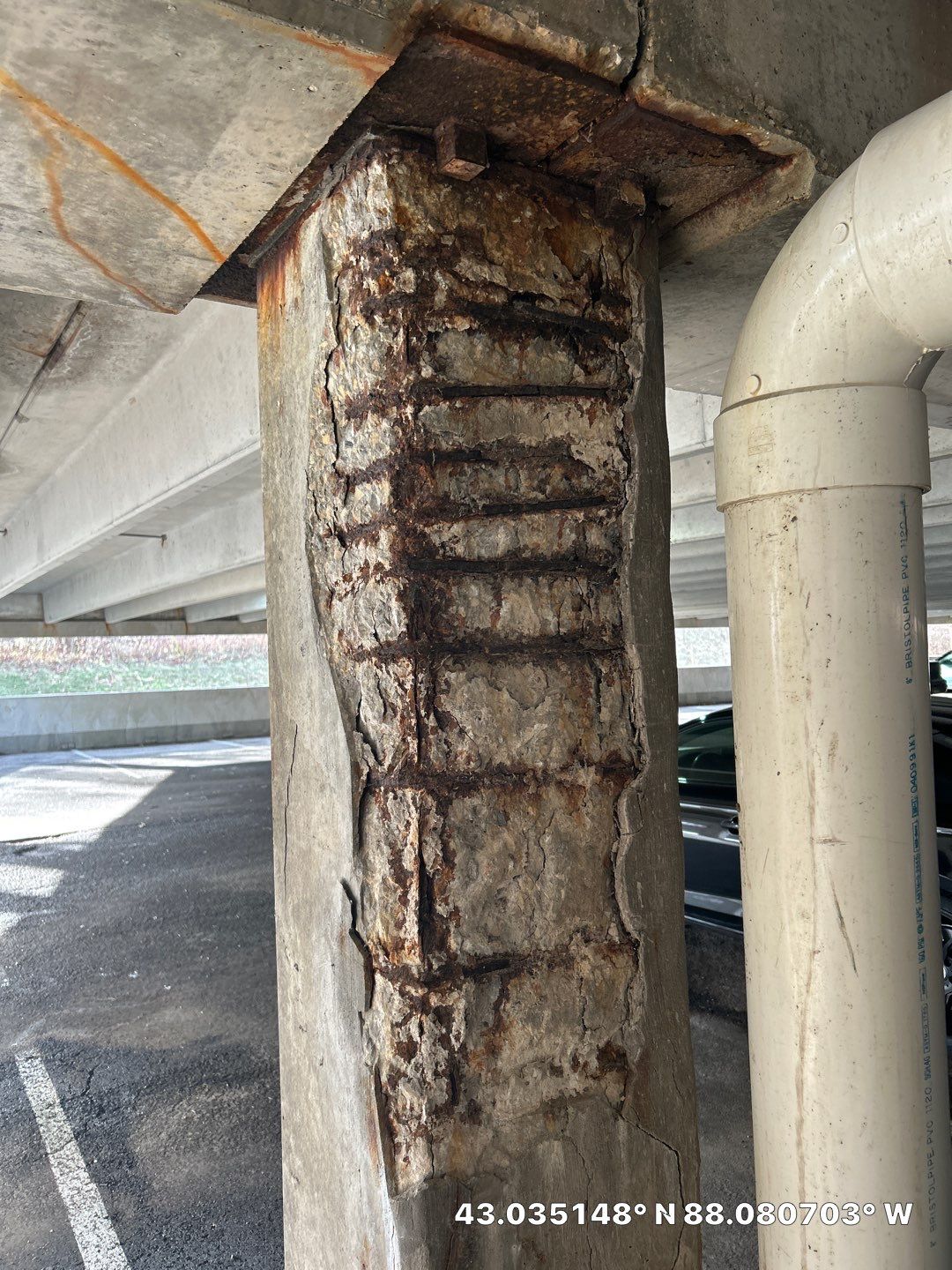
The second expansion path is slower but equally destructive. When salt-laden water — carried in by every vehicle during winter — reaches the reinforcing steel (rebar) inside concrete, it triggers an electrochemical corrosion process. Chloride ions from deicing salts break down the passive oxide layer that normally protects steel.
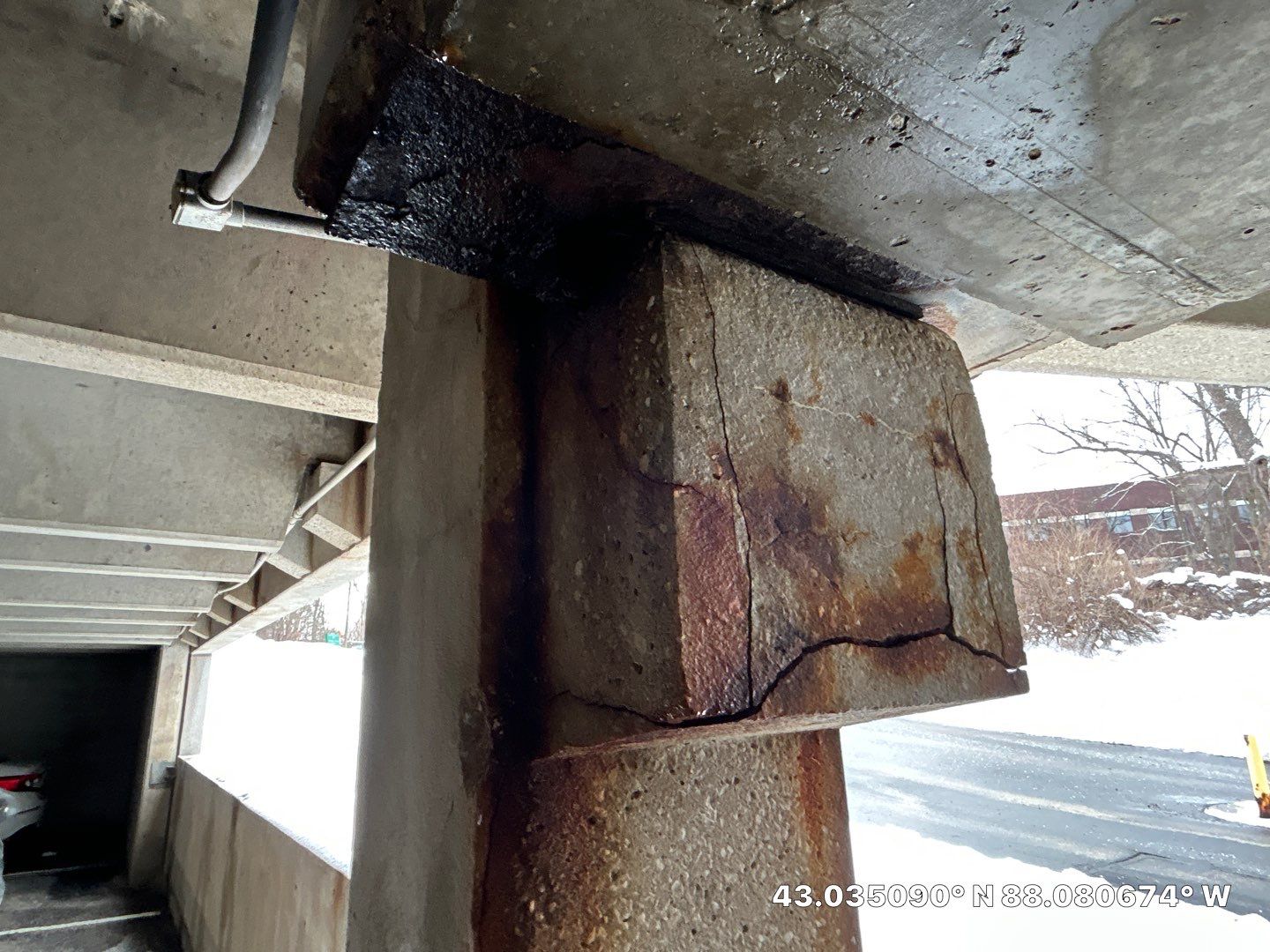
As rebar corrodes, it forms iron oxide (rust) that occupies 2–6 times the volume of the original steel, according to NACE International corrosion data. This expansion generates enormous outward pressure, cracking and delaminating the concrete cover from the inside out. By the time you see rust staining on the surface, the damage beneath is already significant.
“So spalling is caused by two different things. I should say it’s caused by the same thing, expansion. If the concrete wasn’t air entrained, water goes inside the concrete. It freezes. The water expands and busts the concrete. If salty water gets to reinforcing, it corrodes and expands and busts the concrete.”— Mike Hintsala, RSI Expert
The Crack Cycle: How Damage Compounds Each Winter
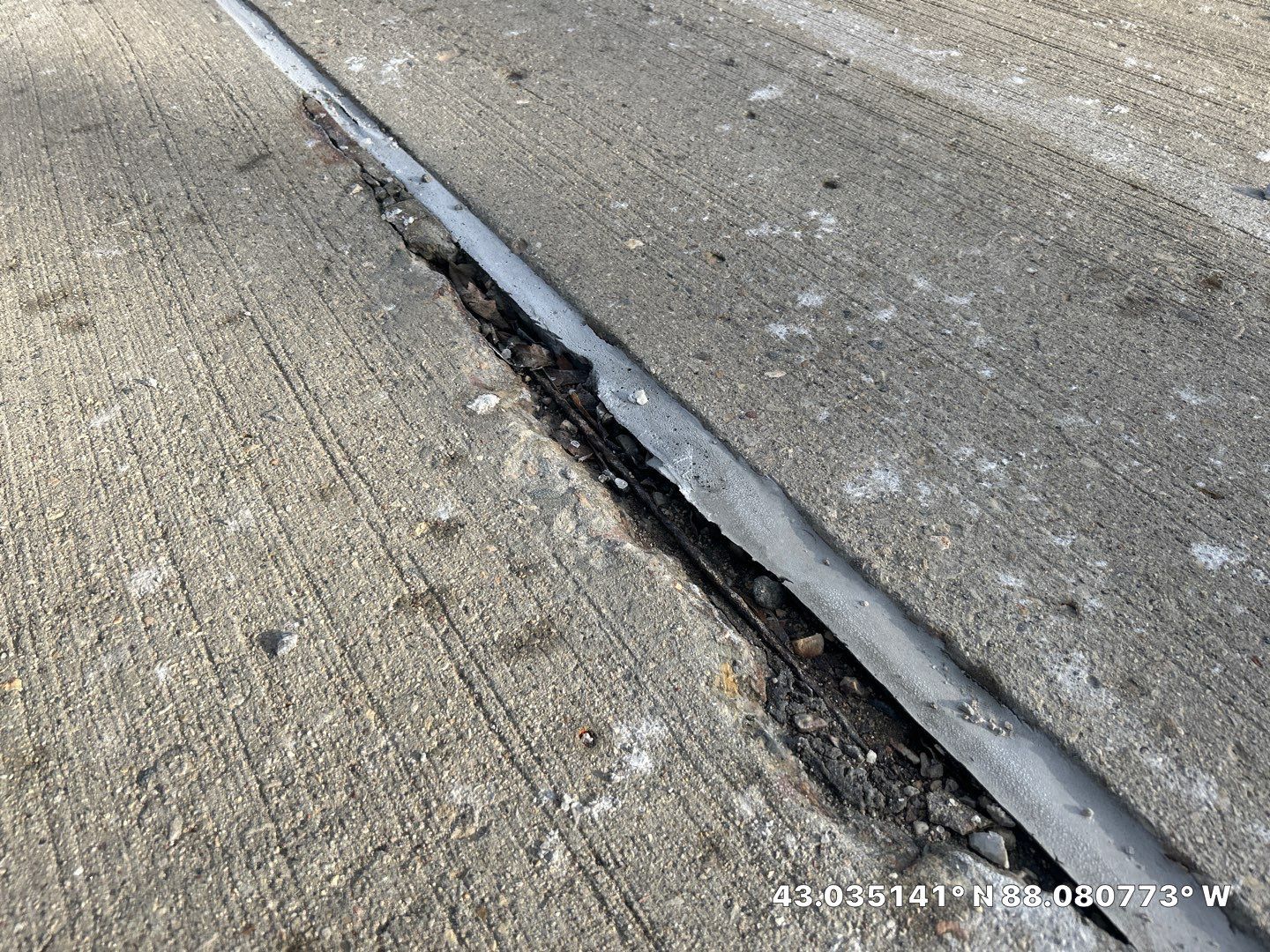
Here’s what makes Midwest concrete spalling so aggressive: it’s not a one-time event. It’s a compounding cycle. Concrete naturally develops shrinkage cracks as it cures. These cracks — even hairline ones — create the initial “avenue” for water to enter. Once water is inside, freeze-thaw expansion widens those cracks. Wider cracks allow more water in during the next cycle. More water means more expansion. The damage accelerates with every passing winter.
This compounding loop is why a parking structure that looks “mostly fine” one winter can develop serious structural concerns within just a few seasons. The damage isn’t linear — it’s exponential. And in the Midwest, where moisture-filled climates and heavy salt use are the norm, the cycle runs faster than almost anywhere else in the country.
Why Midwest Concrete Is Under Constant Attack
Freeze-thaw cycles per year in the Minneapolis–St. Paul region
Volume increase when water freezes inside concrete pores
Internal freeze pressure vs. concrete’s tensile strength — the math is brutal
The Midwest’s moisture-filled climate means concrete is rarely fully dry. Parking structures are especially vulnerable because every car that enters during winter carries road salt — and as Mike Hintsala, RSI Expert, puts it: “Salt corrodes concrete reinforcement quicker than anything else.” That salt doesn’t just damage the surface. It creates an electrochemical corrosion path that attacks the reinforcing steel from within, compounding the freeze-thaw damage that’s already breaking down the concrete season after season.
“Climate is the number one thing,” Hintsala explains. “Without the freeze-thaw cycles, concrete will generally last quite a bit longer. But without the heavy salt, it won’t corrode as fast.” In the Midwest, you get both — and every winter accelerates the cycle.
Early Warning Signs Building Owners Miss
Concrete spalling doesn’t announce itself with a single dramatic failure. It progresses through a series of visible stages — and by the time most building owners take notice, the damage is already well advanced. Here’s what to watch for, from earliest signs to urgent red flags.
-
Surface Scaling and Sandiness
The earliest visible sign of freeze-thaw damage. The concrete surface begins to flake, pit, or feel gritty underfoot. This indicates that the outer layer is already breaking down from repeated freeze-thaw cycling — and the damage will only accelerate from here.
-
Hairline Map Cracking
A network of fine cracks spreading across the concrete surface — sometimes called “pattern cracking.” These hairline fractures are the water entry points forming. Each one is an avenue for moisture to penetrate deeper into the slab, accelerating both freeze-thaw and corrosion damage below the surface.
-
Small Pop-Outs and Corner Loss
When small cone-shaped pieces of concrete break away from the surface, it means freeze-thaw expansion has progressed beyond superficial scaling. Pop-outs at slab edges and corners indicate that internal pressure from expanding ice or corroding rebar is pushing concrete apart from within.
-
Rust Staining Near Rebar Locations
Brown or orange discoloration on the concrete surface is a serious warning sign. By the time rust staining is visible, chloride-driven corrosion of the embedded reinforcing steel is well advanced. The rebar is expanding and will soon begin delaminating the concrete from the inside.
-
Hollow-Sounding Delaminations
Tap the concrete surface with a hammer or drag a chain across a deck — if it sounds hollow, the concrete has delaminated from the rebar layer beneath. This is subsurface failure. The concrete may look intact from above, but it has already separated internally and is at risk of sudden spalling.
-
Trip Hazards, Loose Concrete, and Potholes
This is typically what building owners notice first — but it’s actually a late-stage symptom. As Hintsala describes: “Trip hazards… there’s loose concrete or potholes… there’s a loose piece that can fall and hit somebody — that has to be removed.” If you’re at this stage, the underlying damage is extensive.
The Biggest Mistake: Patching Over the Problem
“The biggest band-aid we see is filling in trip hazards with just concrete patching — we’re not fixing anything. We’re just covering it up.”— Mike Hintsala, RSI Expert
How to Prevent Concrete Spalling Before It Starts
Understanding the science behind concrete spalling is critical — but understanding alone doesn’t protect your structure. The good news: because both failure paths depend on water infiltration, prevention comes down to a single, clear strategy. Keep the water out, and you stop the damage at its source.
Waterproofing: The Single Most Effective Prevention
If there’s one takeaway from 35 years of concrete restoration experience, it’s this: waterproofing is the most cost-effective proactive investment you can make for a concrete structure. Traffic coatings, sealants, membranes, and breathable water repellents each serve a specific role — but they all share the same objective: keeping moisture and chlorides from reaching the concrete and its embedded reinforcing steel.
“What Restoration Systems sells is waterproofing. If the water don’t get in the concrete, it doesn’t cause that corrosion path to occur. Period — without water, it ain’t gonna happen.”— Mike Hintsala, RSI Expert
Traffic coatings — polyurethane-based waterproofing membranes applied to parking deck surfaces — are particularly effective for parking structure protection. They create a durable, traffic-bearing barrier that prevents salt-laden water from penetrating the slab. When properly maintained, these systems can extend the service life of a parking structure by decades.
Maintenance That Actually Works
Beyond major waterproofing systems, there are cost-effective maintenance practices that significantly slow the progression of salt damage and freeze-thaw concrete deterioration. As Hintsala puts it, “Filling cracks is cheap preventative maintenance.” The key is addressing these items before they fail — not after.
- Crack sealing and joint maintenance — Fill cracks and maintain expansion joints before they become water entry points
- Drainage improvements — Correct slopes, clear drains, and install drip edges to move water off the structure quickly
- Sealant replacement — Replace failed sealants and caulking around joints, penetrations, and transitions
- Breathable water repellents — Apply silane or siloxane penetrating sealers on exposed masonry and concrete surfaces
- Coating maintenance — Inspect and repair traffic coatings and membranes before they wear through to exposed concrete
Annual Inspections: The Financial Planner Analogy
In the Midwest, annual concrete inspections aren’t optional — they’re essential. The compounding nature of freeze-thaw and corrosion damage means that conditions can change significantly from one winter to the next. As Hintsala explains: “Yearly here in the Midwest, this is a yearly deal. You can plan for five years, 10 years, 15 years your cost. But just like a financial planner — you better be reviewing your plan, otherwise things can change dramatically, and you didn’t address it.”
“You can’t be mad at the engine if you never changed the oil. What do you expect? Do you expect it to last forever?” — Mike Hintsala on the consequences of deferred parking structure maintenance. If a parking ramp is a $200 million investment, treat it like one. Regular maintenance keeps it performing for decades. Neglect turns a manageable expense into a major capital project.
The most effective approach is proactive but strategic. Not all proactive spending delivers equal ROI. Waterproofing and crack filling offer the highest return per dollar spent. Larger-scale concrete repairs can be planned and phased across multiple budget cycles — but only if you’re inspecting regularly enough to catch problems early and sequence repairs intelligently.
RSI Concrete Repair in Action
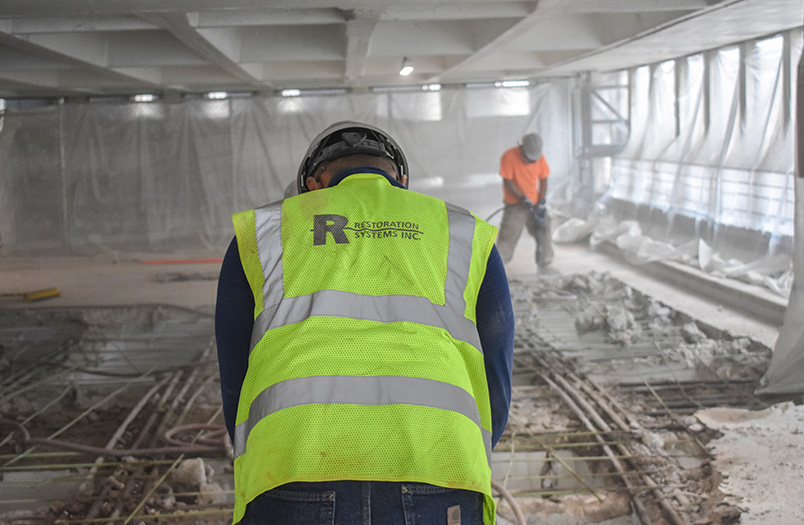
The science of spalling is clear — and so is the evidence from real Midwest projects. Here’s what comprehensive concrete restoration looks like when prevention, repair, and waterproofing come together at scale.
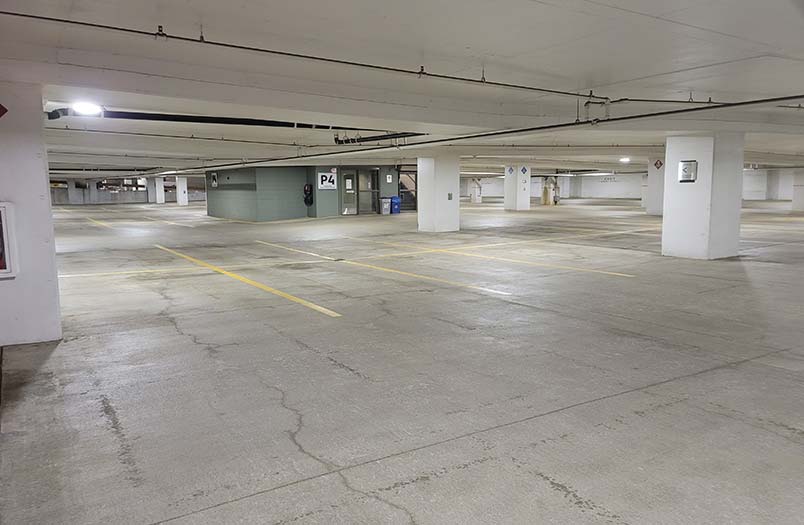
St. Paul Parking Structure Rehabilitation
When years of Midwest exposure overwhelmed this commercial parking structure’s waterproofing systems, the deterioration compounded to the point where comprehensive restoration — not just patching — became necessary. This multi-year project proves Mike’s point: when waterproofing fails, the entire structure pays the price.
Scope: 425,000+ SF traffic coating installation, structural concrete repairs, sealant installation, expansion joint replacement, mechanical improvements
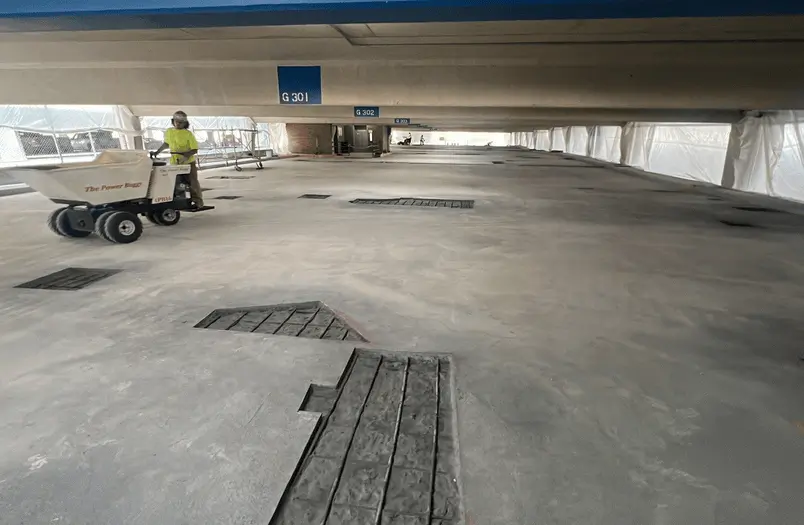
Pine Street Ramps — Multi-System Restoration
This municipal parking structure demonstrates the multi-system approach to stopping the spalling cycle — not just patching concrete, but replacing expansion joints, sealing cracks, and installing a traffic bearing membrane to prevent the water infiltration that drives future damage.
Scope: Concrete repairs, expansion joint replacement, joint and crack repairs, traffic bearing membrane installation, post-tension cable system repairs
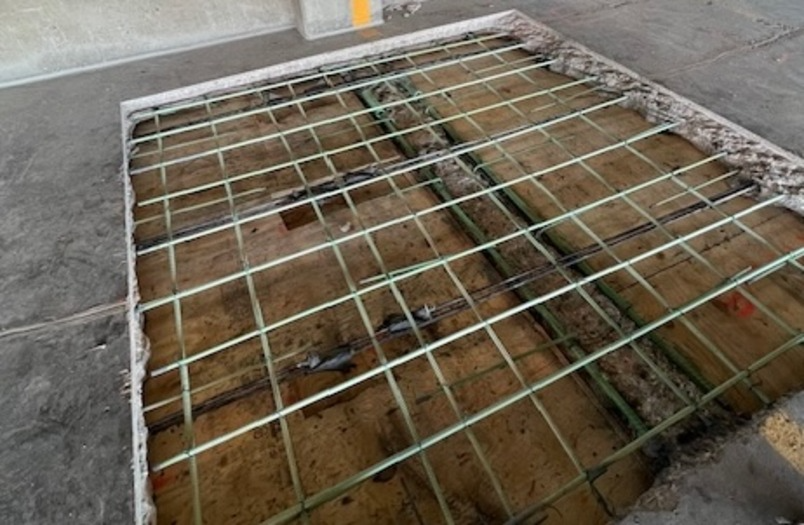
University of Minnesota Prospect Park Ramp
A cautionary tale in deferred maintenance: this institutional parking ramp had experienced “significant deterioration, post-tension system failures, and structural deficiencies due to years of weatherization and heavy use.” What began as surface spalling cascaded into post-tension failures and structural deficiencies — a 9-month restoration that demonstrates how compounding damage escalates when left unchecked.
Learn more about our approach: Concrete Repair Services | Parking Deck Restoration
Don’t Wait for Trip Hazards — Protect Your Concrete Now
Concrete spalling in the Midwest is a compounding problem — every winter cycle makes it worse. The most cost-effective time to act is before damage accelerates. RSI’s team brings 25+ years of experience, ACI and ICRI certifications, and a track record across 300+ projects throughout the region.
Not ready yet? Read our guide to parking structure condition assessments →