01
Geometry Check
When work changes riser height, tread depth, nosing shape, or handrail position, the repaired flight may need to be reviewed against current stair and accessibility requirements. [IBC] [ADA 2010 Standards]

When stair edges start breaking loose, the first question is not how to make the tread look better. It is where the water entered, how far the deterioration runs, and whether the stair can still be repaired safely.
RSI repairs deteriorated concrete, stone, masonry, and structural stair systems at commercial entrances, parking decks, elevated plazas, loading dock access stairs, exterior stair towers, healthcare campuses, educational facilities, and mixed-use properties across the Upper Midwest. In this climate, exterior steps live under “constant moisture, freeze-thaw cycles, and deicing salts”—so a durable repair has to address cracks, spalls, corroded reinforcing steel, failed sealants, drainage, waterproofing, and safe access during the work.

Commercial step repair is rarely just a surface patch. RSI is usually called when owners are seeing cracked or spalled treads, deteriorated nosings, loose stone or masonry, rust staining, standing water on landings, failed joints, or stair edges that have become trip hazards. On busy entrances, parking decks, elevated plazas, loading dock stairs, exterior stair towers, and healthcare, education, apartment, and mixed-use properties, those conditions affect both safety and first impressions.
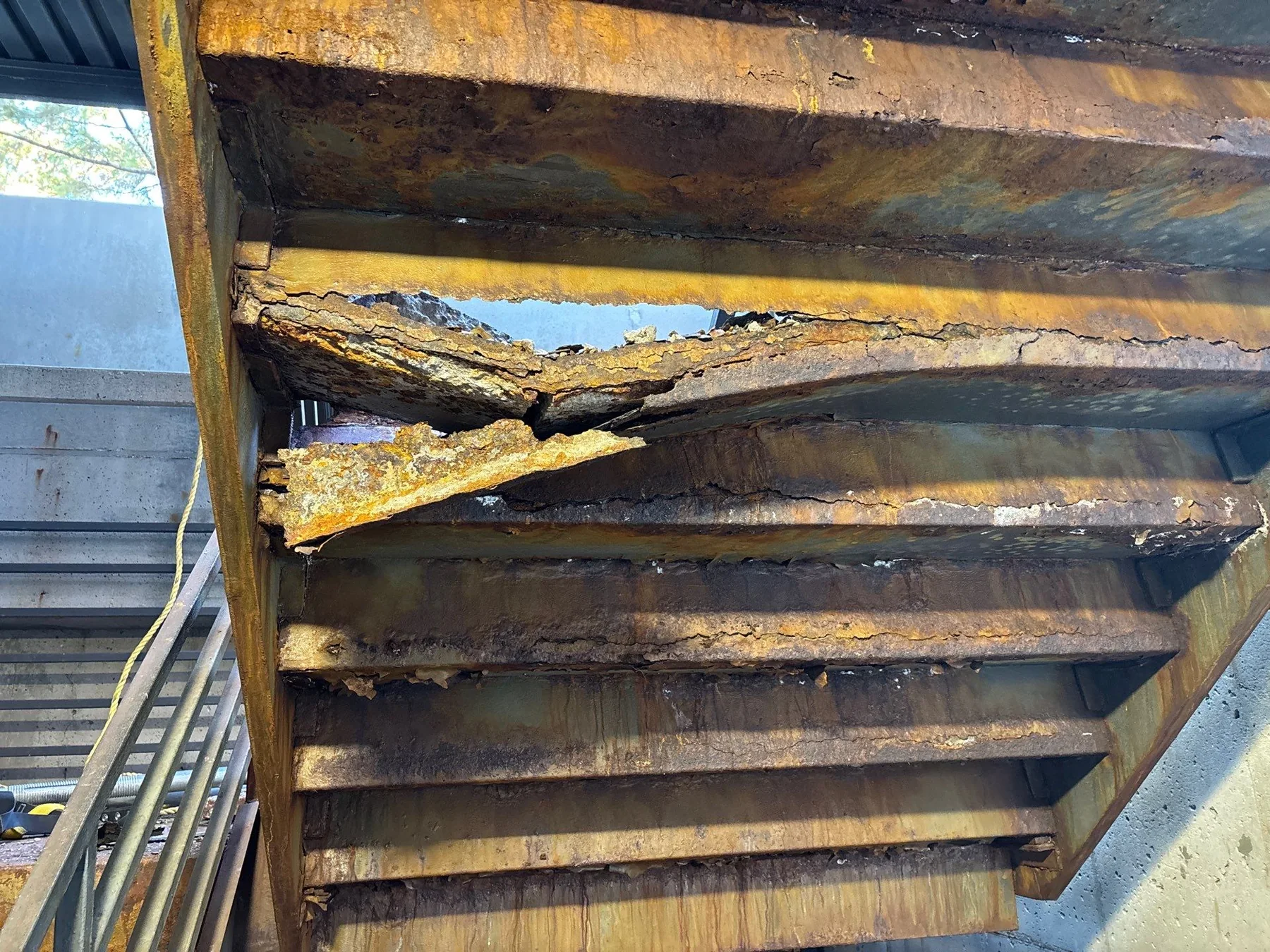
Across the Upper Midwest, exterior stairs take constant punishment from moisture, freeze-thaw cycles, snow removal, deicing salts, thermal movement, and heavy daily foot traffic. Once water enters a crack, joint, porous surface, or failed sealant line, freezing expansion can break concrete apart. Chlorides can also reach reinforcing steel, causing corrosion that expands from inside the stair and pushes the surrounding concrete loose.
RSI scopes step repair by looking beyond the visible crack or loose edge. The evaluation considers the remaining service life of the stair system, the cause of deterioration, drainage, waterproofing, access planning, operating impacts, and the owner’s long-term plan for the property. Many stair repairs also connect to adjacent systems, including sealant replacement, commercial waterproofing, parking deck restoration, concrete repair, stone repair and replacement, and building facade restoration.
A few of RSI’s Commercial Step Repair projects
Step repair specifications should be practical: remove unsound material, rebuild safe stair geometry, protect reinforcement where it remains, and keep water out of the assembly. Code dimensions matter when a repair changes the stair profile, but the field decision begins with the condition of the concrete, stone, masonry, steel, joints, and drainage.
When work changes riser height, tread depth, nosing shape, or handrail position, the repaired flight may need to be reviewed against current stair and accessibility requirements. [IBC] [ADA 2010 Standards]
Skim coating over weak concrete is not a repair. Unsound material has to be removed back to a stable substrate before repair mortar, stone reset, or masonry rebuild work can hold.
Failed joints let water into treads, landings, perimeters, and handrail anchorage areas. Flexible elastomeric sealants are used where the stair still needs to move through temperature swings.
Exterior stairs in the Upper Midwest need low-permeability repair materials, freeze-thaw durability, corrosion mitigation where reinforcing steel is present, and drainage that does not leave water sitting on the landing.
The stair still has to feel consistent underfoot after the repair. Rebuilding a nosing, replacing a tread, raising a landing with topping, or moving a handrail connection can affect riser rhythm, tread depth, nosing projection, and handrail height. RSI coordinates those details with the project requirements and applicable code review rather than treating the patch as an isolated surface fix. [IBC] [ADA 2010 Standards] [OSHA 29 CFR 1910 Subpart D]
Property managers often underestimate how much deterioration can exist beneath the visible surface damage. What looks like a small crack, loose edge, or minor spall is frequently only the symptom of a much larger underlying issue involving water intrusion, reinforcing steel corrosion, or structural deterioration.
Blake DronenRestoration Systems
Exterior stairs in this region face moisture, snow removal, salt, thermal movement, and heavy daily traffic at the same time. The repair fails when the scope only follows what is visible on the face of the tread instead of the water path that made the concrete, stone, or masonry let go.
Water enters cracks, joints, porous concrete, or failed perimeters. Freeze-thaw movement opens the defect further, and deicing salts accelerate corrosion where reinforcing steel or metal stair components are present.
Surface spalls often underestimate the problem. By the time concrete breaks loose at the edge, moisture may already have reached the reinforcement, landing, support section, or masonry backup.
Deicing salts help keep stairs usable in winter, but they also carry chlorides into cracks and pores. Once steel corrodes, expansion pressure can push the surrounding concrete apart.
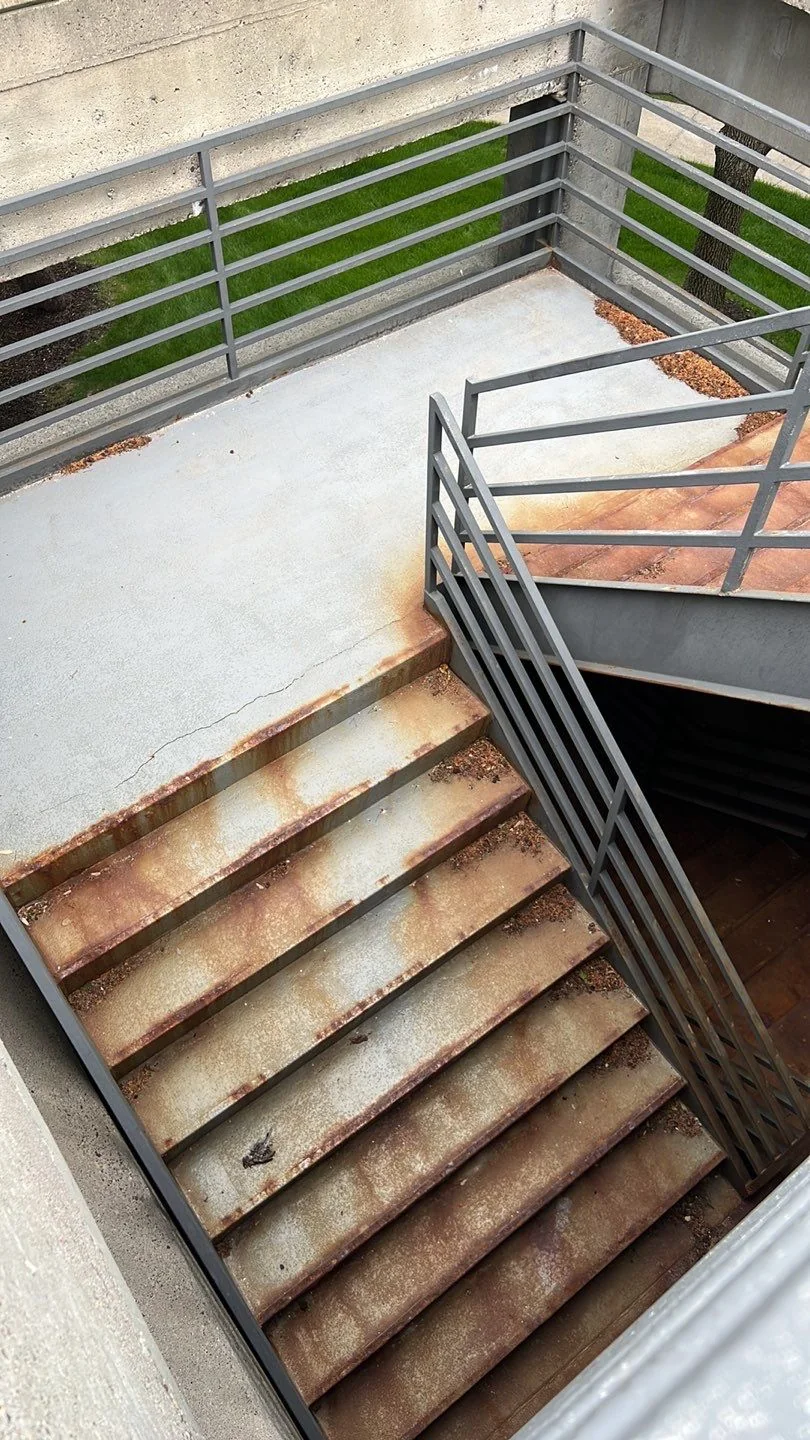
Landings that pond water, irrigation overspray, snow piled against stair edges, and failed stair-to-wall joints keep the assembly wet long after the weather clears.
Repeated small repairs can cost more than addressing the root cause. RSI helps owners separate a “temporary patch” from a repair strategy that protects safety, access, and lifecycle value.
Where stairs connect to parking decks, plaza decks, or exposed landings, RSI may coordinate step repair with traffic coatings, hot-applied waterproofing, or broader waterproofing work to reduce the chance of the same failure returning.
RSI does not assume every damaged stair should be patched, and does not push replacement when a focused repair will perform. The sequence is built to identify the cause of deterioration, protect safe access, and choose the right level of intervention for the stair’s “remaining service life.”
RSI looks at cracks, spalls, loose stone, nosing damage, exposed or corroded steel, settlement, drainage, sealants, waterproofing, handrail anchorage areas, and adjacent flatwork before the scope is locked.
Unsound concrete or masonry is removed, deteriorated nosings are rebuilt, loose components are reset or replaced, reinforcement is repaired where needed, and the substrate is prepared for durable bonding.
Localized damage may be patched or resurfaced. More advanced deterioration may require rebuilding treads, landings, nosings, support areas, or moving into partial or full stair reconstruction.
Sealants, waterproofing membranes, coatings, drainage corrections, and access phasing are coordinated so the finished stair is safe to use and better protected from the next winter cycle.
Cracked treads, nosing failures, and exposed reinforcing steel are often handled through RSI’s concrete repair services; stone and masonry stair components may also tie into stone repair, brick repair, or mortar repair where the stair meets the building.
Repair is appropriate when deterioration is localized and the overall stair system remains stable. Typical repair candidates include cracked or damaged stair edges, moderate spalling, isolated concrete failures, loose stone or masonry components, localized reinforcing steel corrosion, and joint or waterproofing failures that have not compromised the broader structure.
Replacement or partial reconstruction becomes more practical when deterioration is widespread, reinforcing steel corrosion is severe, the stair has movement or settlement issues, water has extensively compromised the substrate, repeated repairs have failed, or the existing stair no longer meets current safety or accessibility needs.
The most common causes are water intrusion, freeze-thaw exposure, deicing salts, poor drainage, failed sealants or waterproofing, inadequate concrete cover over reinforcement, heavy foot traffic, snow removal impact, structural movement, and deferred maintenance. Once water reaches cracks or joints, winter cycling can turn a small defect into a trip hazard or structural concern quickly.
Depending on the stair and exposure, RSI may use high-performance repair mortars designed for freeze-thaw durability, low-permeability concrete repair materials, corrosion mitigation products, flexible elastomeric sealants, waterproofing membranes, protective coatings, and air-entrained concrete systems where appropriate.
Cracked or uneven treads, spalling concrete, loose stone, deteriorated edges, standing water, and damaged handrail connections can increase slip, trip, and fall risk. Once a hazardous condition is visible or known, owners often need to take reasonable steps such as repair, temporary barriers, warning signage, or restricted access until the condition is corrected.
Often, yes. RSI plans temporary access routes, pedestrian protection, barriers, and phasing when an occupied property must remain open. On an active church entrance restoration, the work had to maintain safe access for services and daily operations while deteriorated stair areas were removed, rebuilt, sealed, and protected.
Yes. Stairs are often damaged by the same water, movement, sealant failure, and freeze-thaw exposure affecting adjacent sidewalks, plaza decks, facades, parking structures, entrances, and handrail anchorage areas. Combining related repairs can improve mobilization, scheduling, access planning, and long-term lifecycle value.
RSI repairs commercial steps across the Upper Midwest by looking beyond the broken edge: water path, reinforcement, drainage, access, safety, and long-term value all belong in the scope.