

Commercial Waterproofing Services
System-based waterproofing solutions that protect your building envelope for decades. From plaza decks to parking structures, below-grade foundations to joint systems—RSI delivers comprehensive protection backed by 25+ years of Midwest expertise.
“Waterproofing is a system, not a product. The details—transitions, terminations, drainage, and installation quality—determine whether your investment lasts 5 years or 50.”
— Dan Lephardt, Branch Manager, Wisconsin, RSIThe Biggest Misconception About Commercial Waterproofing
It’s not about products—it’s about systems. Property owners often believe that specifying a premium waterproofing membrane guarantees protection. The reality? Even the highest-quality materials fail when installed without addressing the complete system: transitions, terminations, drainage, substrate preparation, and movement accommodation.
Industry data confirms what we see in the field: 70–80% of waterproofing failures are installation-related, not product defects. The membrane itself rarely fails. What fails are the details that hold the system together—unsealed terminations, joints that exceed movement capacity, missing drainage components, and inadequate surface preparation.
“A waterproofing system is only as strong as its weakest link. You can install the best membrane in the world, but if the termination bar leaks or the joint sealant fails, water finds a way in. Our approach addresses every potential failure point before installation begins.”— Dan Lephardt, Branch Manager, Wisconsin, RSI
What Is Commercial Waterproofing?
Commercial waterproofing is the practice of controlling bulk water and water vapor movement across your building envelope. Unlike residential applications, commercial buildings present complex challenges: multiple penetrations, expansion joints spanning hundreds of feet, plaza decks supporting vehicle traffic, and below-grade foundations subject to constant hydrostatic pressure.
Effective waterproofing requires understanding how water moves through—and around—building assemblies. This means addressing four primary categories:
Below-Grade Waterproofing
Foundation walls, basement slabs, tunnels, and underground structures require waterproofing systems designed to withstand constant hydrostatic pressure. Hot-applied rubberized asphalt and cold-applied systems create monolithic barriers that protect structural elements for 25–40+ years when properly installed.
Above-Grade Waterproofing
Plaza decks, terraces, balconies, and elevated structures face the dual challenge of water management and thermal movement. These horizontal surfaces must handle ponding water, UV exposure, freeze-thaw cycles, and often pedestrian or vehicle traffic—all while maintaining watertight integrity.
Horizontal Applications
Parking structures, loading docks, and traffic-bearing surfaces require traffic-rated coatings and membranes that protect concrete while withstanding vehicle loads, abrasion, and chemical exposure from deicing salts and fluids.
Joint Systems
Sealants and expansion joints accommodate building movement while preventing water intrusion. In the Midwest, where thermal cycling is extreme, joint systems often fail first—making them critical components of any waterproofing strategy.
Most Vulnerable Areas in Commercial Buildings
- Roof-to-wall transitions
- Window and curtain wall perimeters
- Expansion joint terminations
- Mechanical penetrations
- Below-grade wall-to-slab joints
- Elevator pit sumps
- Parking deck drains
- Loading dock depressions
System vs. Product Approach
Why specifying premium materials alone doesn’t guarantee protection—and what actually matters for long-term waterproofing success.
Product-Only Problems
- Unsealed terminations allow water behind membrane
- Joint sealants exceed movement capacity and fail
- Missing or inadequate drainage leads to ponding
- Incompatible materials break down over time
- Substrate defects telegraph through membrane
- Transitions between systems left unaddressed
- No quality assurance documentation for claims
System-Based Benefits
- Every termination sealed with compatible materials
- Joint design accommodates actual building movement
- Drainage integrated into waterproofing assembly
- All components verified for compatibility
- Substrate preparation ensures proper adhesion
- Transition details engineered before installation
- EVFM testing and documentation for verification
The Numbers Behind Waterproofing Failures
Concerned About Your Building Envelope?
Schedule a comprehensive assessment. We’ll identify current issues, evaluate risk areas, and develop a prioritized action plan—before small problems become major repairs.
Waterproofing System Types
Each waterproofing application requires specific materials, installation techniques, and quality controls. We specialize in complete systems engineered for Midwest conditions.
Sealant Systems
Joint sealants, weatherproofing, and caulking systems that accommodate building movement while maintaining watertight seals. Critical for curtain walls, window perimeters, and expansion joints.
Learn more →Traffic Coatings
Protective coatings for parking structures, loading docks, and vehicular surfaces. These traffic-bearing systems protect concrete from chloride intrusion while withstanding vehicle loads.
Learn more →Below-Grade Systems
Foundation waterproofing using hot-applied and cold-applied membranes designed to resist hydrostatic pressure. Provides 25–40+ year protection for basement walls and slabs.
Learn more →Plaza Deck Waterproofing
Complex horizontal assemblies that manage water while supporting pedestrian traffic, planters, and pavers. Requires precise integration of drainage, protection course, and overburden.
Learn more →Expansion Joint Systems
Engineered joint systems that accommodate thermal movement, seismic activity, and structural settlement while maintaining waterproof continuity across building sections.
Learn more →Diagnostics & Assessment
Comprehensive building envelope evaluations including visual inspection, moisture testing, and EVFM leak detection. Identifies root causes before recommending solutions.
Learn more →Sealant Systems
Joint sealants are often the first line of defense against water intrusion—and frequently the first component to fail. In the Midwest, where thermal cycling is extreme, sealants experience constant stress from expansion and contraction cycles that can exceed their movement capacity.
Why Sealants Fail
Most sealant failures result from improper joint design, not material defects. Common issues include:
- Joints too narrow for expected movement range
- Improper backer rod installation (or missing entirely)
- Three-point adhesion that restricts sealant movement
- Incompatible primers or substrates
- Installation during temperature extremes
Critical Sealant Locations
We prioritize sealant assessment at the most vulnerable interfaces: curtain wall perimeters, window-to-wall connections, precast panel joints, expansion joints, and penetrations. These areas require careful evaluation of joint width-to-depth ratios, substrate compatibility, and expected building movement.
University Campus Sealant Replacement
This university campus project presented unique challenges due to direct Lake Michigan exposure, which subjects building envelopes to moisture-laden winds, freeze-thaw cycling, and higher humidity levels. The existing sealant systems had reached the end of their service life, with failures concentrated at curtain wall perimeters and precast panel joints.
RSI’s approach included comprehensive joint evaluation to determine appropriate width-to-depth ratios, substrate testing for primer compatibility, and phased installation to minimize campus disruption. All work was coordinated around academic schedules and completed before the harsh winter season.
Project Outcome
Complete envelope restoration with proper joint geometry and movement accommodation. The new sealant system is engineered for a 15–20 year service life, with joints designed to handle the extreme thermal cycling common to lakefront properties.
Traffic Coatings
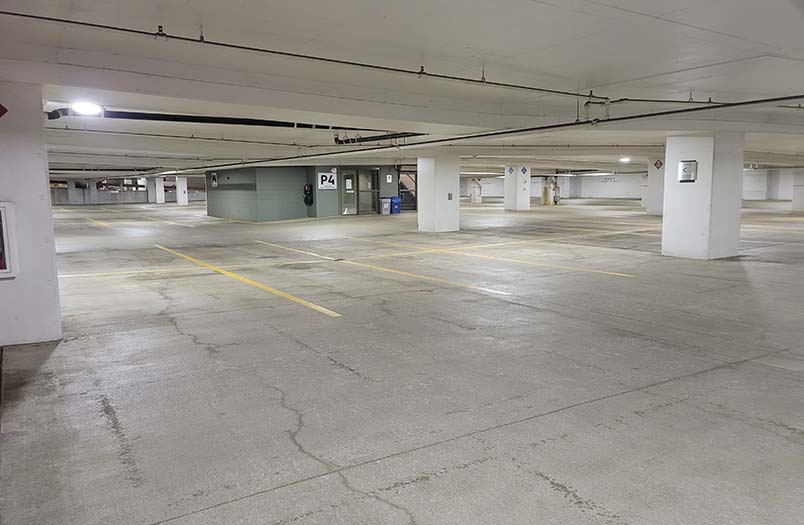
Parking structures represent some of the most challenging waterproofing environments. They combine horizontal surfaces that pond water, exposure to deicing salts that accelerate concrete deterioration, vehicle loads that stress coatings, and limited maintenance windows that constrain repair access.
Parking Structure Applications
Traffic coatings serve a dual purpose: protecting concrete from chloride intrusion while providing a durable, slip-resistant driving surface. These systems must accommodate thermal movement, resist abrasion from vehicle traffic, and withstand chemical exposure from automotive fluids and deicing agents.
RSI installs traffic-bearing membrane systems, including vehicular traffic coatings, pedestrian deck coatings, and broadcast aggregate systems for enhanced traction. Our Minneapolis operations, led by professionals with ICRI (International Concrete Repair Institute) expertise, specialize in parking structure rehabilitation where traffic coatings are integrated with concrete repair.
“The biggest mistake we see in parking structures is treating traffic coatings as an afterthought. The coating system must be specified alongside the concrete repair—not added later. Otherwise, you’re protecting concrete that’s already compromised.”
— RSI Minneapolis OperationsSt. Paul Parking Structure Rehabilitation
This St. Paul parking structure project represents RSI’s largest single waterproofing installation. The scope included comprehensive concrete repair, traffic coating application across multiple levels, and joint sealant replacement throughout the structure. Our crew coordinated with building operations to maintain partial garage access during construction, completing the work in phases to minimize tenant disruption. The new traffic coating system provides chloride protection and slip resistance engineered for Minnesota’s freeze-thaw conditions.
Below-Grade Waterproofing
Below-grade waterproofing protects foundation walls, basement slabs, elevator pits, and other below-ground structures from hydrostatic pressure and groundwater intrusion. Unlike above-grade applications where water flows away, below-grade systems must resist constant water pressure pushing against the membrane.
25-40+ Year Lifecycle
When properly installed, hot-applied rubberized asphalt systems provide 25–40+ years of protection. The key phrase is “properly installed”—below-grade work requires meticulous substrate preparation, continuous membrane application without holidays (pinholes), and proper termination at grade transitions.
Because below-grade waterproofing is buried and inaccessible after backfill, there’s no opportunity for repairs. This makes installer experience critical. Our crews understand that below-grade work is unforgiving—it must be done right the first time.
Hot-Applied Systems
Rubberized asphalt applied at 400°F creates a seamless, self-healing membrane ideal for foundation walls.
Cold-Applied Systems
Fluid-applied membranes for below-slab and blindside applications where hot application isn’t feasible.
Plaza Deck Waterproofing
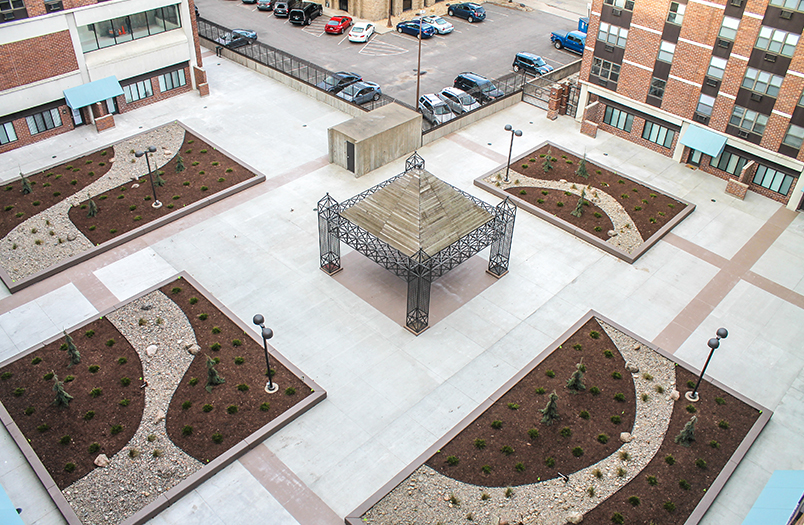
Plaza decks are among the most challenging waterproofing applications in commercial construction. These horizontal assemblies sit atop occupied space—retail, parking, or building infrastructure—where any leak causes immediate damage to the spaces below.
Why Plaza Decks Are Challenging
Unlike vertical surfaces where gravity assists water shedding, plaza decks must manage ponding water, accommodate significant thermal movement, and support overburden loads (pavers, planters, soil) that can mask problems until they become severe.
Successful plaza deck waterproofing requires understanding the complete assembly: structural deck preparation, membrane selection, protection course, drainage layer, and overburden. Each component must work together, with transitions between systems engineered to accommodate movement without compromising waterproof integrity.
Critical Plaza Deck Considerations
- Thermal movement: Decks expand and contract significantly with temperature changes
- Transitions: Roof-to-wall, deck-to-drain, and curb terminations are failure points
- Drainage: Slope and drain placement determine whether water sheds or ponds
- Overburden weight: Pavers and planters stress the membrane and complicate inspections
- Access for repairs: Once covered, the membrane is effectively inaccessible
Milwaukee Plaza Deck Waterproofing
Project Overview
This downtown Milwaukee plaza deck project showcased RSI’s ability to manage complex logistics while maintaining uncompromising quality standards. The site sits adjacent to active light rail lines, requiring precise coordination with Milwaukee County Transit System for material staging and equipment access.
Technical Challenges
The project required a city variance for concrete operations due to the scale of the pour. RSI coordinated a continuous 6-hour concrete placement to ensure proper curing and avoid cold joints that could compromise the deck’s structural integrity. The hot-applied waterproofing membrane was installed with third-party EVFM (Electric Field Vector Mapping) testing—a quality assurance method that uses low-voltage current to detect pinholes and defects invisible to visual inspection.
Why EVFM Testing Matters
Unlike flood testing, which can only detect gross failures after installation, EVFM testing identifies microscopic defects before they become leak paths. This allows crews to make repairs while the membrane is accessible—not after it’s buried under pavers and planters. For critical applications like plaza decks over occupied space, EVFM testing provides documentation that the installed system is defect-free.
Light Rail Coordination
Worked with Milwaukee County Transit System to schedule material deliveries and equipment staging around active rail operations.
6-Hour Continuous Pour
Obtained city variance for extended concrete operations, ensuring monolithic deck placement without cold joints.
EVFM Quality Assurance
Third-party electric field testing verified 100% membrane integrity before overburden installation.
Complete Documentation
Full QA records available for building owner’s files—supporting warranty claims and future maintenance planning.
Expansion Joint Systems
Expansion joints accommodate building movement—thermal expansion and contraction, seismic activity, wind loads, and differential settlement between building sections. When expansion joints fail, the consequences extend beyond water intrusion: structural damage, tenant disruption, and costly emergency repairs.
Why Expansion Joints Fail
Most expansion joint failures stem from design issues rather than material defects. Common causes include:
- Undersized joint design: Joint width insufficient for actual building movement
- Improper sealant selection: Using sealants that can’t accommodate the movement range
- Missing or damaged backer rod: Three-point adhesion restricts sealant movement
- Termination failures: Where horizontal joints meet vertical surfaces
- Traffic abuse: Vehicles impacting joint covers in parking structures
RSI’s Design Approach
Before recommending solutions, we evaluate the actual movement occurring at each joint. This includes reviewing structural drawings, measuring existing joint widths at different temperatures, and understanding the building’s history of movement-related problems. Only then do we specify joint systems sized for the actual—not theoretical—movement range.
Our Expansion Joint Process
We treat expansion joints as engineered systems, not simple caulk lines. This means evaluating joint width-to-depth ratios, specifying compatible backer rod materials, selecting sealants with appropriate movement capacity (+/- 25%, +/- 50%, etc.), and designing terminations where horizontal and vertical joints intersect. The result is joint systems that accommodate movement without compromising waterproof integrity.
Our Diagnostic Process
Before recommending solutions, we invest time in understanding why your building is experiencing water intrusion. This six-step process identifies root causes—not just symptoms.
Document History & Symptoms
Review maintenance records, past repairs, and tenant complaints. Understanding when leaks occur (after rain, during snowmelt, humidity changes) helps identify probable sources.
Visual Inspection & Documentation
Examine the building envelope systematically: roof terminations, wall penetrations, joint conditions, and previous repair locations. Document findings with photos and detailed notes.
Water Testing When Appropriate
Controlled water testing isolates suspect areas to confirm leak paths. This may include spray testing at window perimeters, flood testing on horizontal surfaces, or EVFM testing on membranes.
Root Cause Analysis
Determine whether failures are design-related, installation-related, or due to normal wear. This distinction matters because it affects both the solution and expectations for service life.
Develop Prioritized Recommendations
Not all problems require immediate attention. We categorize findings by urgency: critical (active damage), moderate (deterioration likely), and maintenance (preventive care).
Propose System Solutions
Recommend complete systems—not patchwork repairs. This includes addressing underlying drainage, substrate preparation, and transition details that caused the original failure.
What RSI Does Differently
The difference between a waterproofing specialist and a general contractor attempting waterproofing work.
Non-Specialist Approach
- Recommends products without evaluating root causes
- Applies waterproofing over inadequate substrates
- Ignores transition details and terminations
- Uses crews without waterproofing-specific training
- Skips quality assurance testing to save time
- Provides minimal documentation
- Focuses on lowest bid, not lifecycle value
RSI’s System Approach
- Diagnoses root causes before recommending solutions
- Prepares substrates to manufacturer specifications
- Engineers transition details as critical system components
- Employs crews with decades of waterproofing experience
- Performs EVFM testing and third-party verification
- Delivers complete QA documentation for owner records
- Designs systems for 25+ year service life
“We understand why property owners approach contractor relationships with caution. Years of industry practices have created legitimate skepticism—concerns about unexpected change orders, unclear pricing, and whether a contractor truly has the client’s best interests at heart. That skepticism is earned. Our job is to change that experience, one project at a time, through transparent communication, honest assessments, and delivering exactly what we promise.”
— Mike Hintsala, RSI ExpertQuestions to Ask Your Waterproofing Contractor
Before hiring any contractor for waterproofing work, these questions help identify specialists who understand system-based approaches versus those focused only on product application.
“How will you determine the root cause of our water intrusion?”
A qualified contractor should describe a diagnostic process—not immediately propose products. Listen for mentions of water testing, substrate evaluation, review of building history, and root cause analysis. Be wary of contractors who recommend solutions before investigating the problem.
“What’s your experience with this specific type of waterproofing?”
Waterproofing specialties require different expertise. A contractor skilled in traffic coatings may not have experience with hot-applied below-grade systems. Ask for specific project references that match your application—and verify them.
“How do you address transitions and terminations?”
This question separates specialists from generalists. Transitions (where waterproofing meets other building components) and terminations (where waterproofing ends) are the most common failure points. A system-focused contractor will have detailed answers about how they handle these critical details.
“What quality assurance testing do you perform?”
For critical applications, ask about EVFM (Electric Field Vector Mapping) testing, flood testing, or third-party inspection. Documentation of testing results provides evidence that the installed system meets specifications—important for warranty claims and future maintenance decisions.
“What documentation will you provide?”
Quality contractors provide comprehensive documentation: substrate preparation records, material batch numbers, application conditions (temperature, humidity), testing results, and as-built drawings. This documentation supports warranty claims and helps future contractors understand what was installed.
“What’s the expected service life, and what maintenance is required?”
Honest contractors provide realistic expectations. Hot-applied below-grade systems may last 25–40+ years; sealants typically require replacement in 10–20 years. Ask about maintenance requirements—some systems need periodic recoating or joint sealant replacement to achieve full service life.
Midwest Waterproofing Challenges
Wisconsin and Minnesota present some of the most demanding conditions for building waterproofing systems. Understanding these regional challenges is essential for specifying materials and systems that will perform over decades—not just years.
Freeze-Thaw Cycles
Midwest buildings experience 50–100+ freeze-thaw cycles annually. Each cycle stresses waterproofing components: sealants expand and contract, water infiltrates cracks and freezes (expanding 9% in volume), and thermal movement tests adhesion at every transition. Materials and systems designed for milder climates often fail prematurely here.
Seasonal Timing
Most waterproofing applications require minimum temperatures for proper curing. In the Midwest, this constrains the installation window to roughly May through October. Projects requiring multiple phases must be carefully sequenced to avoid winter shutdowns that leave partially completed systems exposed.
Prevention vs. Reaction
The most cost-effective approach to Midwest waterproofing is prevention. Addressing deterioration before water intrusion occurs costs a fraction of repairing damage after the fact. Regular envelope assessments—ideally before winter and after spring thaw—identify developing problems while they’re still manageable.
Warning Signs of Freeze-Thaw Damage
- Spalling concrete at exposed surfaces
- Sealant pulling away from substrate
- Efflorescence (white mineral deposits) on masonry
- Horizontal cracking in brick courses
- Rust staining from corroding reinforcement
Milwaukee Facade Ordinance Support
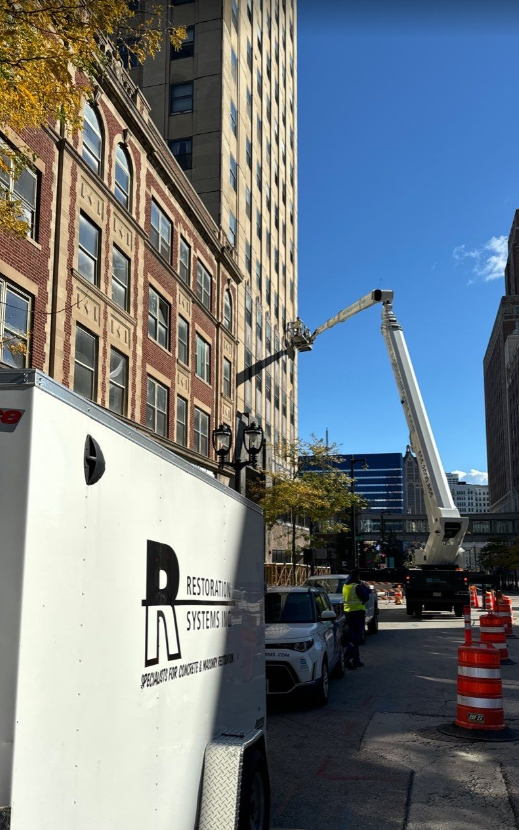
Milwaukee’s facade inspection ordinance requires periodic evaluation and repair of building exteriors—including waterproofing components like sealants, caulking, and protective coatings. Buildings that fail inspection face compliance deadlines and potential liability exposure.
RSI supports property owners through the entire facade ordinance process: from initial inspection and condition assessment through repair specification, execution, and final compliance documentation. Our Milwaukee team, led by Dan Lephardt, has extensive experience navigating the city’s requirements while delivering lasting repairs that address underlying issues—not just visible symptoms.
Inspection Support
Pre-inspection assessments identify issues before official review, giving you time to plan and budget for required repairs.
Repair Specification
Detailed specifications ensure repairs address root causes and meet ordinance requirements the first time.
Execution & Documentation
Complete repair execution with documentation that satisfies city requirements and supports future inspections.
Ongoing Maintenance Planning
Proactive maintenance schedules help avoid future compliance issues and extend repair longevity.
Frequently Asked Questions
What types of commercial waterproofing services do you offer?
+RSI provides comprehensive waterproofing services including traffic coatings for parking structures, below-grade waterproofing for foundations, plaza deck systems, joint sealant replacement, and building envelope restoration. Each system is engineered for the specific application, substrate conditions, and expected service life.
How long do commercial waterproofing systems typically last?
+Service life varies significantly by system type. Hot-applied below-grade membranes can provide 25-40+ years of protection. Traffic coatings for parking structures typically last 10-20 years depending on traffic volume and maintenance. Joint sealants require replacement every 10-20 years. The key factor is proper installation and specification for the application.
What’s the difference between waterproofing and dampproofing?
+Dampproofing resists moisture vapor but cannot withstand hydrostatic pressure—it’s essentially a moisture barrier, not a water barrier. Waterproofing is designed to resist water under pressure, which is critical for below-grade applications where groundwater creates constant pressure against foundation walls. The cost difference is minimal compared to the risk of failure.
Do you provide warranty coverage on waterproofing work?
+Yes, RSI provides workmanship warranties on all waterproofing installations. Additionally, many manufacturer systems include material warranties when installed by certified applicators. We also offer extended warranty options for critical applications. The specific warranty terms depend on the system type and application—we’ll discuss all options during the proposal phase.
Can waterproofing work be done in winter?
+Most waterproofing systems require minimum temperatures for proper curing—typically 40°F and rising. In the Midwest, this constrains most exterior waterproofing work to May through October. However, some interior applications or heated enclosure work can be completed year-round. We can assess your specific project and recommend the best timing approach.
What’s the typical timeline for a commercial waterproofing project?
+Timeline varies significantly based on scope and access. A joint sealant project might take 2-4 weeks; a parking structure traffic coating project could span 6-12 weeks due to phasing requirements. Below-grade waterproofing on new construction integrates with the overall construction schedule. We provide detailed project schedules during the proposal phase.
What areas do you serve?
+RSI provides restoration services throughout the Mid-Atlantic region, including major metropolitan areas and surrounding counties. Our headquarters and primary service area covers a 150-mile radius.
For larger projects outside our primary service area, we can often accommodate travel or partner with local contractors while providing project management and quality oversight. Contact us to discuss your specific location.
Ready to Start Your Restoration Project?
Contact us today for a free on-site assessment. Our team will evaluate your building’s needs and provide a detailed proposal with no obligation.