01
Worker Safety
Access setup must account for fall protection, trained crews, inspections, guardrails, tiebacks, and manufacturer limits before crews begin work at height [OSHA].

The scaffold, swing stage, lift, mast climber, or overhead protection system is where the restoration plan becomes real.
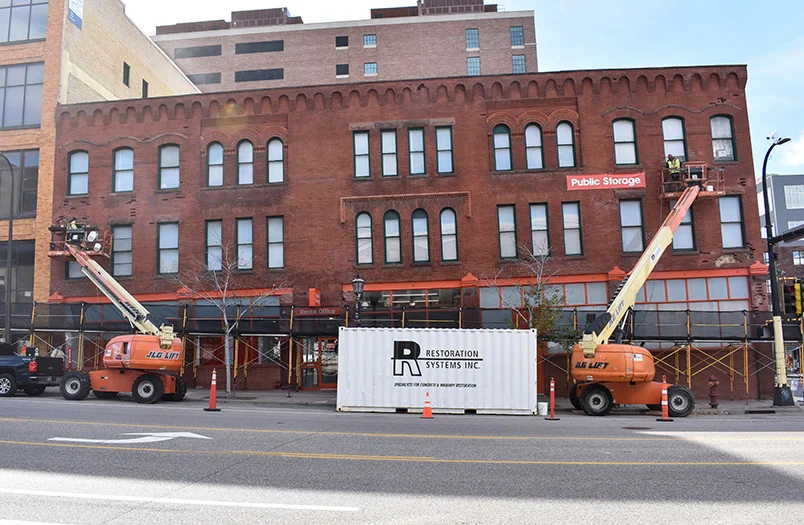
On an occupied commercial building, access is not a rental line item added after the repair scope is written. It controls where crews can work, how materials reach the facade, whether entrances stay open, and how pedestrians are protected below. Because “every building presents different access challenges,” RSI plans exterior access from the repair outward: facade stabilization, waterproofing, sealant replacement, masonry work, inspections, and other exterior restoration at height.

On commercial restoration projects, the access system is not just a way to get crews in the air. It shapes how safely and efficiently facade repairs, waterproofing, sealant replacement, masonry restoration, inspections, and stabilization work can be performed. RSI evaluates the height, geometry, repair locations, site constraints, occupied-building conditions, weather exposure, project duration, and public interface before selecting the platform or protection approach.
That is why one Upper Midwest project may call for suspended swing stages, while another is better served by scaffolding, aerial lifts, mast climbers, suspended platforms, or a custom-engineered configuration. The right choice supports the work face without creating unnecessary disruption at entrances, sidewalks, loading areas, parking zones, or tenant routes.
Poor access selection can slow production, raise labor costs, limit the areas crews can reach, and increase the operational burden on an active commercial property. For high-rise and complex structures, access can become one of the most technically demanding parts of the project, with worker safety, fall protection, installation procedures, inspections, and public protection governed by OSHA requirements and applicable ANSI standards [OSHA 29 CFR 1926] [ANSI/ASSP A10].
RSI plans access as part of the restoration scope for building facade restoration, sealant replacement, tuckpointing and mortar repair, and exterior waterproofing work across Wisconsin, Minnesota, and the broader Upper Midwest.
A few of RSI’s Exterior Access Systems for Commercial Restoration projects
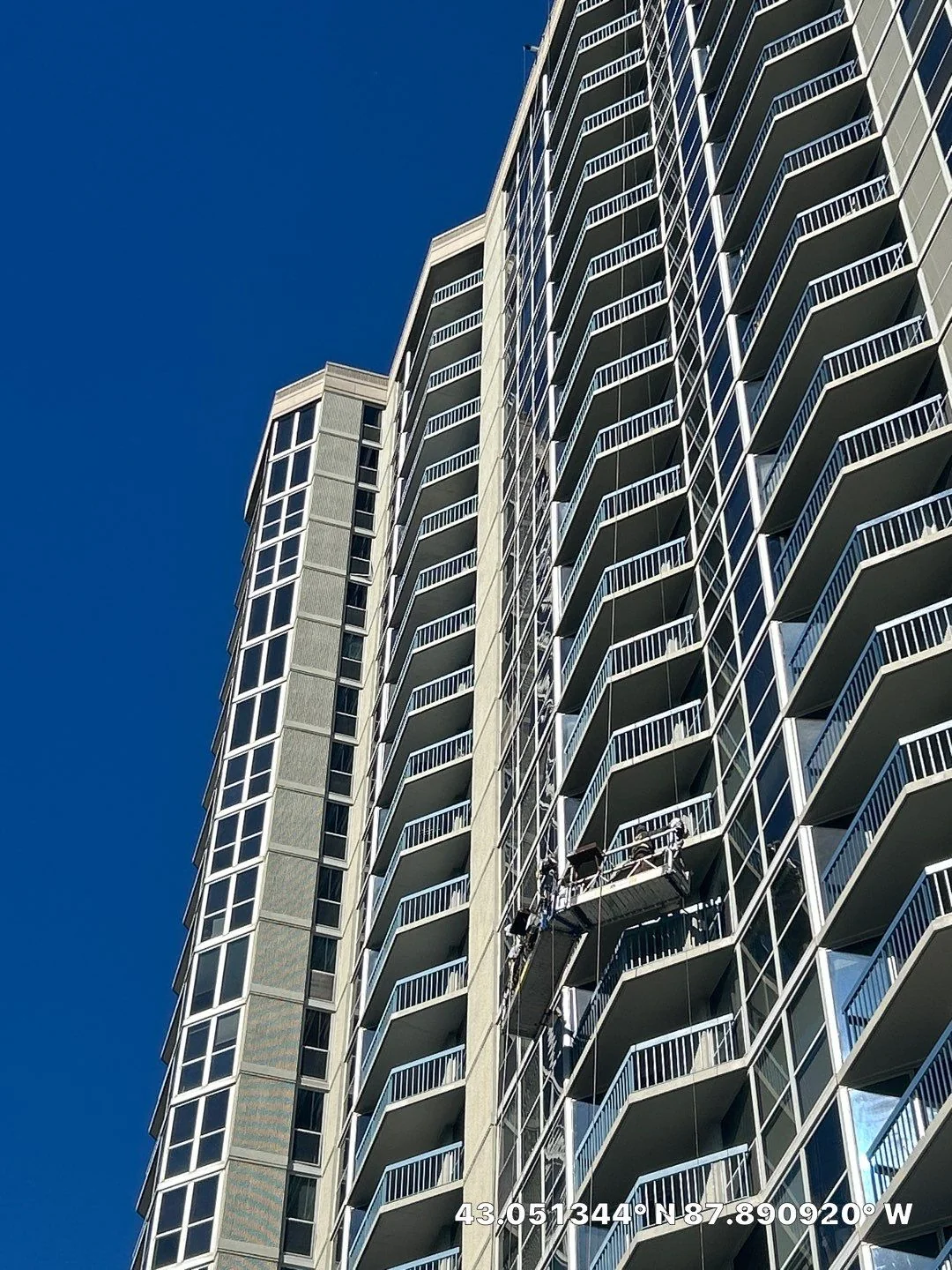
Exterior access systems are governed by OSHA and ANSI requirements, manufacturer instructions, fall-protection rules, inspections, and engineered design criteria where required [OSHA] [ANSI]. In practice, the standard is simple: choose the system that “safely supports the work” while limiting disruption to the building below.
Access setup must account for fall protection, trained crews, inspections, guardrails, tiebacks, and manufacturer limits before crews begin work at height [OSHA].
Sidewalk protection, barriers, and staged work zones are planned where exterior restoration takes place above active pedestrian routes, entrances, or parking areas [IBC].
Height, geometry, roof conditions, repair location, and structural capacity determine whether scaffolding, a swing stage, a lift, a mast climber, or a custom configuration is appropriate.
Access affects labor efficiency, tenant disruption, schedule, cost, material handling, and the quality of the repair. The best system is the one that lets the crew do the right work repeatedly and safely.
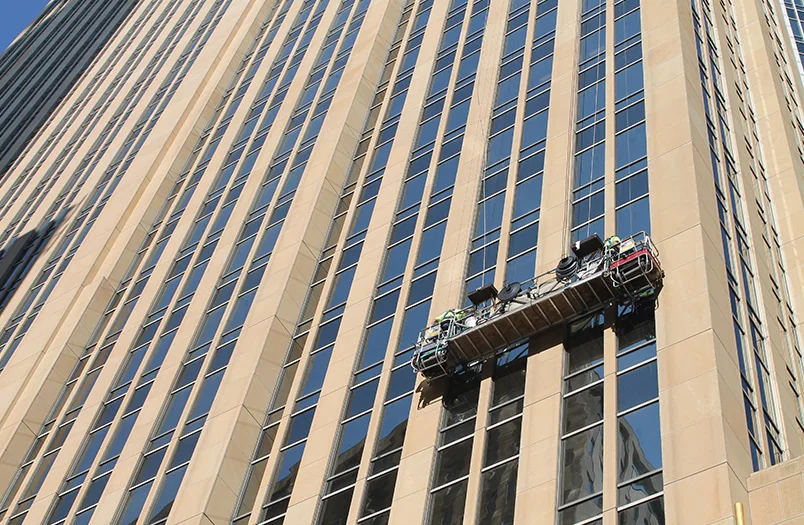
A swing stage reduces the ground footprint, but it does not remove the planning burden. Roof rigging, tieback locations, fall protection, material handling, wind exposure, and the repair sequence all have to be coordinated with the building and the crew doing the restoration.
Access planning directly impacts safety, production, cost, building operations, and the quality of the restoration work itself. In active commercial environments, the access plan has to account for pedestrians, entrances, loading areas, parking operations, and public safety.
Dan LephardtRSI Wisconsin Branch Manager
Across the Upper Midwest, exterior restoration often happens on occupied buildings with tight sidewalks, weather-sensitive materials, aging facades, and limited laydown space. Access fails when it is selected as equipment first instead of as a work plan.
The goal is not to put the largest system on the building. The goal is to reach the repair safely, protect the public, and keep production moving.
A swing stage may be right for isolated sealant work; a mast climber may be better for longer masonry runs. RSI treats the “access strategy” as part of the repair scope, not a default selection.
Entrances, sidewalks, loading docks, parking areas, and tenant routes have to stay visible in the plan. If the public path is an afterthought, the work zone will be rebuilt under pressure.
Once a facade is opened or investigated, repair limits can move. In-house access gives RSI a better path to adjust configurations, shift sequencing, and respond without waiting on a separate access vendor.
Sealants, coatings, mortars, and waterproofing systems have application and cure windows. Access planning has to respect the season, not just the date equipment can arrive.
Where access systems land on roofs, plazas, occupied decks, or parking areas, RSI coordinates protection with commercial waterproofing, traffic coatings, and parking deck restoration requirements.
RSI evaluates access the same way crews will experience it: from the work face, the public edge, the building operations, and the schedule. In-house capability supports “faster mobilization” and gives the team room to adapt to “changing project conditions” as the restoration scope is exposed.
Confirm building height, geometry, repair scope, repair locations, roof and ground constraints, occupied conditions, traffic flow, weather exposure, duration, and safety requirements before pricing a system.
Select scaffolding, suspended swing stages, aerial lifts, mast climbers, suspended platforms, or a custom combination based on how the work must be performed and how the property must continue operating.
Coordinate inspections, fall protection, manufacturer requirements, engineered criteria where needed, overhead protection, pedestrian routing, tenant access, and traffic control before crews are exposed at height.
Because access and restoration are coordinated in-house, RSI can sequence rigging, facade work, sealants, masonry, concrete repairs, protection, and demobilization as one field plan instead of disconnected handoffs.
If access is being installed for spall repair, shelf-angle work, structural patching, or exposed slab edges, the crew plan has to serve concrete repair services from day one.
It is the temporary platform, equipment, and protection package used to safely reach a building exterior during restoration work. Depending on the project, that may include scaffolding, swing stages, mast climbers, aerial lifts, suspended platforms, overhead protection, or custom access solutions.
Access planning affects worker safety, public protection, cost, schedule, tenant disruption, and repair quality. A poor setup can restrict work areas, slow production, block entrances, or prevent crews from reaching the facade well enough to complete the repair correctly.
RSI evaluates the building height and geometry, repair scope and location, site constraints, occupied conditions, pedestrian and traffic flow, project duration, safety requirements, cost efficiency, and weather exposure. The right system is the one that supports the work safely while keeping production efficient.
When exterior work occurs above active pedestrian routes, entrances, parking areas, or adjacent public spaces, overhead protection and controlled work zones may be required by site conditions and local code [IBC]. On active properties, protection is planned with tenant access and public safety rather than added after debris becomes a concern.
Exterior access systems are governed by OSHA and ANSI safety requirements, manufacturer specifications, inspections, training, fall-protection compliance, and engineered design criteria where required [OSHA] [ANSI]. RSI builds safety planning into the access approach before the system is released for field use.
Yes. On a high-rise facade stabilization project in downtown Minneapolis, falling stone created an immediate public-safety concern. RSI installed exterior scaffolding and protection so the building could remain operational while pedestrians, adjacent public areas, tenant access, traffic flow, and ongoing facade investigation were managed together.
RSI has in-house access capabilities, including scaffolding systems, suspended swing stages, aerial lifts, mast climbers, and custom configurations. That helps RSI “better coordinate scheduling,” maintain quality control, reduce delays, and adapt access as restoration conditions evolve.
RSI mobilizes exterior access systems for commercial restoration projects across the Upper Midwest. Bring us in before the scaffold, swing stage, lift, mast climber, or overhead protection package is locked in, and the access plan can support the real repair.