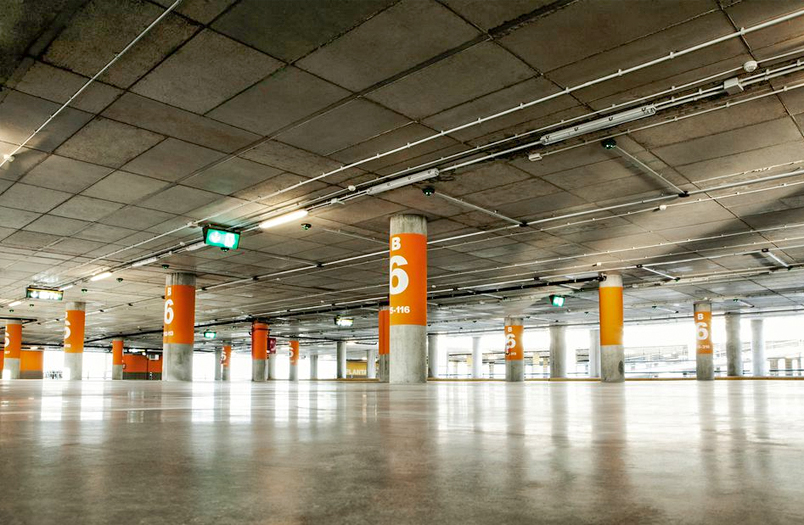
Your parking structure’s hidden infrastructure is under constant stress. The Midwest’s freeze-thaw cycles and road salt create invisible threats that can lead to catastrophic failure. RSI’s specialized team protects the tensioned steel cables that hold your structure together.
21+ Years Experience
300+ PT Projects Completed
ICRI Standards Contributor
Reviewed and Certified by Blake Dronen
President, Restoration Systems Inc.
Key Takeaways
Post-tension cables operate under 25,000–200,000 psi of tensile stress—when they fail, the consequences can be catastrophic and costly to repair.
Invisible corrosion is the hidden threat: PT cables corrode from the inside out, showing no visible warning signs until structural damage has already occurred.
Midwest structures face 50–100+ freeze-thaw cycles annually, combined with chloride-laden road salt that accelerates cable deterioration faster than any other region.
Three repair options exist: carbon fiber reinforcement (least expensive), supplemental steel (most durable for high-traffic), and full cable replacement (restores original capacity).
Annual inspections are critical: Professional assessment of anchor heads and cable condition can detect problems before they become emergencies—think of it as an oil change for your parking structure.
The Infrastructure You Can’t See
Beneath the surface of every post-tensioned parking structure lies a network of high-strength steel cables under immense pressure—the hidden infrastructure that keeps your building standing. Unlike visible structural elements, these cables do their work silently, invisibly, and under constant stress. When they begin to fail, there are often no warning signs until the damage is severe.
For property managers and building owners across the Midwest, this invisible threat represents one of the most significant—and most commonly overlooked—maintenance challenges. The cables that hold your structure together are also the most difficult to inspect and the most expensive to ignore.
“When I was at my previous company, we did a parking ramp in Rockford, Illinois. The original inspection said there were maybe four cables that needed repair. By the time we were done, we had replaced over a thousand. That’s the reality of deferred maintenance on post-tension systems—what starts as a small problem becomes a massive project.”
— Mike Hintsala, RSI Expert
This Rockford project illustrates a pattern we see repeatedly: building owners defer maintenance because the cables are hidden and the structure appears fine from the outside. By the time visible damage appears—spalling concrete, rust staining, sagging slabs—the underlying cable deterioration has already spread far beyond what anyone anticipated. What could have been a targeted repair becomes a comprehensive restoration project costing millions more than early intervention would have required.
The stakes of deferred maintenance on post-tensioned structures are simply too high to ignore. Understanding what’s happening inside your parking structure—and taking proactive steps to address it—is the difference between manageable repairs and catastrophic failure.
What Is Post-Tensioning?
“Think of it like books on a shelf. If you push books together from both ends, they stay upright and rigid. Release that pressure, and they fall over. Post-tensioning works the same way—the cables are constantly pushing the concrete together. When those cables fail, the ‘books’ start to fall.”
— Mike Hintsala, RSI Expert
Post-tensioning is a reinforcement method where high-strength steel cables (tendons) are threaded through a concrete slab after pouring, then tensioned to compress the concrete and dramatically increase its load-bearing capacity, spanning capability, and resistance to cracking.
The engineering behind post-tensioning is both elegant and demanding. Standard post-tensioning strand consists of seven wires with 270 ksi ultimate tensile strength, typically 0.5″ or 0.6″ in diameter per ASTM A416 specifications. These cables operate under extraordinary stress—anywhere from 25,000 to 200,000 psi of tensile force—creating the compression that keeps your structure intact.
This constant tension is what allows post-tensioned parking structures to span longer distances with thinner slabs than traditional reinforced concrete. But it also means that every cable is a critical structural element. Unlike conventional rebar, which simply resists forces, PT cables are actively working every moment of every day, holding the structure in compression.
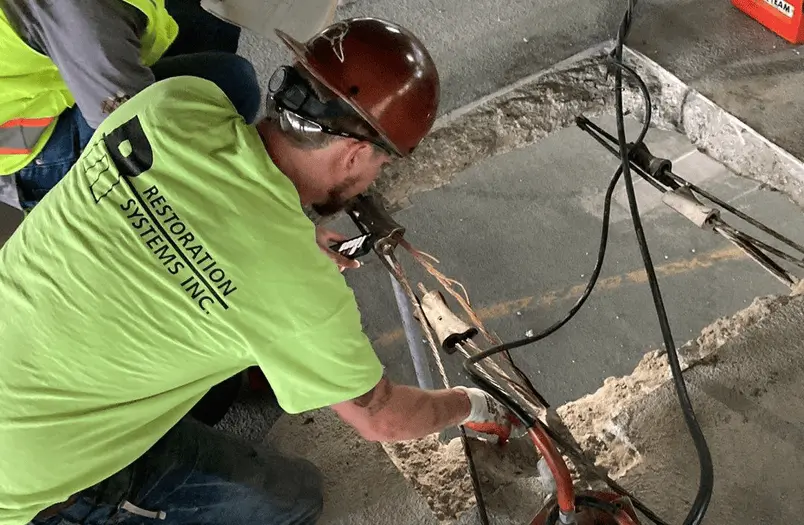
Post-tension cable replacement at Minneapolis Office Complex—restoring the hidden infrastructure that keeps the structure standing.
When a cable corrodes or fails, it’s not just losing passive reinforcement—it’s releasing thousands of pounds of active force. That released tension transfers stress to adjacent cables, which may already be compromised. This cascade effect explains why PT failures tend to accelerate: one failing cable makes its neighbors work harder, speeding their deterioration until the entire system is at risk.
Why Buildings Use Post-Tensioning
Structural Advantages
Post-tensioned construction offers significant engineering benefits that explain why it’s become the preferred method for parking structures across the Midwest:
Longest-lasting construction method when properly maintained—PT systems can serve 50+ years with appropriate care
Fewer joints mean fewer failure points—PT slabs can span longer distances, reducing the number of joints where water and salt can penetrate
Monolithic construction creates a unified structural system where forces distribute across the entire slab
Thinner slabs reduce material costs and building height, improving economic efficiency
Superior crack control—the compression from tensioned cables actively prevents cracking under load
These advantages make post-tensioning the go-to choice for modern parking structures where long spans, durability, and efficient use of materials are priorities.
The Investment Perspective
Post-tensioned structures typically cost about twice as much as precast alternatives upfront. But this comparison misses the bigger picture.
Think of precast construction like Lincoln Logs—individual pieces stacked together with joints at every connection point. Each joint is a potential entry point for water, salt, and the freeze-thaw cycles that destroy concrete in our Midwest climate. Over time, those joints require constant maintenance and eventually fail.
Post-tensioning creates a continuous, monolithic structure with dramatically fewer joints. While the initial investment is higher, the long-term maintenance costs are lower, and the structure’s lifespan is significantly longer when properly cared for.
The key phrase is “properly cared for.” That higher initial investment only pays off if building owners commit to regular inspection and proactive maintenance of the post-tension system. Deferred maintenance on a PT structure doesn’t just cost more—it compounds, as the Rockford project demonstrated.
Bottom line: Post-tensioning is the superior long-term value, but only if you protect the investment through ongoing care.
Why PT Cables Fail in the Midwest
The Midwest presents a uniquely hostile environment for post-tension systems. Our climate doesn’t just test these structures—it actively attacks them through a combination of thermal stress and chemical assault that few other regions experience at the same intensity.
80+
Freeze-Thaw Cycles Annually
Every winter parking structures from Minneapolis, Milwaukee, to Green Bay and the greater Midwest endure 50–100+ freeze-thaw cycles—each one a micro-assault on the concrete’s integrity. Water seeps into hairline cracks, freezes, expands, and forces those cracks wider. The next thaw allows more water to penetrate deeper. This relentless cycle creates pathways for moisture to reach the steel cables hidden inside.
But temperature fluctuation is only half the equation. The real accelerant is road salt. Vehicles track chloride-laden slush into parking structures every winter day, depositing salt directly onto the concrete surface. These chlorides don’t stay on the surface—they penetrate into the concrete matrix, seeking out the embedded steel.
“In our climate, it’s not a question of if your PT cables will corrode—it’s when. The combination of freeze-thaw and chloride exposure is relentless. The structures that survive are the ones where owners catch the problem early and address it before it cascades.”
— Mike Hintsala, RSI Expert
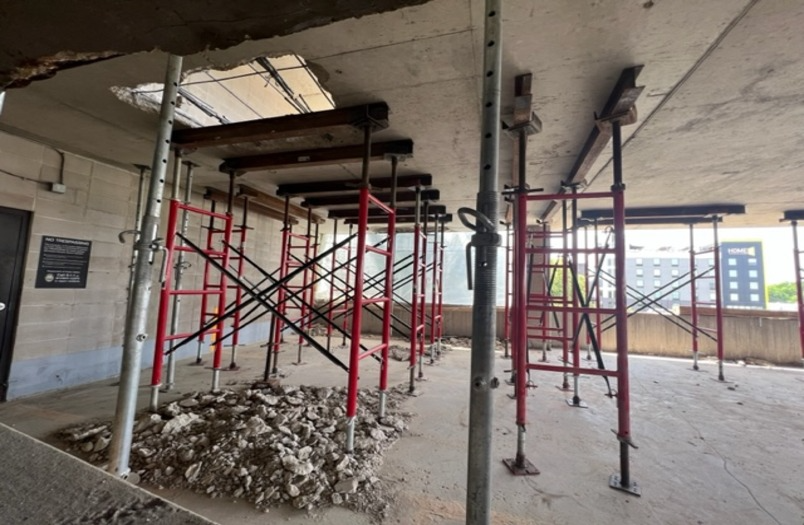
Pine Street Ramps in Green Bay, Wisconsin—detailed PT component work including tendons, end anchorages, and splice couplings in a demanding Midwest climate.
The corrosion cascade typically begins at anchor heads and end caps, where cables terminate at the slab edge. These locations are most exposed to chloride intrusion. Once corrosion starts at the anchor, it works its way along the cable, compromising the steel from the inside out. By the time visible signs appear on the concrete surface—rust staining, spalling, cracking along cable lines—the interior damage is already extensive.
Older “unbonded” or “bare steel” systems without protective grease and sheathing are particularly vulnerable. Many Midwest parking structures built in the 1970s, 1980s, and early 1990s used these older methods, and they’re now reaching the age where cable deterioration is accelerating rapidly. These structures demand especially close attention and proactive maintenance.
6 Warning Signs of PT Cable Failure
Post-tension cable deterioration often progresses invisibly until significant damage has occurred. However, these six warning signs can indicate that your parking structure’s cables need professional assessment:
Concrete Spalling or Bubbling
Concrete breaking away or forming bubbles on the underside of slabs indicates internal pressure from corroding cables expanding beneath the surface.
Visible Deflection or Sagging
Noticeable sagging between columns or uneven slab surfaces suggests cables have lost tension and are no longer supporting designed loads.
Rust Staining on Concrete
Orange or brown staining bleeding through the concrete surface reveals that moisture has reached internal steel and corrosion is active.
Cracking Along Cable Lines
Linear cracks that follow the path of embedded cables indicate stress concentration from cable movement, corrosion expansion, or tension loss.
Deteriorating Anchor Heads
Corroded, cracked, or visibly damaged cable end caps and anchors are the earliest accessible indicators of system-wide cable problems.
Failed Previous Repairs
Patching or repairs that continue to deteriorate suggest underlying cable issues that surface treatments alone cannot resolve.
“The challenge with post-tension systems is that you can’t see the cables. By the time you notice surface damage, the cable inside may have been deteriorating for years. That’s why we always recommend starting with the anchor heads—they’re the one part of the system you can actually inspect without destructive testing.”
— Mike Hintsala, RSI Expert
Noticed Warning Signs in Your Parking Structure?
Don’t wait for a small problem to become a major restoration project. Our PT specialists can assess your structure’s condition and recommend the right approach.
Evaluating a post-tension system requires specialized expertise and a methodical approach. Unlike conventional reinforced concrete, where you can often assess rebar condition through simple coring, PT cables are buried deep within the slab and under constant tension. Disturbing them carelessly can create new problems.
RSI’s assessment process follows the industry standards established by the Post-Tensioning Institute (PTI), specifically PTI M-55.1-19 for field evaluation of bonded post-tensioned concrete structures. However, our approach goes beyond the minimum requirements, informed by over two decades of hands-on experience with Midwest parking structures.
“Many engineers will recommend sounding the entire deck—tapping the concrete to find hollow spots. But that only tells you where delamination has already happened. I prefer to start with the anchor heads. Open up a representative sample, look at the actual cable condition. That gives you real data about what’s happening inside, not just symptoms on the surface.”
— Mike Hintsala, RSI Expert
Our assessment begins with a visual survey of the entire structure, documenting any visible distress patterns. We pay particular attention to drainage patterns, joint conditions, and areas where de-icing salts accumulate. These environmental factors often predict where cable deterioration will be most advanced.
Next, we perform selective anchor head inspections. By carefully exposing a statistically representative sample of cable anchorages at slab edges, we can directly observe cable condition at the location where corrosion typically initiates. This invasive testing provides ground-truth data that non-destructive methods simply cannot match.
Based on our findings, we develop a comprehensive condition report that categorizes cables by urgency: those requiring immediate attention, those to monitor, and those in good condition. This prioritization allows building owners to address the most critical issues first while planning for future maintenance.
“Think of PT cable maintenance like changing the oil in your car. You can push it, ignore the warnings, and eventually the engine seizes. Or you can stay on a regular schedule and the car runs for 200,000 miles. Same with your parking structure—regular inspection and timely repairs extend the life of the whole system.”
— Mike Hintsala, RSI Expert
RSI Assessment Deliverables: Every PT evaluation includes a detailed condition report with cable-by-cable findings, prioritized repair recommendations, cost estimates for each repair option, and a multi-year maintenance plan tailored to your structure’s specific condition and Midwest exposure.
General Pricing Ranges: Minor repairs $45–$65/SF, Partial Depth $65–$85/SF, and Full Depth $85–$150+/SF.
PT Cable Repair and Strengthening Options
Not every post-tension problem requires full cable replacement. RSI offers three proven approaches, each suited to different conditions, budgets, and structural requirements. We help you choose the right solution based on engineering analysis, not sales pressure.
Carbon Fiber Reinforcement
Least Expensive Option
Carbon fiber reinforced polymer (CFRP) strips bond to the underside of concrete slabs, providing supplemental tensile strength where cables have lost capacity. This method is 80% lighter than steel alternatives and installs quickly with minimal disruption.
Bridges cracks and stabilizes deteriorated areas
Rapid installation minimizes downtime
No corrosion concerns—carbon fiber is inert
Requires fireproofing for code compliance
Best for moderate capacity loss situations
Supplemental Steel Systems
Most Impact Durable
External steel beams or plates installed beneath compromised slabs provide robust structural support. This approach is particularly suited to high-traffic parking structures where impact resistance matters—dropped loads, vehicle strikes, and abrasion won’t damage steel like they can damage carbon fiber.
Superior impact and abrasion resistance
Proven long-term durability in harsh conditions
Can support significant additional load
Requires corrosion protection coatings
Best for high-traffic, heavy-use structures
Full Cable Replacement
Full Capacity Restoration
When cables are too deteriorated for supplemental strengthening, full replacement restores the slab to its original design capacity. This involves carefully detensioning and removing failed cables, then installing and tensioning new post-tensioning strand—work that requires specialized equipment and expertise.
Restores full original structural capacity
Addresses root cause, not just symptoms
Longest-lasting solution (50+ year lifespan)
Most disruptive and expensive option
Best when cable deterioration is extensive
“The question isn’t which repair method is ‘best’—it’s which one restores the capacity you need for how long you need it. Sometimes carbon fiber is perfect. Sometimes you need full replacement. We run the numbers and help owners make informed decisions, not just sell them the most expensive option.”
— Mike Hintsala, RSI Expert
Post-Tension Projects Across the Midwest
From university campuses to municipal parking facilities, RSI has delivered post-tension cable repair and replacement projects throughout Minnesota, Wisconsin, and Illinois. Each project demonstrates our ability to handle complex PT challenges on time and on budget.
Comprehensive restoration addressing post-tension system failures across multiple levels. Scope included cable replacement, anchor head repairs, and structural concrete restoration for this major institutional facility.
Detailed PT component work including tendon replacement, end anchorage repairs, splice coupling restoration, and embedded tendon treatment. Municipal infrastructure project requiring coordination with city operations.
Combined PT cable replacement and repair scope for residential parking facility. Project balanced structural restoration needs with minimal disruption to resident parking access throughout construction.
Post-tension cable replacement and repairs combined with comprehensive parking ramp restoration. Multi-phase approach maintained building access while addressing structural deficiencies throughout the facility.
Multi-Phase Project
Why Trust RSI with Your PT System
21
Years PT Experience
300+
PT Projects Completed
16
Projects Per Year Avg.
ICRI
Standards Contributor
“I’ve been involved in writing industry standards for concrete surface preparation through ICRI. When you contribute to the standards others follow, you develop a different perspective on quality. We don’t just meet specifications—we helped create them.”
— Mike Hintsala, RSI Expert
“Post-tension work requires a completely different skill set than conventional concrete repair. The cables are under tremendous force, the tolerances are tight, and mistakes can be dangerous. After 21 years and hundreds of projects, our team has the experience to handle any PT challenge safely and correctly.”
— Mike Hintsala, RSI Expert
Proactive vs. Reactive: The True Cost of Waiting
The difference between proactive and reactive maintenance isn’t just cost—it’s the difference between controlled, planned repairs and emergency interventions that disrupt operations and drain budgets. Every year of deferred maintenance on a post-tension system compounds the eventual repair scope.
“I tell building owners to think about PT maintenance on a yearly basis. Get us in there once a year to look at the anchor heads, check for new damage patterns, and catch problems early. It’s the most cost-effective investment you can make in your parking structure.”
— Mike Hintsala, RSI Expert
The lifecycle economics are compelling. Surface patches and crack sealing—the minimum response to visible damage—typically last 2–5 years before the underlying cable deterioration forces more extensive repairs. Supplemental strengthening systems (carbon fiber or steel) generally perform for 15–25 years. Full cable replacement, while the most expensive intervention, can extend structure life by 50+ years when combined with proper ongoing maintenance.
Reactive Maintenance
Wait for visible damage to appear
Emergency repairs at premium costs
Parking closures disrupt tenants/operations
Small problems become major restorations
Total cost: 3–5× proactive approach
Proactive Maintenance
Annual inspections catch early deterioration
Planned repairs scheduled around operations
Targeted interventions before cascading failures
Predictable budgeting year over year
Maximizes structure lifespan and value
Minneapolis-St. Paul International Airport—a 2-year project for the Metropolitan Airport Commission that included 5 additional concrete haunches at column locations with post-tensioned rods, demonstrating proactive infrastructure investment.
The MSP Airport project exemplifies proactive thinking. Rather than waiting for individual failures, the Metropolitan Airport Commission committed to a comprehensive 2-year restoration that addressed post-tensioning needs across the facility. The result: a parking structure positioned to serve travelers reliably for decades to come, with predictable maintenance costs going forward.
Frequently Asked Questions About Post-Tension Repair
Post-tensioning is a concrete reinforcement method where high-strength steel cables (tendons) are threaded through ducts cast into a concrete slab, then tensioned after the concrete cures. This tension—typically between 25,000 and 200,000 psi—compresses the concrete, dramatically increasing its load capacity and spanning ability while reducing cracking. Think of it like pushing books together on a shelf: the compression keeps everything rigid and in place. Post-tensioned parking structures can span longer distances with thinner slabs than conventional reinforced concrete, making them economically attractive for large facilities.
Warning signs of PT cable deterioration include:
Concrete spalling or bubbling on the underside of slabs
Visible sagging or deflection between columns
Rust staining bleeding through the concrete surface
Linear cracking that follows cable paths
Deteriorating anchor heads at slab edges
Previously patched areas that continue to deteriorate
However, the challenge with PT systems is that significant internal corrosion can occur before any surface symptoms appear. Annual professional inspections that include anchor head examination are the only reliable way to catch problems early.
We recommend annual inspections for all post-tensioned parking structures in the Midwest, with more frequent monitoring for structures over 20 years old or those showing any warning signs. Annual inspections should include visual assessment of the entire structure, examination of drainage patterns and salt accumulation areas, and selective anchor head inspections to directly evaluate cable condition. This yearly approach catches deterioration early when repairs are still targeted and affordable, rather than waiting for problems to cascade into major restorations.
The choice depends on the extent of cable deterioration and your structural requirements. Carbon fiber reinforcement is appropriate when cable capacity loss is moderate and the structure can function with supplemental tensile strength rather than full original capacity. It’s faster to install, less expensive, and causes minimal disruption. Full cable replacement is necessary when cables are severely corroded, have lost significant tension, or when the structure needs to maintain its original design capacity for decades to come. A proper engineering assessment determines which approach—or combination of approaches—makes sense for your specific situation.
Midwest parking structures face a uniquely aggressive combination of environmental factors. Our region experiences 50–100+ freeze-thaw cycles annually, each one expanding water in concrete cracks and creating pathways for moisture intrusion. Compounding this, vehicles track chloride-laden road salt into structures throughout the winter, depositing corrosive chemicals directly onto driving surfaces. These chlorides penetrate into the concrete over time, eventually reaching the embedded steel cables. The combination of thermal stress and chemical attack accelerates cable corrosion faster than in milder climates, making regular inspection and proactive maintenance especially critical for Midwest structures.
Repair longevity varies by method and maintenance:
Surface patches and crack sealing: 2–5 years (treats symptoms, not causes)
Carbon fiber reinforcement: 15–25 years with proper protection
Supplemental steel systems: 20–30 years with corrosion protection maintenance
Full cable replacement: 50+ years with ongoing preventive maintenance
The key to maximizing any repair’s lifespan is combining it with regular inspection and addressing new issues before they affect the repaired areas. No repair is permanent if the environmental factors that caused the original deterioration aren’t also managed.
Yes. When PT cable failures create immediate safety concerns—exposed cables, significant deflection, or structural instability—RSI can mobilize quickly to assess the situation and implement emergency stabilization measures. Our team has the specialized equipment and expertise to safely work with tensioned cable systems under emergency conditions. That said, emergency repairs are always more expensive and disruptive than planned maintenance. The best emergency is one that never happens because annual inspections caught the problem early.
Protect Your Parking Structure’s Hidden Infrastructure
Whether you’ve noticed warning signs or want to stay ahead of potential problems, RSI’s post-tension specialists are ready to help. Our team has the experience, expertise, and equipment to assess, repair, or replace your PT system—keeping your structure safe and operational for decades to come.