
Traffic Coatings for Parking Structures & Commercial Buildings
The Midwest’s leading experts in traffic bearing membrane systems. Protect your parking structure investment with ICRI-standard installation that lasts 15-25 years.

What Are Traffic Coatings?
Traffic coatings are specialized protective membranes applied to concrete surfaces that must withstand vehicle traffic while preventing water infiltration. Also known as traffic bearing membranes or parking deck coatings, these systems create a durable, waterproof barrier that protects structural concrete from moisture, deicing chemicals, and the constant abrasion of vehicular movement.
Unlike standard paints or sealers, traffic coatings are engineered to flex with structural movement, bridge hairline cracks, and resist the unique demands of parking structures. A properly installed traffic coating system serves three critical functions: waterproofing the concrete substrate, providing a durable wear surface for vehicles, and extending the overall service life of the structure.
In the Midwest, where parking structures face 50–100+ freeze-thaw cycles annually and heavy exposure to chloride-laden deicing salts, traffic coatings represent one of the most effective investments a facility manager can make to protect their infrastructure.
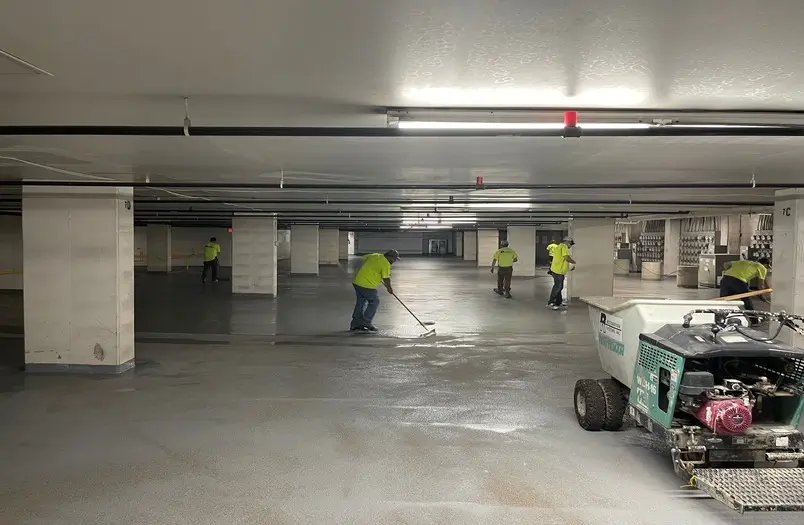
Traffic Coating System Types
Understanding the different traffic coating chemistries helps you select the right system for your application
| System Type | Best Applications | Typical Lifespan | Key Benefits |
|---|---|---|---|
| High-Solids Polyurethane | Parking structures, drive lanes, ramps | 15-25 years | Excellent abrasion resistance, UV stability, crack bridging |
| Methyl Methacrylate (MMA) | Cold weather applications, fast turnaround | 10-15 years | Rapid cure (1-2 hours), applies at low temps |
| Epoxy Systems | Interior covered decks, lower traffic areas | 8-12 years | Excellent chemical resistance, hard wearing |
| Polyurea/Polyaspartic | High-traffic commercial, quick return to service | 10-20 years | Extremely fast cure, flexible, chemical resistant |
Why Surface Preparation Determines System Success
The single most important factor in traffic coating performance isn’t the coating material itself—it’s surface preparation. Industry data consistently shows that 60-70% of coating failures can be traced back to inadequate surface preparation. This is where RSI’s expertise becomes your greatest asset.
The ICRI Standard: Industry Gold Standard
The International Concrete Repair Institute (ICRI) developed the Concrete Surface Profile (CSP) system to standardize how contractors prepare concrete for coatings. These guidelines—ranging from CSP 1 (nearly smooth) to CSP 10 (very rough)—specify the exact surface texture needed for different coating types. Traffic coatings typically require CSP 3-5, achieved through shot blasting or scarification.
“Those are the industry standards that every professional contractor follows. I was on the committee that established and helped write those standards. When we prepare a surface, we’re not guessing—we’re following the exact specifications that I helped create for the entire industry.”
— Mike Hintsala, RSI Expert
This isn’t marketing language. RSI Expert Mike Hintsala literally contributed to writing the ICRI 310.2 guidelines that every professional restoration contractor in North America references. When RSI prepares your concrete surface, you’re getting expertise from someone who helped define what “proper preparation” means for the entire industry.
What Proper Preparation Looks Like
Professional surface preparation involves several critical steps:
- Concrete Repair: All spalls, delaminations, and deteriorated areas must be repaired before coating application
- Crack Treatment: Structural and non-structural cracks require appropriate treatment to prevent reflective cracking
- Profile Creation: Shot blasting or scarification creates the mechanical “tooth” needed for coating adhesion
- Contamination Removal: Oil, grease, and other contaminants must be completely removed
- Moisture Testing: Concrete moisture levels must be within acceptable ranges before coating
Skip any of these steps, and you’re setting the stage for premature coating failure—turning what should be a 15-25 year investment into a 3-7 year expense that requires complete removal and replacement.
RSI’s 4-Step Traffic Coating Process
Our systematic approach ensures every project meets ICRI standards and delivers lasting performance
1. Assessment & Testing
Comprehensive evaluation including adhesion testing, moisture analysis, and condition documentation to determine the right system for your structure
2. Surface Preparation
ICRI-standard shot blasting and scarification to achieve proper CSP profile. Complete concrete repairs and crack treatment before coating
3. System Application
Multi-layer traffic coating installation using manufacturer-specified techniques. Each coat verified for proper thickness and coverage
4. Quality Verification
Final inspection with adhesion testing and documentation. We stand behind every installation with comprehensive warranty coverage
RSI’s Technical Advantage
Our investment in specialized equipment and rigorous training protocols translates directly to better results and faster project completion
Advanced Equipment Fleet
RSI maintains one of the region’s most comprehensive fleets of concrete preparation equipment, including:
- Robotic shot blasting systems for consistent profile creation
- Diamond grinding equipment for precision surface leveling
- High-volume dust collection systems for clean work environments
- Moisture testing and adhesion verification equipment
This equipment investment allows us to handle projects of any scale efficiently while maintaining consistent quality standards across every square foot.
Trained Craftsmen
Equipment alone doesn’t guarantee results—skilled application does. RSI’s team includes craftsmen with decades of experience in traffic coating systems, trained specifically on:
- ICRI surface preparation standards and verification
- Manufacturer-specific application techniques
- Quality control protocols at every project phase
- Safety procedures for coating chemicals and equipment
This combination of advanced equipment and expert application is why RSI consistently delivers installations that perform for 15-25 years—not the 3-7 years typical of improper installations.
Midwest Climate: Why Your Structure Needs Extra Protection
Parking structures in Minnesota, Wisconsin, and surrounding states face environmental challenges that accelerate concrete deterioration far beyond what structures in temperate climates experience. Understanding these challenges helps explain why proper traffic coating installation isn’t just recommended—it’s essential.
Freeze-Thaw Cycles: Midwest parking structures endure 50–100+ freeze-thaw cycles annually. Water infiltrates concrete pores, freezes and expands, then thaws—repeating this destructive cycle dozens of times each winter. Without proper waterproofing, this process rapidly deteriorates even high-quality concrete.
Chloride Exposure: Deicing salts are the #1 accelerator of reinforcing steel corrosion. Chloride ions penetrate unprotected concrete and attack embedded rebar, causing expansive rust that spalls concrete from within. A properly installed traffic coating creates a barrier against this chloride intrusion.
Midwest structures can see chloride levels 3-5x higher than coastal environments due to concentrated winter salt application on vehicles and walkways.
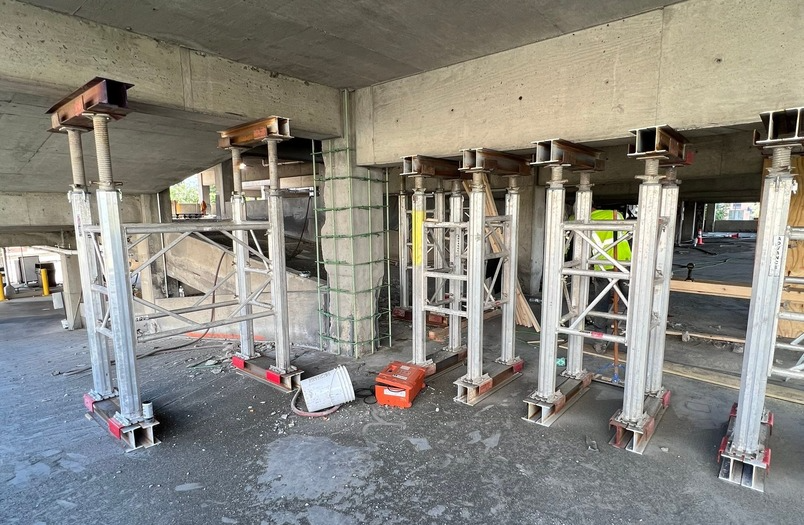
The ROI of Proper Installation
The numbers tell the story: professional traffic coating installation delivers measurable return on investment
The True Cost of Deferred Maintenance
Every facility manager faces budget pressures, and it’s tempting to postpone traffic coating maintenance to save money in the short term. But the math on deferred maintenance is brutal—and the longer you wait, the worse it gets.
A Real-World Cautionary Tale
Consider a case Mike Hintsala encountered recently: a parking structure owner who had been putting off traffic coating maintenance for years. What started as a manageable $500,000 repair project escalated dramatically.
“I just finished looking at a project that was $500K—but because they deferred the waterproofing, it’s now closer to $4M. The structural damage from water infiltration turned a straightforward coating job into a major structural rehabilitation. That’s not an unusual story—we see this pattern regularly.”
— Mike Hintsala, RSI Expert
An 8x cost increase isn’t an outlier—it’s what happens when water infiltrates unprotected concrete, corrodes reinforcing steel, and causes structural damage that requires extensive repairs before any coating can be applied.
The Lifecycle Cost Perspective
Smart facility managers think in terms of lifecycle cost, not just installation cost. When you compare the total cost of ownership over a 30-year period:
Properly installed system (15-25 year lifespan): One to two coating cycles with minimal underlying repairs. Predictable maintenance costs. Structure remains in service throughout.
Improperly installed or deferred (3-7 year lifespan): Four to ten coating cycles required. Each cycle involves removing failed coating, repairing accumulated damage, then recoating. Progressively larger repairs needed. Potential structural issues require closures.
The difference isn’t 2x or 3x—it can be 5-10x when you factor in removal costs, accumulated damage repairs, and service disruptions.
Traffic Coatings vs. Penetrating Sealers
Understanding when to use each protection system is critical for maximizing your investment and structure longevity
| Characteristic | Traffic Coatings | Penetrating Sealers |
|---|---|---|
| Protection Type | Continuous membrane barrier on surface Recommended | Subsurface protection within concrete pores |
| Waterproofing Level | Complete waterproofing barrier | Water resistant, not waterproof |
| Crack Bridging | Yes—bridges hairline cracks up to 1/16″ | No crack bridging capability |
| Wear Resistance | High—designed for vehicle traffic | None—concrete surface exposed to wear |
| Typical Lifespan | 15-25 years (properly installed) | 5-10 years |
| Best Applications | Top decks, drive lanes, ramps, areas with ponding potential Primary Protection | Lower levels, covered decks, new construction protection |
| Surface Preparation | Extensive—requires shot blasting to CSP 3-5 | Minimal—clean, dry surface required |
| Initial Cost | Higher upfront investment | Lower initial cost Budget Option |
| Lifecycle Cost | Lower—fewer reapplication cycles needed | Higher—more frequent reapplication required |
| Visibility | Visible colored surface finish | Invisible—concrete appearance unchanged |
When to Choose Each System
The choice between traffic coatings and penetrating sealers isn’t always either/or—many structures benefit from using both in different areas.
Traffic coatings are essential for: top decks exposed to weather, drive lanes with high traffic concentration, ramps where water can pond, any area where waterproofing is critical, and surfaces with existing crack patterns that need bridging.
Penetrating sealers work well for: lower parking levels protected from direct weather exposure, new construction as an initial protection layer, budget-constrained situations where full coating isn’t feasible, and areas with excellent drainage where waterproofing is less critical.
RSI often recommends a combined approach: traffic coating on top decks and drive lanes (156,000+ SF at RiverWest, for example), with penetrating sealer on lower protected levels (65,000+ SF of sealer at the same project). This strategy optimizes both protection and budget.
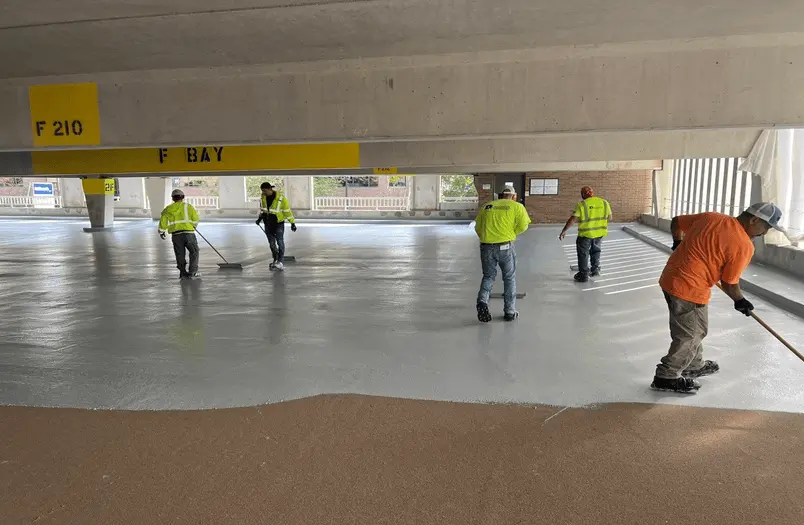
Maintaining Your Traffic Coating Investment
A properly installed traffic coating system is designed to last 15-25 years—but that lifespan assumes appropriate ongoing maintenance. Neglecting maintenance doesn’t just shorten coating life; it can lead to the same escalating repair costs that deferred installation causes.
Annual Inspection Protocol
RSI recommends annual inspections of traffic coating systems, ideally in spring after the freeze-thaw season ends. Key inspection points include:
- Wear patterns: High-traffic areas like turn lanes and parking stall entries show wear first
- Coating adhesion: Look for bubbling, peeling, or areas where coating has lifted from substrate
- Crack development: New cracks in the coating may indicate substrate movement or coating fatigue
- Ponding areas: Water that doesn’t drain within 24 hours indicates potential problems
- Joint conditions: Expansion joints and caulked joints should be intact and flexible
Maintenance vs. Replacement
Not every issue requires complete coating replacement. Many problems can be addressed with targeted maintenance:
Localized wear areas can often be spot-repaired with compatible coating materials, extending overall system life significantly.
Joint failures should be addressed promptly—failing joints allow water infiltration that undermines surrounding coating.
Minor adhesion issues caught early can be corrected before they spread to larger areas.
“On coating systems, we don’t have warranty issues. The reason is we follow proper surface preparation protocols and work closely with manufacturers on application techniques. When you do it right the first time, you don’t get callbacks.”
— Tayton Eggenberger, Branch Manager, Minnesota, RSI
This track record of zero warranty callbacks reflects RSI’s commitment to doing the job right—and it translates directly to lower lifecycle costs for structure owners.
5 Warning Signs Your Traffic Coating Needs Attention
Early detection of coating issues can save significant repair costs. Watch for these indicators:
-
1
Visible Wear Patterns
Faded color or visible concrete showing through in high-traffic areas indicates the wear surface is compromised. While some wear is normal, accelerating wear patterns suggest system fatigue.
-
2
Bubbling or Blistering
Bubbles in the coating surface indicate moisture is trapped beneath, usually from inadequate surface preparation or moisture testing. This almost always requires removal and reapplication.
-
3
Peeling or Delamination
Coating lifting from the concrete substrate is a serious failure mode. Water can migrate under the lifted coating, accelerating deterioration of both coating and concrete.
-
4
Standing Water After 24 Hours
Ponding water indicates either drainage problems or coating failure that’s allowing water to penetrate and pool. Both conditions accelerate deterioration.
-
5
Rust Staining on Coated Surface
Orange-brown staining coming through the coating indicates the waterproofing has failed and chloride-laden water is reaching and corroding embedded reinforcing steel—a serious structural concern.
Project Types We Serve
RSI has installed traffic coating systems across a wide range of commercial and institutional parking structures throughout the Midwest
Municipal & Public Structures
City-owned parking ramps and public parking facilities require durable systems that can withstand heavy daily use while meeting municipal budget constraints.
- St. Paul Parking Structure – 425,000+ SF traffic coating
- Pine Street Ramps, Green Bay – Traffic membrane + expansion joints
- Appleton Parking Ramp – Emergency repairs and restoration
These projects demonstrate our ability to work within public procurement processes while delivering quality that protects taxpayer investments.
Institutional & Commercial
Universities, hospitals, and commercial properties have unique scheduling requirements—we work around operational needs to minimize disruption.
- University of Minnesota Prospect Park Ramp – Complex PT repairs + coating
- RiverWest Parking Garage – 156,000 SF completed in one month
- Avidor Active Adult Homes – 30,500 SF completed in one week
Our ability to execute rapidly—like completing 30,500 SF in just one week at Avidor—means less downtime and faster return to full operation.
Featured Traffic Coating Projects
A selection of recent traffic coating installations across Minnesota and Wisconsin
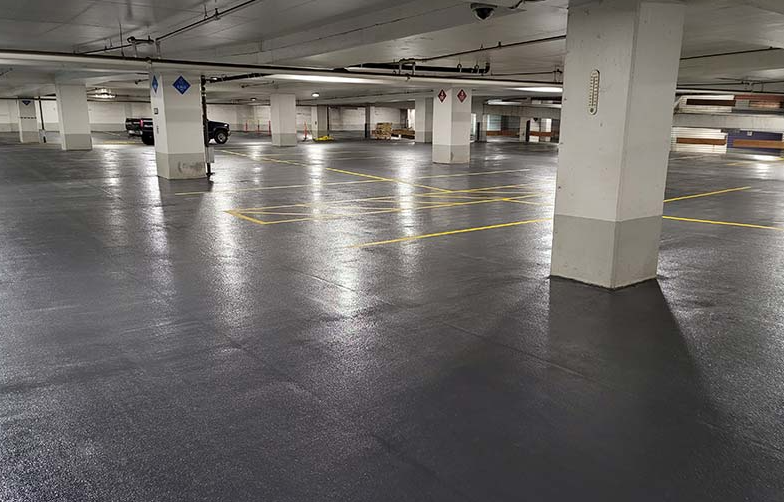
St. Paul Parking Structure
St. Paul, Minnesota
425,000+ SF high-solids polyurethane waterproofing traffic bearing membrane with expansion joint replacement and sealant installation. Our largest quantified traffic coating project.
RiverWest Parking Garage
Minneapolis, Minnesota
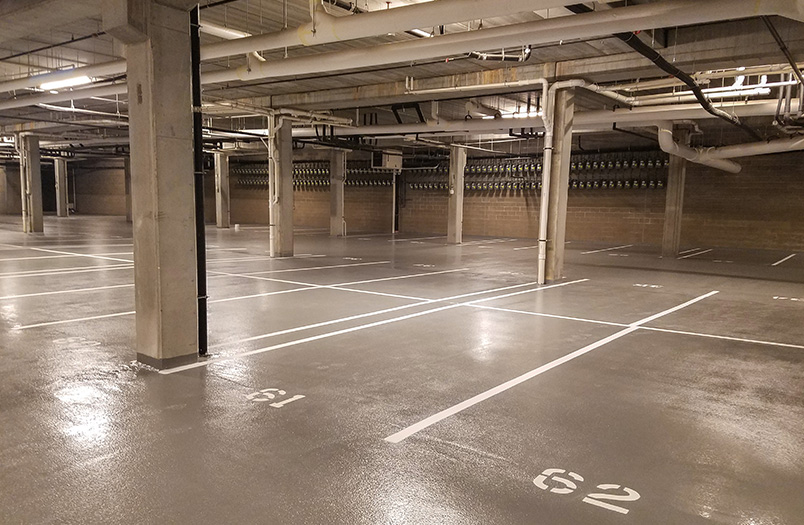
Complete system: 156,000+ SF traffic coating removal and new high-solids polyurethane installation plus 65,000+ SF penetrating sealer. Completed in just one month.
University of Minnesota Prospect Park Ramp
Minneapolis, Minnesota
Complex institutional project combining polyurethane waterproofing and traffic-bearing membrane system with post-tension cable repairs.
Rapid Execution: The Avidor Project
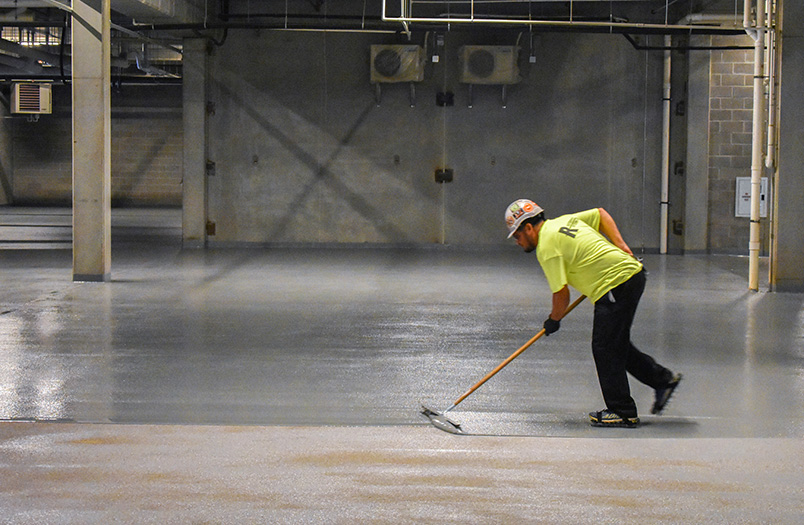
One of the clearest demonstrations of RSI’s operational efficiency is the Avidor Active Adult Apartment Homes project in Edina, Minnesota. This 30,500 square foot fluid-applied waterproofing system was completed in just one week.
Rapid project completion isn’t just about having enough crew members—it requires meticulous planning, proper equipment deployment, and experienced craftsmen who can maintain quality at speed. The Avidor project showcased all three.
Project highlights:
Complete surface preparation, primer application, and multi-coat traffic coating installation within a compressed timeline. The property maintained partial operation throughout, with minimal disruption to residents.
This same rapid-execution capability applies to emergency situations. When the Appleton Parking Ramp required urgent repairs, RSI mobilized quickly to assess conditions and implement repairs before further deterioration could occur.
Why Choose RSI for Traffic Coatings
The difference between a traffic coating that lasts 5 years and one that lasts 25 years comes down to expertise, preparation, and execution
ICRI Standards Authority
Our senior technical advisor helped write the ICRI surface preparation standards that the entire industry follows. When we prepare your surface, we’re not interpreting guidelines—we’re applying the expertise that created them.
Proven Track Record
Zero warranty callbacks on coating systems. This isn’t luck—it’s the result of rigorous quality control, proper surface preparation, and manufacturer-specified application techniques on every project.
Rapid Execution Capability
From 30,500 SF in one week (Avidor) to 156,000 SF in one month (RiverWest), we have the equipment and crews to execute large-scale projects on tight timelines without sacrificing quality.
Midwest Regional Expertise
We understand Midwest conditions—50–100+ freeze-thaw cycles, heavy chloride exposure, temperature extremes. Our system recommendations and application timing are calibrated for regional conditions.
Complete Service Integration
Traffic coatings often require coordinated concrete repairs, post-tension work, or structural rehabilitation. RSI handles all disciplines in-house, ensuring seamless project execution.
25+ Years of Excellence
Since 1997, RSI has built a reputation throughout Minnesota and Wisconsin for exceeding expectations. Our principals average more than 25 years’ experience each in concrete restoration.
Frequently Asked Questions
Common questions about traffic coatings, installation, and maintenance
How long do traffic coatings last?
Properly installed traffic coating systems typically last 15-25 years when applied to correctly prepared surfaces and maintained according to manufacturer recommendations. The key variable is surface preparation quality—systems installed without proper ICRI-standard preparation often fail within 3-7 years, requiring costly removal and reapplication.
Factors that affect lifespan include: traffic volume and turning movements, exposure to deicing chemicals, quality of surface preparation, system type selected, and ongoing maintenance practices.
What’s the difference between traffic coatings and penetrating sealers?
Traffic coatings form a continuous membrane on the concrete surface, providing complete waterproofing, wear resistance, and crack bridging capability. They’re visible as a colored surface layer.
Penetrating sealers absorb into concrete pores, creating subsurface protection without changing the surface appearance. They’re water-resistant but not waterproof, and don’t provide wear resistance or crack bridging.
For exposed parking decks, traffic coatings are typically the better choice. Penetrating sealers work well for protected lower levels or as supplemental protection.
How much does a traffic coating system cost?
Traffic coating costs vary based on several factors: current concrete condition (does it need repairs first?), system type selected, total square footage, access conditions, and scheduling requirements.
Rather than quoting generic per-square-foot numbers that may not apply to your situation, we recommend a free assessment. RSI will evaluate your specific conditions and provide an accurate quote that includes all necessary preparation and repair work—not just the coating application.
What causes traffic coatings to fail?
The primary causes of premature traffic coating failure include:
- Inadequate surface preparation: This accounts for 60-70% of all coating failures. Without proper CSP profile, coatings can’t achieve mechanical adhesion.
- Moisture issues: Applying coating over concrete with excessive moisture leads to bubbling and delamination.
- Improper thickness: Coatings applied too thin won’t perform; too thick and they may crack.
- Temperature/humidity during application: Coatings have specific application windows that must be respected.
- Substrate movement: Coatings applied over deteriorated or actively moving concrete will crack and fail.
Can traffic coatings be applied over existing coatings?
Sometimes yes, sometimes no—it depends on the condition of the existing coating and compatibility with the new system. If the existing coating is well-adhered and compatible, an overlay may be possible after proper surface preparation.
However, if the existing coating shows signs of failure (bubbling, peeling, delamination), it must be completely removed before applying new coating. Coating over a failing system simply transfers the failure mode to the new layer.
A professional assessment can determine whether overlay or removal is the appropriate approach for your situation.
How long does traffic coating installation take?
Project duration depends on square footage, concrete condition, system type, and weather conditions. As reference points from recent RSI projects:
- 30,500 SF (Avidor): Completed in 1 week
- 156,000 SF (RiverWest): Completed in 1 month
- 425,000 SF (St. Paul): Multi-phase project
Most parking structure projects can be phased to maintain partial operation throughout installation. RSI works with facility managers to minimize operational disruption while maintaining project efficiency.
What time of year is best for traffic coating installation?
In the Midwest, the optimal window for traffic coating installation is typically late spring through early fall (May through October) when temperatures and humidity levels are within manufacturer specifications for application.
However, covered parking structures or projects using MMA (methyl methacrylate) systems can often be completed outside this window, as MMA products cure at lower temperatures than polyurethane systems.
Planning ahead is important—booking your project during the prime installation season requires scheduling several months in advance.
What is ICRI surface preparation, and why does it matter?
The International Concrete Repair Institute (ICRI) established the Concrete Surface Profile (CSP) system to standardize surface preparation for coating applications. The CSP scale ranges from 1 (nearly smooth) to 10 (very rough), with traffic coatings typically requiring CSP 3-5.
This profile is achieved through shot blasting, scarification, or grinding, and creates the “mechanical tooth” that coatings need for proper adhesion. Without the correct CSP, coatings can’t achieve the bond strength needed for long-term performance.
RSI Expert Mike Hintsala served on the ICRI committee that developed these standards—giving us authoritative expertise in proper surface preparation.
Does RSI provide warranties on traffic coating installations?
Yes. RSI provides comprehensive warranty coverage on traffic coating installations. The specific warranty terms depend on the system selected and project scope, but our track record speaks for itself: zero warranty callbacks on coating systems.
This isn’t luck—it’s the result of following ICRI standards for surface preparation, using manufacturer-specified application techniques, and maintaining rigorous quality control throughout every project phase.
Can traffic coatings be customized with colors or lane markings?
Yes. Traffic coating systems are available in various colors, and lane striping, directional arrows, parking stall markings, and pedestrian zones can be integrated into the coating system.
Color-coding different areas (parking stalls vs. drive lanes, for example) can improve wayfinding and add visual interest to the space. RSI works with facility managers to plan marking layouts that meet both functional and aesthetic requirements.
Ready to Start Your Restoration Project?
Contact us today for a free on-site assessment. Our team will evaluate your building’s needs and provide a detailed proposal with no obligation.