
Tuckpointing Mortar Types: Type N, Type S, and Historic Lime Mortars Explained
Choosing between Type N, Type S, and historic lime mortars isn’t just a technical decision — it determines whether your building is protected or actively damaged.

Quick Guide: Mortar Selection
Key takeaways for building owners and property managers
- Mortar is a sacrificial material — designed to deteriorate before the brick or stone it surrounds, protecting your building’s more permanent masonry units.
- Type O / Historic Lime Mortar: Lowest strength (~350 psi per ASTM C270). Required for historic buildings, limestone, and soft brick like Chaska brick.
- Type N: Medium strength (~750 psi). Versatile standard for above-grade exterior walls and general tuckpointing on newer construction.
- Type S: Highest strength (~1,800 psi). Used for structural load-bearing walls and below-grade applications where water impermeability is critical.
- Wrong mortar actively damages buildings — mortar that’s too hard cracks and displaces the surrounding masonry, causing cascading deterioration across the facade.
Why Mortar Selection Matters More Than You Think
Most building owners think of mortar as permanent glue — something applied once and forgotten. The reality is fundamentally different. As RSI Branch Manager Tayton Eggenberger explains, “The mortar acts as both the bonding agent and a sacrificial material — it holds the masonry units together while allowing minor movement and moisture transfer. Ideally, the mortar should deteriorate before the brick or stone does, protecting the more permanent materials.” That sacrificial role is by design. Mortar is meant to wear first, absorbing stress and moisture so the brick and stone around it stay intact.
When the wrong mortar type is selected — especially one with too high a compressive strength — that sacrificial relationship reverses. Instead of protecting the surrounding masonry, the mortar becomes the harder material, forcing stress and movement into the brick or stone. According to NPS Preservation Brief #2, the federal standard for repointing mortar joints, replacement mortar should always be equal to or lower in compressive strength than the original. Violating this principle has real consequences. Dylan Reynolds, Project Manager at RSI, has seen it firsthand with limestone: using Type S mortar around limestone “can lead to displacement of the facade materials, because the mortar is actually harder and more rigid than the stone itself.”
“Choosing a mortar type that is too hard in compressive strength for the surrounding masonry will cause rapid deterioration of the masonry facade materials themselves.”
— Dylan Reynolds, Project Manager, RSI
This isn’t theoretical. RSI has encountered projects where other contractors used high-strength concrete patching material to repair small spalls in limestone. The result was cascading failure — not just at the patched area, but across adjacent pieces. “We have experienced this firsthand,” Dylan says. “Not only the need for further repair at that individual piece, but all of the surrounding and adjacent pieces delaminating, cracking, spalling, and displacing from the facade. And beyond that, the mortar itself that’s utilized around the limestone pieces deteriorates as well.” One wrong material choice triggered damage that spread across the entire facade system. That’s why mortar selection isn’t a detail — it’s a decision that determines the long-term health of your building.
Understanding Mortar Types: Type O, Type N, and Type S
Not all tuckpointing mortar types perform the same way — and the strongest option isn’t always the right one. ASTM C270, the industry standard specification for mortar used in masonry construction, classifies mortar types by minimum compressive strength. As the Brick Industry Association (BIA) advises, mortar selection should always consider the properties of the existing masonry — not default to maximum strength. Here’s how the three most common types compare.
| Mortar Type | Compressive Strength | Best For | Key Characteristics |
|---|---|---|---|
| Type O (Lime) | ~350 psi ASTM C270 | Historic buildings, limestone, soft/old brick (Chaska brick) | Lowest strength; allows movement without damaging surrounding masonry; required for most historic preservation work |
| Type N | ~750 psi ASTM C270 | Above-grade exterior walls, general tuckpointing, newer construction | Medium strength; extremely versatile; the workhorse for non-historic commercial masonry |
| Type S | ~1,800 psi ASTM C270 | Structural load-bearing walls (CMU), below-grade applications | Highest strength; superior water impermeability; used where structural capacity is critical |
“At RSI, we match compressive strength and permeability to the existing masonry. Historic buildings often require lime-based mortars, such as Type O, for their softer compressive strength. Those are extremely compatible and safe for surrounding masonry — limestone, or old historic brick that are softer in nature.”
— Dylan Reynolds, Project Manager, RSI
Type O’s low compressive strength is a feature, not a limitation. At roughly 350 psi, historic lime mortar flexes with the natural movement of older masonry rather than fighting against it. This is essential when working with limestone, Chaska brick, or any soft, porous historic material — the mortar absorbs stress so the surrounding units don’t crack or spall. For buildings in historic districts, Type O is typically mandated by preservation standards.
Type N mortar is the versatile middle ground. Dylan describes it as “an extremely versatile medium-strength mix that’s really good for general masonry and newer construction.” At approximately 750 psi, it’s ideal for above-grade exterior walls and standard tuckpointing work on non-historic commercial buildings. Type S mortar, at roughly 1,800 psi, delivers the highest compressive strength and superior water impermeability. It’s the right choice for structural load-bearing walls — particularly concrete masonry units (CMU) — and any below-grade application where moisture resistance is critical. The key takeaway: mortar selection is driven by building age, masonry unit type, position on the building (above vs. below grade), structural requirements, and preservation mandates — never by a one-size-fits-all assumption.
How Building Age and Midwest Climate Drive Mortar Decisions
Choosing the right mortar for old brick buildings starts with understanding what those buildings were made of — and why. Minneapolis and St. Paul have a high concentration of masonry structures over 100 years old, many built with materials and mortars that no longer exist commercially. Dylan Reynolds points out that “a lot of the buildings in downtown Minneapolis were built with what’s called Chaska brick — it was actually made here in Chaska, Minnesota.” Manufactured in the 1850s and 1860s, Chaska brick is softer and more porous than modern brick, and it demands low compressive strength mortar — typically Type O. The challenge: “You can’t get Chaska brick anymore.” RSI sources compatible replica brick or salvaged originals, sometimes from across the country, to ensure proper material matching.
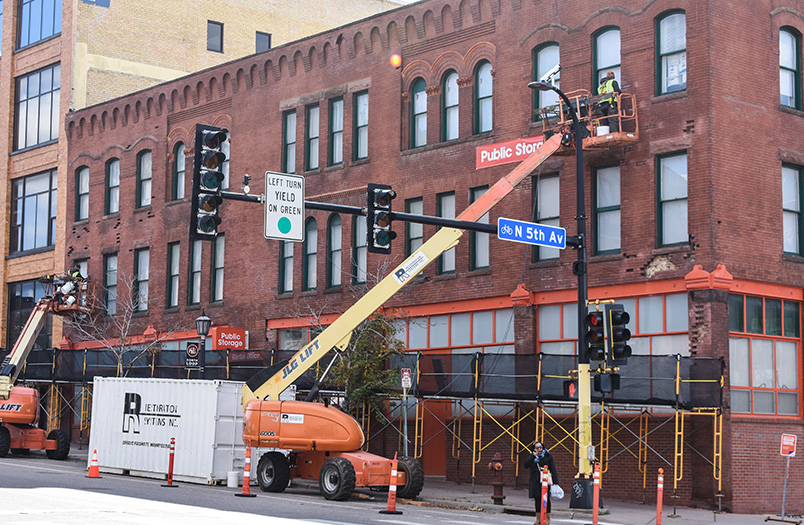
For buildings within designated historic districts, mortar selection isn’t optional — it’s regulated. Tayton Eggenberger explains that RSI is “required to do a petrographic analysis to ensure that the mortar and brick we’re putting back in the building meets those historical standards,” whether those standards come from the Minnesota Historical Society, the Minneapolis Heritage Preservation Commission, or the Secretary of the Interior’s Standards. RSI’s partnership with the Minneapolis Historic Preservation Committee across 20+ projects gives their team deep, practical knowledge of these requirements. As the federal benchmark, NPS Preservation Brief #2 establishes that replacement mortar must be compatible with — not stronger than — the original.
“With historic masonry, a lot of the buildings in downtown Minneapolis were built with what’s called Chaska brick — it was actually made here in Chaska, Minnesota. On a lot of those structures, we see that it requires low compressive strength mortar.”
— Dylan Reynolds, Project Manager, RSI
9% — Water expands by approximately 9% when it freezes. That expansion exerts immense pressure that cracks and weakens brick, stone, and mortar — and each freeze-thaw cycle compounds the damage.
Midwest winters make mortar selection even more consequential. Dylan explains that “the freeze-thaw cycle causes expansion as water infiltrates masonry materials in the summer. As that water freezes in the fall, it expands and causes cracks. Those cracks then compound, leading to further water intrusion, which compounds through several freeze-thaw cycles into a completely unstable facade.” Each season’s damage feeds the next — hairline cracks become water pathways become structural instability. Softer historic mortars, while essential for material compatibility, also require more frequent inspection and maintenance in harsh climates. Proper mortar selection paired with proactive care is the only reliable strategy for preserving Midwest masonry facades long-term.
RSI Tuckpointing in Action: Real-World Mortar Selection
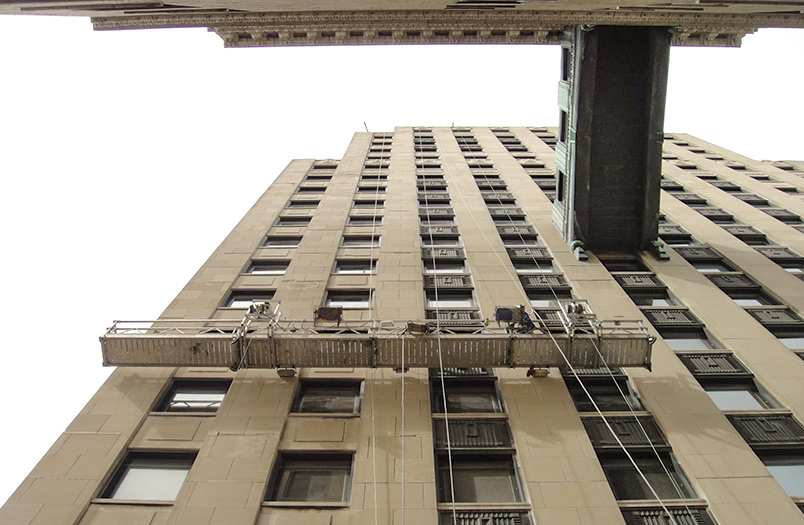
First National Bank Building
On a project spanning 108,000 square feet of exterior facade, every mortar joint matters. A wrong mortar choice at this scale doesn’t just affect one area — it compounds across the entire building envelope, potentially compromising the full facade. RSI’s team completed this 8-month tuckpointing and stone replacement project with precise mortar matching across every elevation, demonstrating the capacity and discipline required for large-scale commercial restoration.
View Full Case Study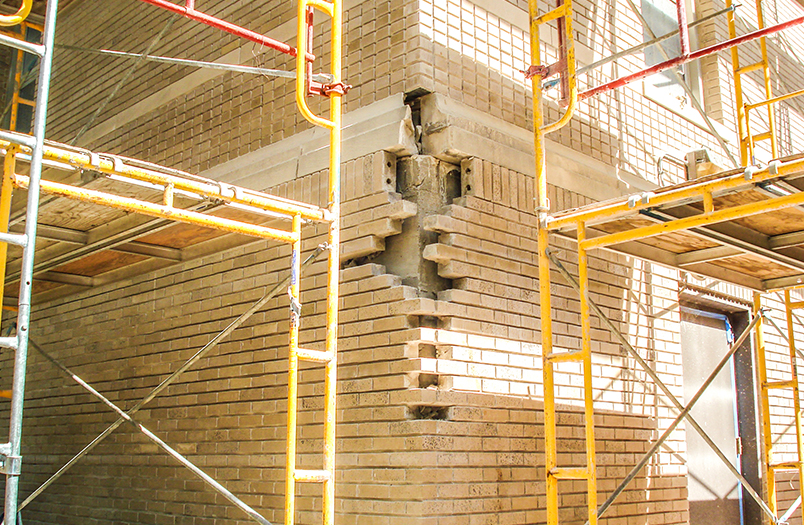
Lourdes Hall, Winona State University
This project is mortar compatibility in practice. With 150 pieces of original Indiana Limestone requiring replacement alongside 56,000 SF of tuckpointing, every joint needed Type O historic lime mortar to protect the soft surrounding stone. Using anything harder would have risked spalling across the limestone facade — exactly the cascading damage Dylan describes when mortar is too rigid for the materials around it.
View Full Case StudyHow to Tell If Your Tuckpointing Contractor Is Doing It Right
Whether you’re evaluating a new contractor or reviewing work in progress, these four indicators separate qualified masonry specialists from general contractors cutting corners.
-
The 2x Depth Rule
RSI’s standard is removing deteriorated mortar to a depth of two times the width of the joint. “If you have a quarter-inch joint, you’re cutting a half inch deep,” Dylan explains. “But oftentimes it’s a half-inch or an inch joint, and then we’re going deep.” This ensures enough new mortar material for a structural bond that carries load and sheds water. Non-specialized contractors often cut back only a quarter inch — nowhere near enough for lasting results.
-
Watch for “Skimming”
The most common improper tuckpointing repair is skimming — and it’s designed to fool you. “What you’ll see from non-specialized contractors is called skimming,” Dylan warns. “They’ll either not remove any mortar and just skim over the surface to hide it, or they’ll cut back a quarter of an inch.” A skimmed joint looks acceptable at first glance, but there’s no real bond beneath the surface. It fails quickly, and then you’re paying twice: once for the failed repair and again for the correct one.
-
Ask About Mortar Type Selection
A qualified tuckpointing contractor should be able to explain exactly which mortar type they’re recommending and why — matched to your building’s age, masonry materials, and structural requirements. If they use the same mortar on every project regardless of building type, that’s a significant red flag. As this article makes clear, the difference between Type O, Type N, and Type S isn’t preference — it’s engineering matched to your specific building.
-
Demand Material Compatibility Documentation
For historic buildings especially, ask for lab analysis or petrographic analysis confirming the mortar’s compatibility with your existing masonry. Tayton Eggenberger notes that “one of the things we’re required to do is a petrographic analysis to ensure that the mortar and brick we’re putting back in the building meets those historical standards.” RSI provides material composition reports and works directly with the Historic Preservation Committee to document compliance — a level of accountability that protects both the building and the owner.
Frequently Asked Questions About Tuckpointing Mortar
What is the difference between Type N and Type S mortar?
Type N mortar has a medium compressive strength of approximately 750 psi and is the most versatile option for above-grade exterior walls and general tuckpointing on newer construction. Type S mortar is significantly stronger at roughly 1,800 psi and is designed for structural load-bearing walls (such as CMU) and below-grade applications where water impermeability is critical. The key distinction is that stronger isn’t always better — using Type S on a building that only requires Type N can cause unnecessary stress on the surrounding masonry.
What type of mortar should be used on historic buildings?
Historic buildings typically require Type O or historic lime-based mortar, which has a low compressive strength of approximately 350 psi. This softer mortar is essential because it flexes with the natural movement of older masonry — such as limestone, Chaska brick, and other soft historic materials — rather than forcing stress into the surrounding units. Per NPS Preservation Brief #2, replacement mortar must be equal to or lower in compressive strength than the original. Buildings in designated historic districts are often required to undergo petrographic analysis to verify mortar compatibility before any work begins.
What happens if the wrong mortar type is used during tuckpointing?
Using mortar that is too hard for the surrounding masonry reverses mortar’s intended sacrificial role. Instead of the mortar deteriorating first to protect the brick or stone, the harder mortar forces stress and moisture into the softer masonry units. This can lead to cracking, spalling, delamination, and displacement of facade materials — not just at the repaired area, but cascading across adjacent pieces. RSI has seen firsthand how a single wrong material choice can trigger damage that spreads across an entire facade system, requiring far more extensive and costly repairs.
How do I know if my tuckpointing contractor is using the right mortar?
A qualified tuckpointing contractor should be able to explain exactly which mortar type they’re recommending and why — matched to your building’s age, masonry materials, and structural requirements. Key indicators of quality work include: removing deteriorated mortar to a depth of at least two times the joint width (the “2x Depth Rule”), avoiding surface skimming, selecting the correct mortar type for your specific building, and providing material compatibility documentation. For historic buildings, ask for petrographic analysis confirming the mortar’s compatibility. If a contractor uses the same mortar on every project regardless of building type, that’s a significant red flag. Learn more about evaluating tuckpointing contractors.
How does Midwest weather affect mortar and tuckpointing decisions?
The Midwest freeze-thaw cycle is one of the most damaging forces on masonry. Water infiltrates brick, stone, and mortar joints during warmer months, then expands by approximately 9% when it freezes. That expansion creates cracks, which allow more water intrusion, compounding through each successive freeze-thaw cycle into progressively worse deterioration. Proper mortar selection is critical in this climate — the mortar must be compatible with the surrounding masonry to absorb stress without cracking, while also providing appropriate water resistance. Softer historic mortars, while essential for material compatibility on older buildings, require more frequent inspection and maintenance in harsh Midwest winters. Learn about RSI’s facade restoration approach.
Protect Your Building with the Right Mortar
Whether you’re maintaining a historic landmark or preserving a modern commercial facade, mortar selection determines the long-term health of your building. RSI’s team brings 25+ years of experience and partnerships with the Minneapolis Historic Preservation Committee to every project across the Midwest.