
Understanding Post-Tension Slabs: Inspection, Assessment, and Repair Strategies
Expert guidance from 35+ years of PT slab inspection and repair across the Midwest — a practical guide for building owners and facility managers.

Key Takeaways
What every building owner needs to know about post-tension slabs
- Post-tension slabs are the most durable parking structure type — when properly maintained, they outlast precast structures and require the least ongoing repair.
- Damage is invisible until failure — PT cables are hidden inside the slab, making deterioration nearly impossible to detect without specialized inspection.
- Older structures with bare steel cables are highest risk — buildings constructed before modern waterproofing practices are especially vulnerable in salt-heavy Midwest climates.
- Annual inspections are recommended for Midwest PT structures — freezing temperatures and road salt accelerate the deterioration cycle year after year.
- Carbon fiber is the preferred repair material in the Midwest due to its corrosion resistance, crack-bridging ability, and cost-effectiveness compared to steel alternatives.
- Deferred maintenance leads to exponential cost escalation — what starts as a handful of cable repairs can escalate into full structural replacement costing millions.
Why Post-Tension Slabs Deserve Special Attention
When a post-tension cable fails, it doesn’t give a warning. The sudden release of tension — each strand can carry approximately 33,000 lbs of force per ACI 423 guidelines — sends energy violently through the concrete. The slab bulges. Concrete displaces. In some cases, the event is severe enough that police and emergency responders are called to the scene.
For building owners, the real danger isn’t the dramatic failure itself. It’s what you can’t see happening before it occurs. Post-tension cables are embedded inside the slab, making corrosion and deterioration virtually invisible until something breaks. That hidden nature is what makes deferred maintenance on PT structures so costly — and so dangerous.
“We went to a parking ramp in Rockford, Illinois, and we’re under contract to do concrete repairs and an estimated four PT cable repairs. By the time we left there, we had done over 1,000.”
— Mike Hintsala, RSI Expert
That Rockford project is a cautionary example of what happens when PT slab inspection is deferred. What began as a routine concrete repair contract revealed catastrophic hidden damage — from 4 planned cable repairs to over 1,000 actual repairs. On a similar out-of-state project, the scope exploded from 6 partial cable repairs to full cable replacement on an entire level. The owner ran out of funds and faced potential ramp closure.
“You can’t be mad at the engine if you never change the oil. What do you expect? Do you expect it to last forever?” — Mike Hintsala, RSI Expert, on the consequences of deferred PT maintenance.
Consider this: if your parking ramp represents a $200 million investment, how often would you review a $200 million financial portfolio? Probably not once every 10 years. Yet many building owners treat their parking structures as afterthoughts — the lowest-priority asset in their portfolio — until a failure forces their hand.
To understand why these failures happen — and why they’re so difficult to catch in time — you need to understand how post-tension systems actually work.
How Post-Tensioning Works — And Why It Matters for Parking Structures
The Book Metaphor — Compression in Plain Terms
“Squeeze 10 books together, center books don’t fall. You let go, they all fall. Take a bunch of books, squeeze them — you can pick them up right off the table. You let go, they’ll all fall down. Post-tensioning is a cable through those books, screwed tight to keep those books from falling.”
— Mike Hintsala, RSI Expert
That’s the core principle. High-strength steel cables — called tendons — are threaded through the concrete slab and tensioned after the concrete cures. This puts the entire slab under compression, holding it together the way squeezing books keeps them from falling. Per PTI guidelines, unbonded monostrand tendons used in parking structures can carry approximately 33,000 lbs of force per strand at 75% ultimate tensile strength. When those cables corrode and fail, the compression is lost — and the concrete loses its structural integrity.
Post-tension concrete slabs have been used for decades, and they remain the longest-lasting parking structure type requiring the least amount of repair when properly maintained. They are a premium construction method that rewards owners who invest in ongoing care.
PT Slabs vs. Precast: Why the Distinction Matters
PT slabs cost approximately twice as much as precast construction, but they deliver significantly less ongoing maintenance when properly cared for. The difference comes down to how each structure is built. Precast structures are assembled from individual concrete components — and as Mike Hintsala explains, they’re “built like Lincoln Logs. Think of all the holes between those logs. Precast structures are built the same way, so you’ll constantly waterproof and keep them tight.” A PT slab, by contrast, is a monolithic structure held tight by the cables themselves.
There’s an important historical distinction as well. Older PT structures used bare steel cables with no corrosion protection. Modern systems are designed to be fully watertight, with coated and sheathed tendons that dramatically extend service life. This means building age is one of the most significant risk factors for PT cable failure — structures built before modern waterproofing practices are far more vulnerable to salt and moisture intrusion.
How Post-Tension Slab Failures Are Discovered
Why PT Inspection Is Uniquely Difficult
Unlike conventional reinforced concrete — where you can sound for delamination and visually identify rebar corrosion — PT cables are completely hidden inside the slab. You can’t see them, and standard surface inspection techniques won’t reveal their condition.
“Post-tension slab inspection is really difficult because you can’t see it. Generally, we do the repairs when you can actually see a failure, because those cables let go and the concrete bulges.”
— Mike Hintsala, RSI Expert
Investigation methods range from non-destructive techniques like ground-penetrating radar (GPR) and impact-echo testing to more invasive approaches — opening anchors and physically checking cable condition. While GPR can locate tendons, it has limitations in assessing corrosion state. Mike advocates for the more thorough, hands-on approach because it yields the most reliable data about actual cable health.
Signs of Cable Distress Owners Can See
While most PT damage is hidden, there are visible warning signs that building owners and facility managers should watch for during routine walkthroughs:
- Concrete bulging — upward or downward slab displacement where cable tension energy has dissipated
- Evidence of previous PT repairs — a sign that cables may be under ongoing attack or were not properly protected
- Active water intrusion near cable paths or anchorage zones, especially with visible staining or mineral deposits
- Spalling or deterioration near anchorage zones — cracking and concrete loss at the points where cables are anchored to the structure
Never drill, core, or cut into a post-tension slab without first identifying cable locations. Severing a tensioned cable can release thousands of pounds of force instantaneously — a potentially catastrophic and life-threatening event. Always consult a qualified structural engineer before any modifications.
Post-Tension Cable Repair Techniques
Post-tension cable repair is a certified specialty technique. The cables are under enormous tension, making this work genuinely dangerous for untrained personnel. Only contractors with specific PT certification should perform this work — it’s not standard concrete repair.
Cable Replacement & Repair (Certified Work)
Direct cable replacement is the most straightforward concept but the most difficult to execute. As Mike Hintsala explains, “Inside of a square box, fixing those cables is going to be really difficult, unless you can feed them all the way through. So access is a problem.” In many cases, physical constraints inside beams and slabs make full cable replacement impractical, pushing the repair toward supplemental reinforcement methods.
Carbon Fiber Reinforcement
Carbon fiber reinforced polymer (CFRP) has become the dominant PT slab repair material in the Midwest — and for good reason. Industry data confirms that CFRP systems can restore and even exceed original structural capacity when properly engineered and installed.
“Carbon fiber is generally preferred because of all the things it does well — it bridges cracks, it’s waterproof, it’s cheaper, easier. The issue is that it needs to be designed by somebody competent and used in the right way.”
— Mike Hintsala, RSI Expert
Carbon fiber does carry trade-offs. It’s vulnerable to vehicle impact damage — unlike a steel plate that can absorb a hit, a carbon fiber application can be compromised by contact. It’s also flammable and requires fireproofing per modern building codes. These factors must be weighed against its clear advantages in corrosion resistance and cost.
Steel Plate Bonding & External PT
Steel plate bonding is an established repair technique, but it’s rarely used in the Midwest. The reason is simple: exposed steel corrodes too aggressively in salt-heavy environments. External post-tensioning — installing new cables on the outside of the beam — is another option, particularly for structures requiring significant capacity restoration. Both methods are viable but situation-dependent.
A critical practical constraint: adding repair material to the underside of beams reduces vehicle clearance height in the garage. This real-world limitation often drives technique selection — carbon fiber’s thin profile gives it a significant advantage over bulkier steel or external PT systems.
Midwest Climate and PT Slab Longevity
The Midwest presents a uniquely aggressive environment for post-tension structures. The deterioration pathway is predictable — and relentless:
As Mike Hintsala puts it: “People have concrete spalls for different reasons — freeze-thaw damage, poor concrete — and now concrete is enabling water to get to those cables. Those cables break, corrode, and we fix them.” Per PTI corrosion studies, chloride-laden water from road salt is the primary accelerant in this cycle, particularly in structures with unprotected bare steel tendons.
Older Midwest structures — built before modern tendon sheathing and waterproofing practices — carry the highest risk. They’ve endured decades of chloride exposure with no cable protection. This is also why carbon fiber is the preferred repair material in this region: the corrosive salt environment simply doesn’t allow exposed steel repairs to hold up long-term.
RSI has seen this deterioration chain firsthand across hundreds of Midwest projects — and our approach to post-tension slab repair is built on that regional experience.
RSI Post-Tension Slab Repair in Action
University of Minnesota Prospect Park Ramp
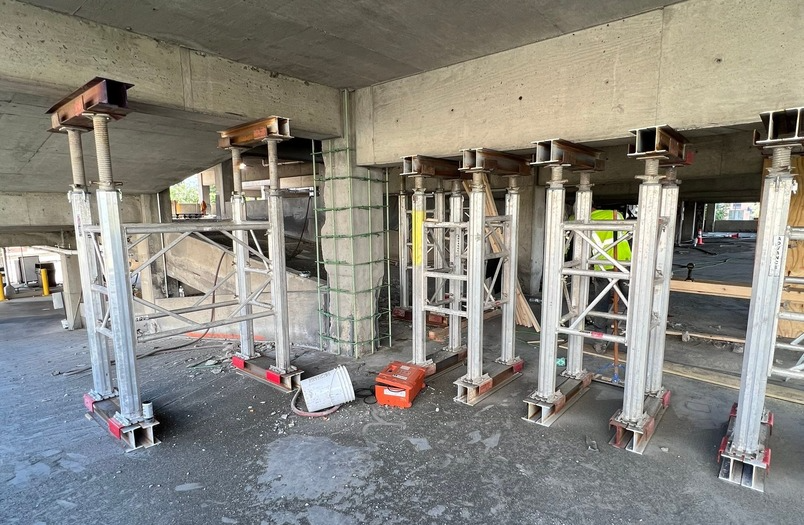
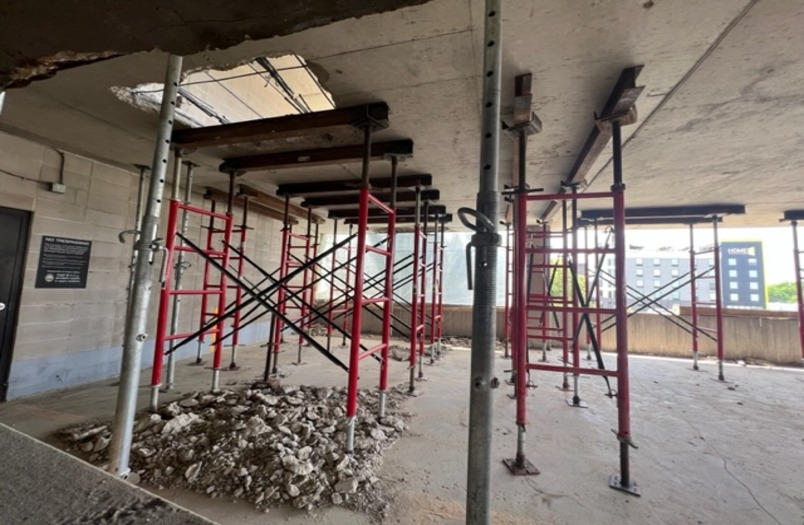
This institutional parking ramp required a comprehensive approach — PT cable failures were just one part of a larger structural deterioration picture that included concrete damage, column distress, and coating system failure. The 9-month timeline demonstrates the scale involved in properly restoring a PT structure with advanced deterioration.
- Post-Tension Cable Repairs
- Structural Concrete & Column Repairs
- Structural Steel Installation
- Traffic Coating, Floor Drains & Sealant Replacement
Pine Street Ramps — City of Green Bay
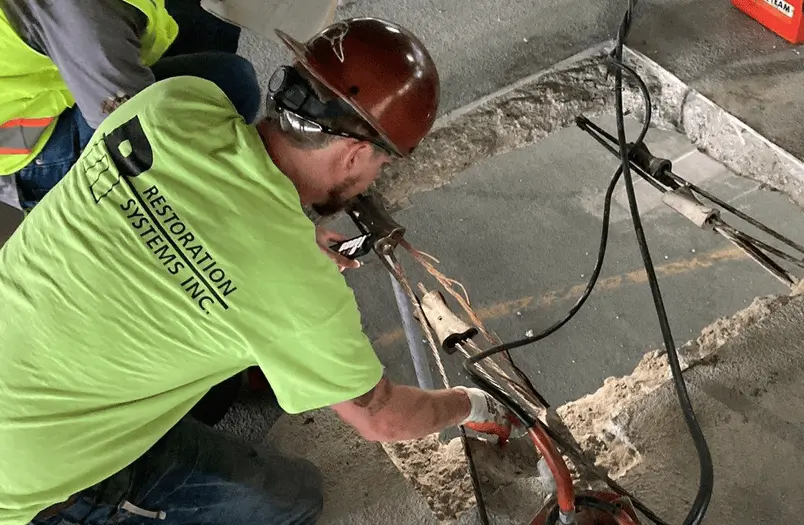
This municipal project demonstrates that PT repair goes far beyond simple “cable replacement.” The scope required specialized work on individual system components — tendons, end anchorages, splice couplings, and embedded tendons — each with distinct failure modes requiring deep engineering knowledge.
- PT Cable Repairs (Tendons, Anchorages, Splice Couplings)
- Full & Partial Depth Concrete Repairs
- Vertical & Overhead Concrete Repairs
- Expansion Joint & Traffic Bearing Membrane Replacement
RSI’s PT experience extends across building types and project scales. At the Lux Apartments in Brooklyn Center, MN, our team completed PT cable replacement and structural concrete repairs in just 2 months — demonstrating that focused post-tension slab repair can be completed efficiently when deterioration is caught early. A Minneapolis Office Complex project showcased RSI’s full-service capability, combining PT cable replacement with exterior facade restoration in a single contract.
Learn more about our post-tension cable repair services or explore our full parking deck restoration capabilities.
Inspection Schedules and Proactive PT Slab Maintenance
After understanding the stakes, the failure modes, and the repair options, the most important question for building owners is straightforward: how often should you inspect? For post-tension parking structures in the Midwest, the answer is clear.
Annual inspections for Midwest PT structures are non-negotiable. Freeze-thaw cycles, road salt, and hidden cable deterioration demand yearly assessment to catch problems before they escalate.
Mike Hintsala puts it in practical terms: “Yearly here in the Midwest, this is a yearly deal. You can plan for five years, 10 years, 15 years your cost. But it doesn’t change. Just like a financial planner, you better be reviewing your plan, otherwise things can change dramatically, and you didn’t address it.”
“If a parking ramp is a $200 million investment to build a new one, how many times would you look at your $200 million portfolio to make sure the money’s in the right places? Probably not once every 10 years. Parking ramps are considered an afterthought, but with regular maintenance, they can last a long time.”
— Mike Hintsala, RSI Expert
PT slab inspections can be scheduled year-round — there’s no seasonal restriction. That said, inspecting during wet or thaw periods can be informative, as active water intrusion becomes visible and can reveal pathways to the cable system that might otherwise go unnoticed.
Too many building owners treat their parking structures as the lowest-priority asset in their portfolio. But the math is simple: a small, regular investment in annual inspection and preventive maintenance costs a fraction of the emergency repairs that result from years of neglect. RSI approaches every client relationship with this long-term perspective — we’re not a one-and-done contractor, we’re a maintenance partner invested in the longevity of your structure.
For more on building a proactive approach, see our guides on parking structure condition assessments and 5-year capital planning.
Protect Your Post-Tension Investment — Schedule an Inspection
RSI’s certified PT specialists have inspected and repaired post-tension structures across the Midwest for over 25 years. Whether you need a first-time assessment or an annual maintenance inspection, our team brings the expertise your structure demands. Small, regular investments prevent catastrophic failures.
300+ Projects | 25+ Years Avg. Principal Experience | Certified PT Cable Repair
Schedule a PT Slab Inspection Or call 952-368-0463