
Water-Resistant Caulking: Selecting Sealants for Wet Commercial Environments
Commercial sealant selection is a system-level discipline — not a trip to the hardware store. Here’s how to match the right product to your building’s specific joint conditions, substrates, and exposure demands.

What You Need to Know
- “Water-resistant caulking” is a consumer term — commercial buildings require sealants rated for specific movement capacity, adhesion, UV resistance, and chemistry compatibility.
- Silicone, polyurethane, and hybrid sealants each serve different joint conditions — there is no universal “best” product.
- Most sealant failures are caused by wrong selection, poor surface prep, or improper joint geometry — not material defects.
- Midwest freeze-thaw cycling and wide thermal swings demand higher-performance sealants and tighter installation windows than moderate climates.
- RSI evaluates sealant needs joint-by-joint, matching chemistry to specific service conditions rather than defaulting to a single product.
Why Sealant Selection Matters in Wet Commercial Environments
Choose the wrong sealant for a commercial building joint, and here’s the cascade that follows: early debonding leads to water infiltration. Moisture gets trapped behind façade elements — invisible until the damage is severe. Winter arrives, that trapped water expands approximately 9% as it freezes, and microcracking accelerates through the concrete and masonry. Within a few seasons, what started as a sealant selection error has become a structural repair costing ten times the original sealant replacement job.
“Sealants are the flexible connectors at gaps and transitions. Most leaks start at joints and openings, not field areas — so sealants are often the difference between a successful system and a recurring leak.”
Industry experience consistently shows that the majority of building envelope water intrusion originates at joints, transitions, and penetrations — not across field areas of walls or roofs. That makes sealant selection one of the highest-consequence decisions in commercial waterproofing. This article gives property managers and facility directors the evaluation framework to understand what your contractor should be doing — and what questions to ask when they aren’t.
“Water-Resistant Caulking” vs. Commercial-Grade Sealants
“‘Water-resistant caulk’ is often a consumer-grade term. Commercial waterproofing relies on tested, rated sealants — movement capability, adhesion, UV resistance, chemistry compatibility. The wrong ‘caulk’ may shrink, crack, or debond quickly in dynamic joints.”
What “Water-Resistant” Really Means in Commercial Applications
In commercial construction, water-resistant caulking isn’t a product category — it’s a performance outcome achieved through proper sealant selection and installation. Commercial-grade sealants are classified under ASTM C920 with specific ratings for movement capacity (±25%, ±50%), adhesion class, and use compatibility. These aren’t marketing labels — they’re tested, measurable performance standards that determine whether a sealant will hold up under your building’s specific conditions.
A ±25% rated sealant in a 1-inch joint can handle ±0.25 inches of movement. Exceed that threshold and the sealant tears or debonds — making movement capacity one of the most critical selection criteria for any commercial joint.
Key Performance Criteria
Four factors drive every commercial sealant decision: movement capacity matched to expected joint movement, adhesion strength appropriate for the substrate, UV resistance for exposed applications, and chemistry compatibility with adjacent materials, membranes, and coatings. There is no single “waterproof caulk” — the right product depends on the specific joint condition, and getting any one of these factors wrong leads to premature failure.
Sealant Chemistry Breakdown: Matching Product to Environment
Each sealant chemistry has specific strengths — choosing the right one means matching product capabilities to your joint’s actual service conditions.
| Sealant Type | Best For | Movement Capacity | UV Resistance | Paintable | Key Limitation |
|---|---|---|---|---|---|
| Silicone | Exposed joints, curtainwall, high-UV areas | ±25% to ±50% | Excellent | No | Cannot be painted; requires primer on most substrates |
| Polyurethane | Concealed joints, masonry/concrete, traffic-bearing | ±25% typical | Moderate | Yes | UV degradation if left exposed long-term |
| Hybrid / Polysulfide | Chemical exposure, fuel/solvent contact, below-grade | ±12.5% to ±25% | Varies | Varies | Narrower movement range; application-specific |
Where Wet-Environment Sealant Selection Is Most Critical
These are the locations where water exposure, movement demands, and failure consequences converge — and where the wrong sealant choice does the most damage.
Window & Curtainwall Perimeters
Among the most common envelope failure points. Missing back dams, wrong sealant chemistry, or poor surface prep at window perimeters are top causes of commercial water intrusion — and often the first place leaks appear.
Precast Panel Joints
Large-format joints with significant thermal movement. The sealant must accommodate seasonal expansion and contraction without losing adhesion to concrete substrates — requiring careful chemistry matching and proper joint geometry.
Copings, Parapets & Roof-Edge Details
Fully exposed to UV, rain, and ice. These horizontal joints see ponding water and extreme temperature cycling — demanding sealants with superior UV resistance and weathering performance.
Expansion Joints & Traffic-Bearing Transitions
Must handle the largest movement ranges while withstanding foot or vehicle traffic. Undersized joints or rigid repair materials guarantee failure — these assemblies require both flexibility and abrasion resistance.
How RSI Selects Sealants for High-Moisture Environments
RSI doesn’t default to a single sealant product — we evaluate each joint condition individually and match the chemistry to the specific demands of that location. This five-factor framework drives every commercial sealant selection decision we make:
- Service Conditions — Is the joint exposed to immersion, UV, foot traffic, or chemical contact? Each condition narrows the viable product options.
- Movement Demands — Rated capacity must match expected joint movement. Undersizing movement capacity is a primary cause of premature sealant failure.
- Substrate Compatibility — Masonry, concrete, metal, and stone each require different primers and surface preparation for long-term adhesion.
- Cure Profile — Temperature and moisture requirements during installation determine when and how a sealant can be properly applied.
- System Compatibility — The sealant chemistry must work with adjacent membranes, coatings, and flashing materials without adverse reactions.
On a recent large-scale project — 30,000 linear feet of sealant replacement across a university campus along Lake Michigan — RSI used both polyurethane and silicone sealants: different chemistries for different joint conditions on the same project. That’s the difference between commercial sealant selection and “picking a caulk.”
“Owners often think: ‘We used a premium product, so it should work.’ Reality: Waterproofing succeeds or fails at details, transitions, drainage, and installation quality.”
Midwest Climate Factors That Accelerate Sealant Failure
The Climate Challenge
As Dan Lephardt puts it: “UV + wide thermal swings + freeze-thaw movement = faster fatigue. Joints see larger seasonal movement, and ice/water sitting on joints accelerates breakdown.”
Minneapolis experiences 50+ freeze-thaw cycles annually, with temperature swings that can span 130°F+ from winter lows to summer highs. Midwest joints undergo more movement cycles at greater amplitude than moderate climates. Water expands approximately 9% when freezing — saturated concrete and masonry suffer microcracking, scaling, and spalling that compounds each season.
What This Means for Selection
- Higher movement capacity ratings are needed compared to moderate-climate specifications — Midwest joints move more, more often.
- Cold-weather installation constraints are critical — many sealants have minimum install temperatures and cure requirements that limit viable application windows.
- Phased approach often necessary: emergency mitigation in fall/winter, then permanent sealant replacement under proper conditions in spring/summer.
- Sealants stiffen in cold weather, increasing stress at bond lines exactly when thermal cycling is sharpest and joint movement is most frequent.
RSI Sealant Replacement in Action
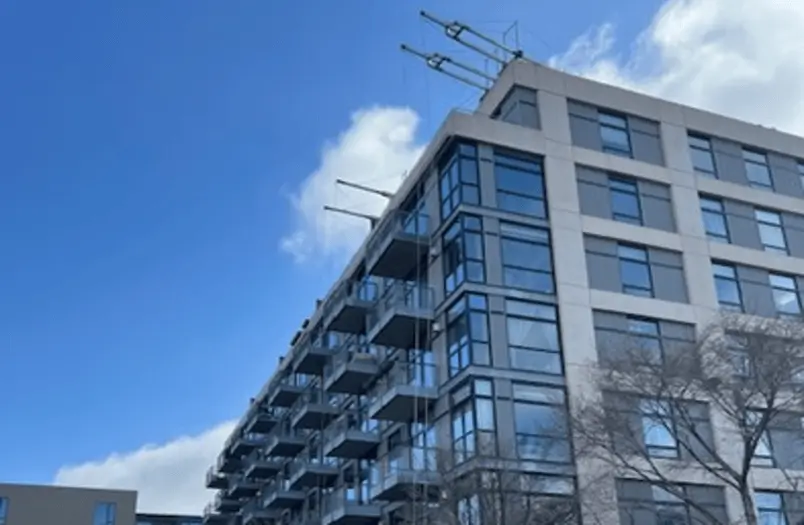
720 Lofts — Specialty Rigging + Full Sealant Replacement
Window perimeter sealant replacement, control joint sealant replacement, and sealant replacement between dissimilar materials across this residential high-rise. Specialty rigging — including golden gate booms spanning penthouse balconies — enabled full façade access without disrupting resident balcony use.
Three different joint types on a single building required different sealant chemistries — proving that commercial sealant replacement is precision work, not just “re-caulking.”
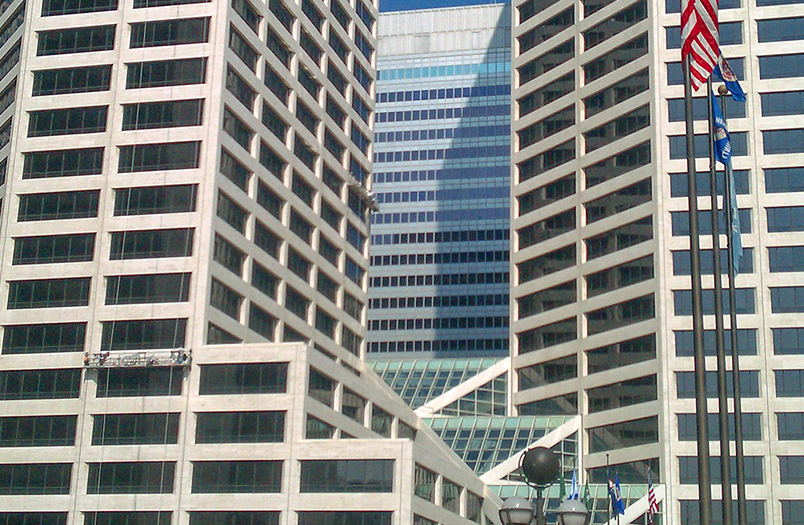
US Bank Plaza — High-Rise Sealant + Stone Joint Restoration
Sealant replacement at window perimeters and stone joints across twin towers (20 and 40 stories), plus stone repair and replacement. The phased, 5-year execution on occupied commercial towers required precise scheduling and lifecycle planning.
Sealant replacement at extreme scale demonstrates that substrate compatibility — stone vs. metal vs. concrete — drives chemistry decisions across every joint on a major commercial building.
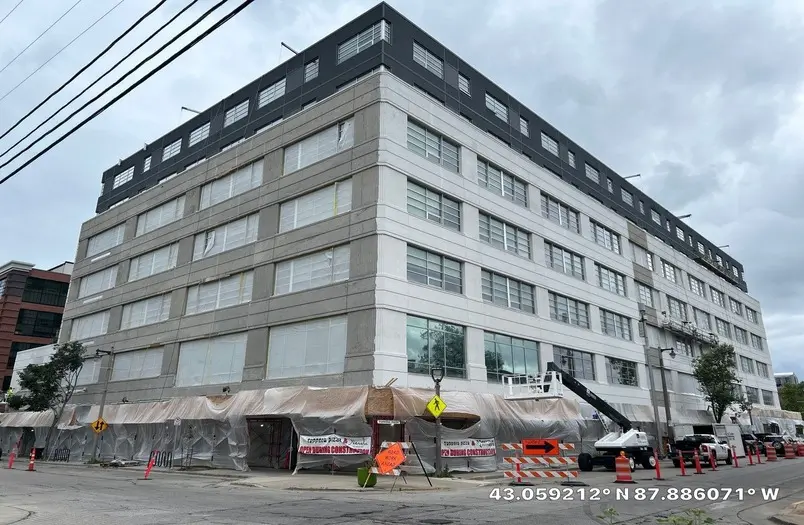
Kenilworth Square Apartments — Envelope Restoration
30,000 SF of failed coating removal plus sealant replacement, epoxy injection, and concrete repairs. A cautionary example of what happens when the wrong products are originally specified — sealant replacement became part of a much larger envelope restoration scope.
What Happens When the Wrong Sealant Is Used?
-
Early Debonding & Leaks
Wrong chemistry or inadequate movement capacity leads to adhesion loss within 1–3 years instead of the expected 10–20 year service life. Water begins entering the wall assembly at every failed joint.
-
Trapped Moisture Behind Façade
Water infiltrates through failed joints and becomes trapped within the wall assembly — invisible to building occupants and managers until damage has already progressed significantly.
-
Staining, Efflorescence & Interior Damage
Mineral deposits, water stains, and mold growth appear as visible symptoms of deeper envelope failure. By this point, the damage behind the façade is typically far more extensive than what’s visible.
-
Accelerated Freeze-Thaw Damage
Saturated concrete and masonry undergo microcracking and spalling each winter as trapped water expands. The damage compounds exponentially — each freeze-thaw cycle makes the next one worse.
-
Structural Repair Costs 10× the Original Sealant Job
What started as a sealant selection error becomes a major façade restoration — concrete repairs, steel corrosion remediation, coating removal, and full envelope rehabilitation.
Two of the most damaging misconceptions Dan Lephardt encounters: “Assuming ‘more sealant’ equals better waterproofing” and “treating leaks as a single-point repair instead of a pathway problem.” Both lead to repeat failures and escalating costs.
Questions to Ask Before Approving a Sealant Repair
Before approving any sealant repair scope, Dan Lephardt recommends property managers ask these six questions — the answers will tell you whether you’re getting a system repair or a temporary patch.
“What is the root cause — and how do we know?”
+If the contractor can’t explain how water is getting in — with diagnostic evidence, not assumptions — they can’t reliably stop it. Demand root-cause analysis before accepting any repair scope.
“Is this a system repair or a patch?”
+Understand whether the proposed scope addresses the full water pathway — from entry point through the wall assembly to interior damage — or just seals the visible symptom. Patches buy time; system repairs solve problems.
“How are terminations, transitions, and drainage being addressed?”
+Terminations, transitions, and drainage details are where most envelope failures originate. If they’re not explicitly included in the repair scope, the work is likely addressing symptoms rather than the actual failure points.
“What is the expected service life and maintenance plan?”
+A quality sealant repair comes with realistic lifecycle expectations and a maintenance schedule — not vague promises. Ask for specific service life projections and what ongoing inspections are recommended.
“What warranty is offered — and what voids it?”
+Understand the exclusions and owner responsibilities that could void warranty coverage. A comprehensive warranty means little if routine conditions — like deferred maintenance — are listed as exclusions.
“What access or open-ups are included to verify hidden conditions?”
+Exploratory access reveals the conditions that drive the real scope of work. If a contractor’s proposal doesn’t include any investigative open-ups, they’re scoping based on assumptions — and the final cost will likely change.
Get a Sealant Assessment from RSI
RSI’s waterproofing team evaluates sealant conditions joint-by-joint — identifying root causes, matching chemistries to service conditions, and delivering repair scopes built for long-term performance. Whether you’re addressing active leaks or planning proactive maintenance, our diagnostic-first approach ensures the right solution.