
Why Mortar Selection Matters More Than You Think
Most building owners think of mortar as permanent glue — something applied once and forgotten. The reality is fundamentally different. As RSI Branch Manager Tayton Eggenberger explains, “The mortar acts as both the bonding agent and a sacrificial material — it holds the masonry units together while allowing minor movement and moisture transfer. Ideally, the mortar should deteriorate before the brick or stone does, protecting the more permanent materials.” That sacrificial role is by design. Mortar is meant to wear first, absorbing stress and moisture so the brick and stone around it stay intact.
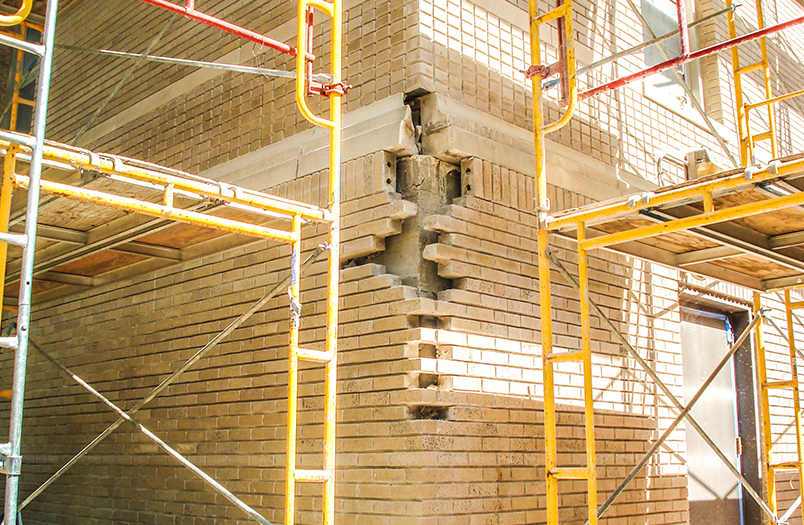
When the wrong mortar type is selected — especially one with too high a compressive strength — that sacrificial relationship reverses. Instead of protecting the surrounding masonry, the mortar becomes the harder material, forcing stress and movement into the brick or stone. According to NPS Preservation Brief #2, the federal standard for repointing mortar joints, replacement mortar should always be equal to or lower in compressive strength than the original. Violating this principle has real consequences. Dylan Reynolds, Project Manager at RSI, has seen it firsthand with limestone: using Type S mortar around limestone “can lead to displacement of the facade materials, because the mortar is actually harder and more rigid than the stone itself.”
“Choosing a mortar type that is too hard in compressive strength for the surrounding masonry will cause rapid deterioration of the masonry facade materials themselves.”
— Dylan Reynolds, Project Manager, RSI
This isn’t theoretical. RSI has encountered projects where other contractors used high-strength concrete patching material to repair small spalls in limestone. The result was cascading failure — not just at the patched area, but across adjacent pieces. “We have experienced this firsthand,” Dylan says. “Not only the need for further repair at that individual piece, but all of the surrounding and adjacent pieces delaminating, cracking, spalling, and displacing from the facade. And beyond that, the mortar itself that’s utilized around the limestone pieces deteriorates as well.” One wrong material choice triggered damage that spread across the entire facade system. That’s why mortar selection isn’t a detail — it’s a decision that determines the long-term health of your building.