

Skip to content
Serving MN · WI · IA · IL · ND · SD · NE · IN New Now in Indiana with Wells Restoration Systems 952.368.0463
Building Envelope

Expansion Joint Sealants for Commercial Structures: A Material Selection Guide

Most building envelope water intrusion starts at joints and transitions — not in the field areas of a wall or roof. When the wrong expansion joint sealant is specified, the consequences cascade: water infiltration leads to concealed damage, structural deterioration, and repair costs that dwarf the original sealant budget. The right sealant choice depends on joint design, substrate conditions, exposure, and system compatibility — not just picking a premium product off a spec sheet.

Dan Lephardt
Dan Lephardt Waterproofing & Building Envelope Specialist, RSI

Key Takeaways

  • Sealant selection is a system decision — joint design, substrate prep, and compatibility with adjacent materials matter as much as the product itself.
  • Polyurethane and silicone sealants serve different roles — matching chemistry to specific joint conditions prevents premature failure.
  • Joint geometry (depth-to-width ratio) and proper backer rod installation are the most overlooked factors in long-term sealant performance.
  • Midwest freeze-thaw cycling and wide thermal swings create harsher demands on expansion joints — material and installation timing must account for regional conditions.
  • Most expansion joint sealant failures trace back to design, surface prep, or installation errors — not defects in the sealant material itself.

Polyurethane vs. Silicone: Choosing the Right Expansion Joint Sealant Chemistry

The two dominant commercial sealant chemistries — polyurethane and silicone — are not interchangeable. Each delivers distinct performance characteristics that make it the right choice for specific joint conditions and the wrong choice for others. As Dan Lephardt puts it: “The same building may require different sealant chemistries at different joint locations.” On a recent RSI project involving 30,000 linear feet of sealant replacement across a university campus along Lake Michigan, both polyurethane and silicone were specified — because different joints demanded different solutions. Understanding those trade-offs is where effective material selection begins.

Polyurethane Sealants

Polyurethane sealants are the workhorses of commercial joint sealing — valued for their strong adhesion and abrasion resistance. Classified under ASTM C920 with Class 25 (±25%) or Class 50 (±50%) movement capability, they bond tenaciously to concrete, masonry, and metal substrates. Their paintability is a significant advantage for concealed or aesthetic-sensitive locations where color matching matters.

Key Strengths
  • Excellent adhesion to most commercial substrates including concrete, masonry, and metal
  • Superior abrasion and tear resistance — ideal for traffic-bearing joints on parking decks and plaza surfaces
  • Paintable — accepts topcoats for color matching and additional UV protection
  • Available in ASTM C920 Class 25 and Class 50 movement ratings for a range of joint conditions
Best Applications

Parking deck and plaza expansion joints, concealed flashing terminations, traffic-bearing transitions, and locations where the sealant will be painted or coated. Important consideration: polyurethanes are more sensitive to moisture during cure — substrates must be dry at the time of installation.

Silicone Sealants

Silicone sealants excel in exposed, high-movement applications where UV resistance and long-term weathering durability are paramount. They maintain flexibility across a wider temperature range than polyurethanes — a critical advantage in the Midwest — and typically deliver longer service life in facade-exposed conditions, making them the go-to choice for curtain wall and window perimeter joints.

Key Strengths
  • Superior UV and weathering resistance for long-term exposed service on building facades
  • Maintains flexibility across a wider temperature range — critical for Midwest thermal cycling
  • High movement capability — ±50% or greater in premium formulations per ASTM C920
  • Longer expected service life in facade-exposed conditions compared to most polyurethanes
Best Applications

Curtain wall and window perimeter joints, precast panel joints, exposed facade control joints, and coping and parapet details. Important consideration: silicone is not paintable — color selection must happen at specification. Less abrasion-resistant than polyurethane in traffic-bearing areas.

Hybrid & Specialty Systems

Some joint conditions exceed the capabilities of standard field-applied sealants. Immersion environments, extreme movement ranges, or sustained chemical exposure may require engineered expansion joint systems — preformed compression seals, bellows-type covers, or custom-fabricated gasket systems. At the Wells Fargo Center in Minneapolis, RSI replaced existing window gaskets with custom-sized silicone gaskets engineered for each window location — proving that the right “sealant” solution sometimes isn’t a caulk joint at all, but a purpose-built envelope component.

Wells Fargo Center facade rehabilitation in Minneapolis featuring custom silicone gasket installation at window perimeters
Wells Fargo Center, Minneapolis — RSI installed custom-sized silicone gaskets at each window location, moving beyond standard caulk joints to an engineered envelope solution.

Beyond the Product: Joint Design and Selection Criteria That Determine Performance

Choosing the right sealant chemistry is only part of the equation. The most common cause of expansion joint sealant failure isn’t a defective product — it’s a breakdown in joint design, surface preparation, or installation execution. As Dan Lephardt explains: “Waterproofing succeeds or fails at details, transitions, drainage, and installation quality.” Product-only thinking is exactly why buildings get re-caulked repeatedly and still leak.

“You can install the ‘best’ membrane made, but if the termination isn’t sealed, a joint moves beyond capacity, drainage is missing, or penetrations aren’t detailed… you still leak. Systems manage water, movement, and transitions — product-only thinking is why ‘we re-coated it and it still leaks.'”

— Dan Lephardt, Branch Manager, RSI Milwaukee

Joint Geometry and Backer Rod

Before any sealant is specified, the joint itself must be properly designed. Per ASTM C1193, the critical parameter is the depth-to-width ratio — ideally 1:2, meaning sealant depth should be approximately half the joint width. This geometry ensures the sealant can flex without exceeding its elongation limits as the joint opens and closes through thermal and structural movement cycles.

Equally important is backer rod installation. A closed-cell foam rod inserted into the joint before sealant application serves two essential purposes: it controls sealant depth to achieve the correct ratio, and it prevents three-sided adhesion — one of the most common and damaging installation errors in commercial sealant work. When sealant bonds to three surfaces instead of two, it can’t stretch freely. It tears. Dan identifies this as a top failure cause: “Wrong joint size or shape — no backer rod, three-sided adhesion.”

These aren’t minor details. A sealant rated for ±50% movement will still fail prematurely if the joint geometry forces it to stretch beyond its design limits, or if three-sided adhesion restricts the flexibility that makes it effective in the first place.
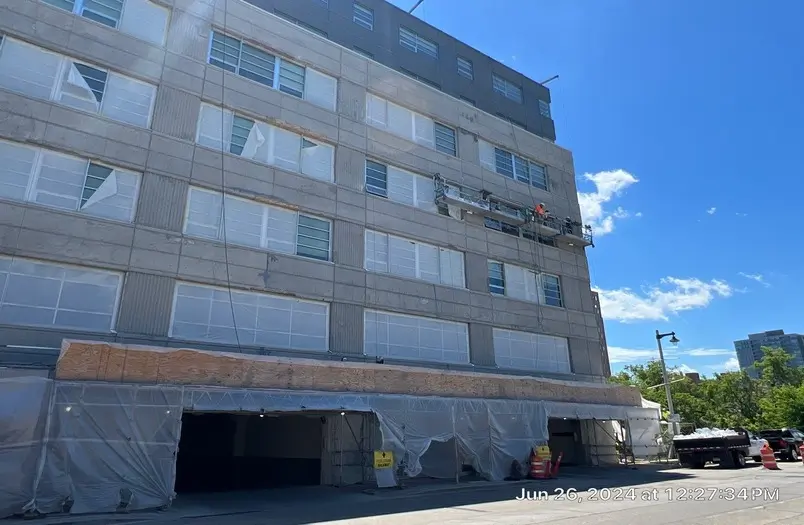
Kenilworth Square Apartments in Milwaukee undergoing comprehensive building envelope restoration including sealant replacement
Kenilworth Square Apartments, Milwaukee — sealant replacement integrated with a 30,000 SF envelope rehabilitation including coating removal, epoxy injection, and concrete repair.

RSI’s 5-Variable Selection Process

With joint geometry addressed, RSI evaluates five variables to match the right sealant to each specific joint condition. There’s no one-size-fits-all approach — and as Dan’s university campus project proved across 30,000 linear feet of sealant work, the same building often requires different products at different locations.

  1. Service conditions — UV exposure, moisture level, traffic wear, and chemical contact (including deicing salts on horizontal joints and parking structures)
  2. Movement demands — expected joint movement expressed as ±25% or ±50% per ASTM C920 classification, calculated from thermal expansion coefficients and anticipated structural movement
  3. Substrate compatibility — adhesion performance varies significantly by material; concrete, masonry, metal, stone, and glass each have different surface energy and preparation requirements
  4. Cure profile and temperature constraints — many commercial sealants cannot be installed below 40°F, and moisture-sensitive products require dry substrates for proper adhesion
  5. System compatibility — the sealant must be chemically compatible with adjacent membranes, coatings, flashing, and primers to prevent debonding or degradation at interfaces

“We match service conditions — immersion, UV, traffic, chemicals — with movement demands at ±25%, ±50%, and so on. Then substrate type and prep limitations, cure profile and install temperature constraints, and compatibility with adjacent membranes and coatings.”

How Midwest Conditions Intensify Every Criterion

Every selection criterion above becomes more demanding in the Midwest. The region’s wide seasonal temperature swings — from well below zero to 90°F and higher — mean expansion joints experience significantly larger movement ranges than identical joints in moderate climates. That movement stresses sealants harder and more frequently throughout their service life.

  • Freeze-thaw cycling accelerates joint deterioration: water expands approximately 9% when freezing, causing microcracking and spalling in concrete and masonry substrates that undermines sealant adhesion season after season
  • Higher movement class requirements — joints that might perform adequately at ±25% in a temperate climate often demand ±50% sealants in Minneapolis or Milwaukee to accommodate wider thermal swings
  • Constrained installation windows — many sealants can’t be installed below 40°F, and frost or condensation on substrates changes prep requirements, limiting viable work seasons across the Midwest
  • Salt and chloride exposure from deicing compounds compounds sealant degradation at horizontal joints on parking structures, plaza decks, and building entries throughout the winter months

This is why RSI often recommends a phased approach for Midwest building owners: stabilize urgent leak conditions with temporary measures, then execute permanent sealant repairs during proper weather windows when materials can cure correctly and substrates can be thoroughly prepared. As Dan notes: “More focus on freeze-thaw resistance, movement capacity, and water shedding. Scheduling matters: many products have minimum install temps and cure requirements.”

RSI Expansion Joint Sealant Work in Action

The selection principles above aren’t theoretical — they’re the same framework RSI applies on every project. Here’s how they play out on real buildings across Minneapolis and Milwaukee, where getting sealant selection right means accounting for joint-specific conditions, system integration, and Midwest exposure demands.

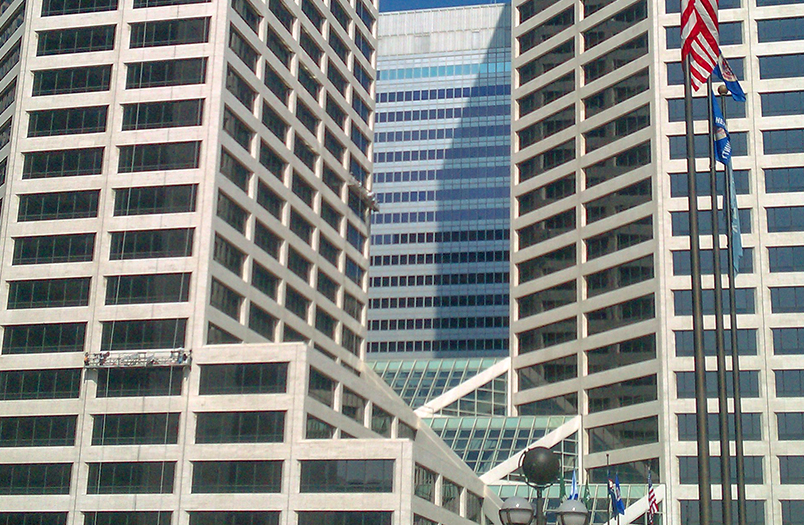
US Bank Plaza twin towers in Minneapolis during a multi-year sealant replacement and stone joint restoration program
Minneapolis, Minnesota

US Bank Plaza — 5-Year Sealant Program Across 60 Stories

Twin towers totaling 60 stories, addressed over a 5-year contract. RSI combined sealant replacement at window perimeters with stone joint repairs and cracked stone replacement — demonstrating that commercial sealant programs integrate with broader envelope restoration rather than standing alone. This is systems thinking at scale.

Additional Midwest Projects

Specialized Sealant Solutions Across the Region

Wells Fargo Center, Minneapolis: RSI installed custom-sized silicone gaskets at every window location — demonstrating that the right envelope solution sometimes means moving beyond standard caulk joints to engineered gasket systems designed for curtain wall applications.

Kenilworth Square Apartments, Milwaukee: Sealant replacement as one component of a comprehensive 30,000 SF envelope rehabilitation — proving that effective joint work integrates with coating removal, epoxy injection, and concrete repair as part of a unified restoration strategy.

Protect Your Building With the Right Sealant Strategy

Expansion joint sealant selection is a system decision that determines whether your building envelope protects your investment for decades — or becomes a recurring source of leaks, damage, and escalating repair costs. The right approach starts with understanding how water moves through your building’s assemblies, not just which product to specify.

“Address small leaks early — they’re cheaper to fix than structural damage. Inspect sealants, joints, and drainage annually. Think in lifecycle costs, not patch-to-patch spending.” — Dan Lephardt, RSI