01
Visual assessment
Review affected areas, adjacent assemblies, prior repairs, exterior conditions, facade terminations, deck slopes, drains, expansion joints, sealant lines, and other likely water-entry points.

Find the entry point, trace the travel path, and give owners a repair plan that stops the leak at its source.
A stain under a parking deck, a drip at a window head, or water in occupied space below a plaza rarely tells the whole story. As Dan Lephardt puts it, the “visible leak location is often not where the problem actually originates.” RSI investigates commercial leaks by reading the building history, testing the likely failure points, and documenting why water is getting in before repair dollars are committed.

A commercial leak investigation starts by separating the visible symptom from the actual entry point. RSI first looks at the owner’s immediate concern, the building history, the urgency of the leak, and the conditions that seem to trigger it. That matters because water intrusion may show up in a ceiling, tenant space, stairwell, or below-grade room while the failure is coming from a different assembly entirely.
On site, RSI reviews the affected areas, surrounding assemblies, and exterior conditions that may be feeding the leak. The investigation can include waterproofing systems, sealants, drains, facade conditions, expansion joints, concrete deterioration, and known problem areas. Depending on the building and suspected source, the team may use controlled water testing, infrared thermography, moisture meters, drainage flow testing, concrete sounding, deterioration mapping, or selective exploratory openings.
This diagnostic approach is especially important in Upper Midwest buildings, where freeze-thaw cycles and repeated moisture exposure place heavy stress on concrete, waterproofing membranes, joints, and facade systems. Water can move through wall cavities, along reinforcing steel, across structural framing, or beneath a topping slab before it becomes visible, so the repair scope should be based on the leak path rather than the stain alone.
After the investigation, RSI provides a findings summary that identifies likely sources of intrusion, contributing conditions, areas tested, photo documentation, and recommended repair options. The goal is to help owners, property managers, and engineers make practical decisions: stop the active leak, avoid repeat temporary fixes, and plan repairs that address why the intrusion developed in the first place.
Leak findings often lead directly into related work such as commercial waterproofing, caulking and sealant replacement, building facade restoration, or concrete repair.
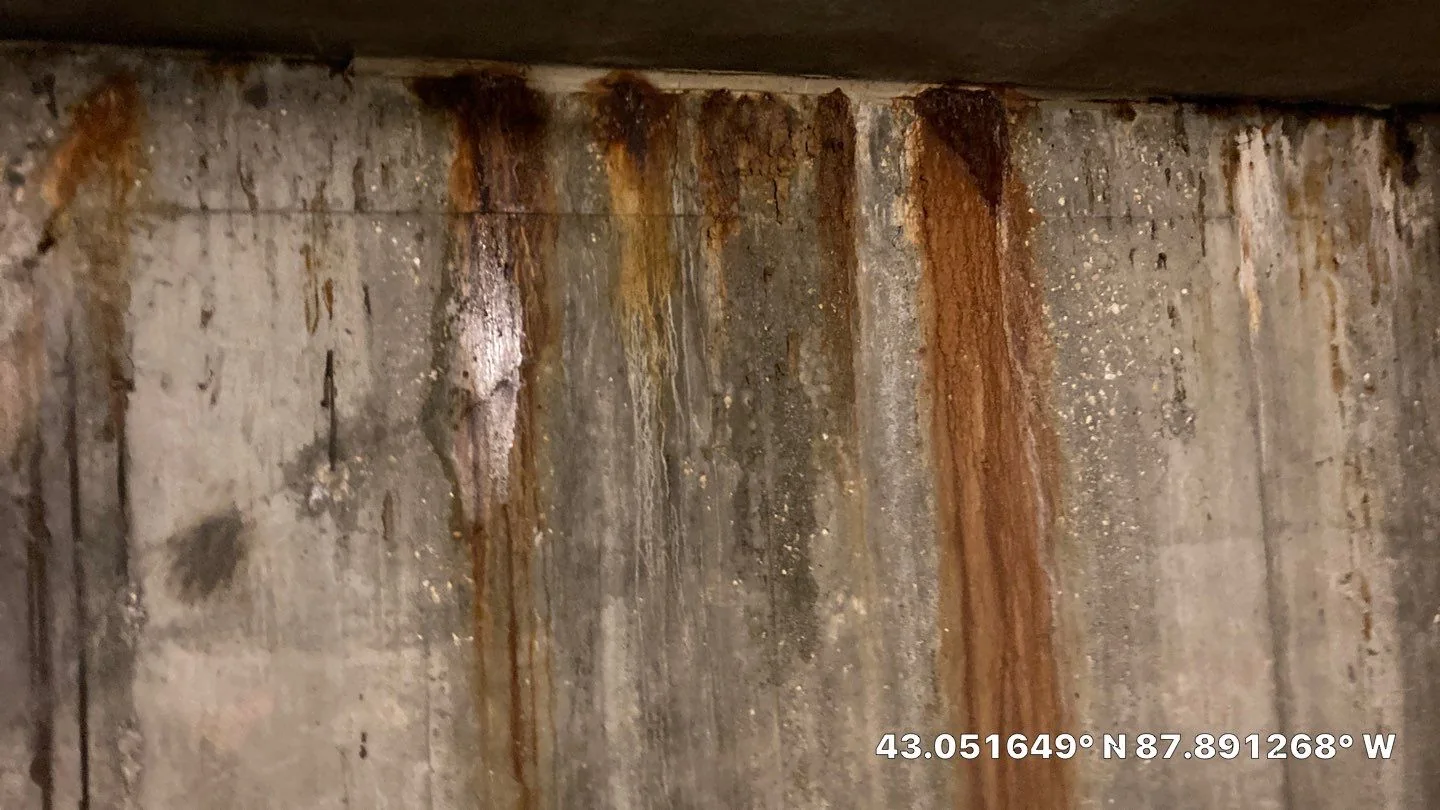
RSI uses visual investigation, moisture detection, controlled testing, and selective openings depending on the building type and suspected failure. The goal is to separate symptoms from sources: a failed drain transition uphill on a deck, an open sealant joint at a window perimeter, a cracked concrete path, or a below-grade waterproofing breach can all look like the same ceiling leak from inside.
Review affected areas, adjacent assemblies, prior repairs, exterior conditions, facade terminations, deck slopes, drains, expansion joints, sealant lines, and other likely water-entry points.
Use moisture meters and infrared scanning where conditions allow to identify wet areas, compare suspect zones, and decide where focused testing or exploratory work will be most useful.
Introduce water in controlled sequences so the team can isolate which joint, transition, drain, facade element, or membrane area is contributing to the leak path.
Open limited areas when concealed conditions need confirmation. Selective probes can expose failed waterproofing, trapped water, deteriorated concrete, or transitions that cannot be evaluated from the surface.
That selection matters because, as RSI sees it, every leak behaves differently; the investigation is “customized to the building and conditions” rather than forced into a stock checklist.
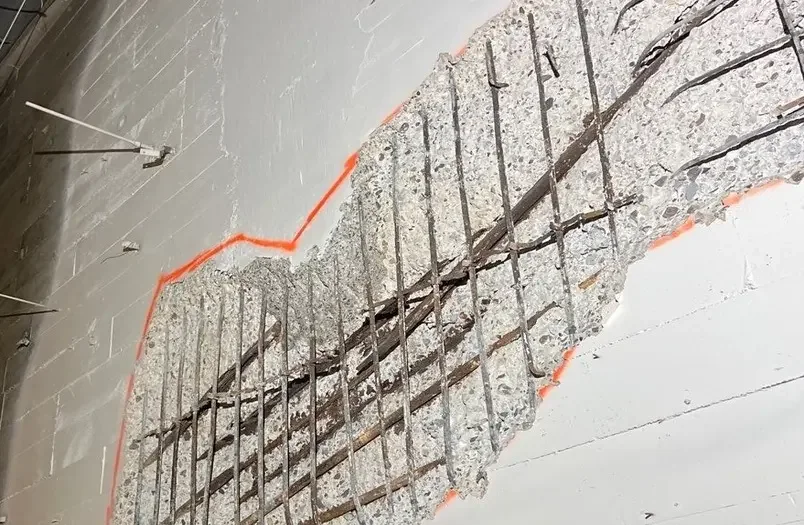
Parking structures, plaza decks, facades, balconies, podium decks, below-grade structures, and commercial roofing transition areas. The exposed reinforcing steel shown here is the kind of finding that can shift a repair from a surface sealant scope to a concrete and waterproofing scope.
For comparable parking-structure restoration context, see RSI’s Riverwest Parking Garage Restoration project.
Water rarely travels in a straight line. A leak showing up inside a building may originate dozens of feet away, move through concealed assemblies, or only occur under certain weather conditions. Effective leak investigation requires knowledge of waterproofing assemblies, expansion joints, facade systems, concrete behavior, drainage design, and building movement.
Dan LephardtRSI Wisconsin Branch Manager
Freeze-thaw cycling, wind-driven rain, deicing salt, building movement, and aging sealants create recurring stress on waterproofing systems and concrete assemblies. Across the Upper Midwest, a small leak can become a repair planning issue when water starts damaging interiors, corroding reinforcing steel, or undermining adjacent systems.
Repeated wetting, freezing, expansion, and thawing drive water deeper into cracks, joints, deck transitions, and concrete defects. Investigation has to account for what the building does in winter, not only what is visible on a dry site walk.
The most common owner mistake is waiting too long or layering “temporary fixes” at the visible stain. If the source is uphill on a deck or hidden behind a facade, the leak returns when the same weather pattern comes back.
Water on a plaza or parking deck often finds the weak transition: a drain body, termination, curb, expansion joint, or edge condition. Those details need to be inspected before a membrane or sealant repair is assumed.
A high-rise or commercial facade leak can enter at a joint or window perimeter, move through concealed cavities, and appear far from the entry point. That is why interior symptoms alone are not enough to define the scope.
Once water reaches reinforcing steel, corrosion expansion can crack and spall the concrete. Each season can open the leak path further, tying the waterproofing problem to a structural repair sequence.
Where leak investigation traces water to cracked, spalled, or delaminated concrete, findings should feed directly into concrete repair services. Where the failure is at a parking structure or traffic surface, RSI can also evaluate whether parking deck restoration or traffic coatings belong in the repair plan.
The sequence is diagnostic: understand the symptom, inspect the surrounding assemblies, test only what needs testing, and turn the findings into an actionable repair path. The report is part of the service because documentation is the “foundation for future repair planning and budgeting.”
RSI starts by gathering leak history, building history, prior repair attempts, access constraints, and the conditions that trigger the leak. Weather pattern, location, timing, and urgency shape the inspection plan.
The team visually assesses the affected area, the exterior or deck conditions around it, and the systems that can contribute: waterproofing, sealants, drains, facade components, expansion joints, concrete, and known problem areas.
Depending on the suspected source, RSI may use controlled water testing, moisture mapping, infrared scanning, drainage flow testing, sealant and joint inspection, concrete sounding, deterioration mapping, or selective exploratory openings.
The report documents existing conditions, areas tested, photo evidence, likely causes of intrusion, contributing conditions, recommended next steps, and repair-prioritization guidance for owners, property managers, and engineers.
Many investigations end at a moving joint or failed transition, which is why RSI connects leak findings to caulking and sealant replacement, hot-applied waterproofing, or broader parking deck restoration only after the source is understood.
A commercial leak investigation is a structured review of the building envelope and waterproofing systems that could be letting water in. RSI looks at symptoms, building history, affected areas, surrounding assemblies, and likely entry points, then uses testing or exploratory work where needed to identify the source and recommend repair options.
Water can travel through wall cavities, along reinforcing steel, through concrete cracks, across framing, or beneath a topping slab before it appears. RSI often sees leaks surface several floors below or many feet away from the actual waterproofing, facade, joint, or drainage failure.
Common investigations include parking structures, plaza decks, building facades, balconies, podium decks, below-grade structures, and commercial roofing transition areas. RSI frequently investigates water entering occupied spaces below parking ramps or plaza decks, as well as high-rise facade leaks, window perimeter failures, and below-grade foundation water intrusion.
Depending on the building and suspected source, RSI may use controlled water testing, infrared thermography, moisture meters, exploratory openings, drainage flow testing, sealant and joint inspection, concrete sounding, and deterioration mapping. The method is selected to answer the building’s specific leak question.
Many repeat leaks were repaired at the visible symptom instead of the actual source. A wet ceiling below a deck might be fed by a failed waterproofing or drainage transition farther uphill, and a window leak may be tied to a hidden facade path rather than the joint that looks worst from the inside.
Reports typically include photo documentation, existing condition observations, areas tested, likely causes of intrusion, contributing conditions, recommended next steps, and repair-prioritization guidance. The intent is to give owners, property managers, and engineers clear information they can use for planning and budgeting.
Yes. Many investigations involve occupied tenant space below a parking deck or plaza, active parking structures, and commercial buildings that must remain in use. Access, testing sequence, protection, and communication are planned around the building’s operations.
Early is better. Small leaks can become larger and more expensive when water deteriorates concrete, corrodes reinforcing steel, damages interiors, or compromises adjacent systems. Early investigation usually gives owners more repair options and a better chance of controlling the scope.
RSI performs commercial leak investigation across the Upper Midwest for parking structures, plaza decks, facades, balconies, podium decks, below-grade structures, and roof transition areas. We track how water is moving through the assembly so the repair targets the source, not just the stain.