The Midwest’s leading structural restoration experts. From minor spall repairs to full-depth concrete replacement, RSI delivers lasting solutions for parking structures, commercial buildings, and industrial facilities—on time and on budget.
RSI’s team helped create the ICRI concrete surface profile (CSP) standards that the entire restoration industry uses—the same guidelines other contractors follow.
Midwest structures face 50–100+ freeze-thaw cycles annually, combined with de-icing salt exposure, creating the most aggressive environment for concrete deterioration in the country.
Crack injection choice matters: Epoxy for structural cracks in dry conditions; polyurethane for active water leaks. Using the wrong product wastes money and fails within months.
Quality repairs should last 5+ years minimum. If you’re repairing the same areas repeatedly, something’s wrong—either with the diagnosis or the contractor’s work.
Trip hazards and loose concrete create serious liability. As Mike puts it: “All that stuff is relatively cheap compared to any settlement because somebody got hurt.”
Warning Signs Your Concrete Needs Professional Repair
Concrete deterioration rarely happens overnight. Most facility managers first notice small issues—a crack here, some surface scaling there—that seem minor but often indicate deeper structural problems. Knowing what to look for can help you address issues before they become expensive emergencies.
Visible spalling and delamination: Chunks of concrete breaking away from the surface, often exposing corroded rebar beneath. This is the most obvious sign of advanced deterioration.
Potholes and surface failures: High-traffic areas showing depression or complete material loss. These create trip hazards and accelerate surrounding damage.
Trip hazards at joints and cracks: Uneven surfaces where concrete has heaved or settled, creating liability concerns for pedestrian traffic.
Rust staining on concrete surfaces: Orange-brown discoloration indicates the reinforcing steel inside is corroding—a serious structural concern that will only worsen.
Water infiltration and efflorescence: Water dripping through overhead slabs or white mineral deposits signal that protective barriers have failed.
Widening or active cracks: Cracks that grow over time or show seasonal movement indicate ongoing structural stress requiring evaluation.
The liability reality: “When we evaluate repair costs, we always consider the broader risk picture,” explains Mike Hintsala, RSI Expert. “The investment in addressing trip hazards and loose concrete is modest compared to the potential liability exposure from an injury. A proactive approach to structural safety protects both your tenants and your bottom line.”
Kenilworth Square Apartments in Milwaukee required 30,000 SF of coating removal, epoxy injections, and extensive concrete repairs—the kind of comprehensive scope that develops when early warning signs are ignored.
Why RSI? We Helped Write the Industry Standards
When facility managers research concrete repair contractors, they often find companies citing ICRI (International Concrete Repair Institute) guidelines as proof of expertise. Here’s what makes RSI different: our team didn’t just learn those standards—we helped create them.
Mike Hintsala, RSI Expert, served on the ICRI technical committee that developed the concrete surface profile (CSP) standards now used industry-wide. These guidelines define how contractors should prepare surfaces, select repair materials, and verify quality. They’re the benchmarks every legitimate restoration contractor references.
“People read the ICRI guidelines and say, ‘I want to talk to the guy who wrote this.’ And I tell them—you’re looking at him. I was the one helping set these standards for the industry, and now I’m out here executing them every day.”
— Mike Hintsala, RSI Expert
Mike’s Credentials
21+ years in commercial concrete repair and structural restoration
300+ parking structure and commercial building projects completed
ACI (American Concrete Institute) certified professional
What This Means for Your Project
When RSI evaluates your structure, you’re getting more than a contractor’s opinion—you’re getting an assessment from someone who literally defined what “proper” concrete repair looks like for the entire industry.
This depth of expertise translates into practical benefits: accurate scoping that catches problems other contractors miss, repair specifications that match the actual conditions, and quality standards that exceed minimum requirements because we helped establish what those minimums should be.
RSI’s Institutional Knowledge
Founded in 1997 and operated by principals averaging more than 25 years’ experience each, RSI has built its reputation project by project across the Midwest. Our team doesn’t just repair concrete—we understand the science of deterioration, the regional challenges unique to Minnesota and Wisconsin climates, and the long-term implications of repair decisions.
This expertise is why institutional clients like the University of Minnesota, the Minneapolis-St. Paul International Airport, and municipal parking authorities across the region trust RSI with their most critical concrete restoration projects.
When you’re choosing a concrete repair contractor, the question isn’t just “can they do the work?”—it’s “do they understand why certain approaches succeed and others fail?” At RSI, that understanding is built into our DNA.
Understanding Commercial Concrete Repair Types
Not all concrete damage requires the same solution. Understanding the three main repair categories helps you communicate with contractors and evaluate proposals accurately.
$45-65/SF
Minor Repairs
“Concrete repair can be pretty much separated into spalls, where you and I can think of that as overhead, on walls, something that’s loose that you can see that needs to be patched,” explains Mike Hintsala. These are surface-level repairs for concrete that’s delaminated or broken away but hasn’t compromised the full slab depth.
Overhead and vertical surface repairs
Delaminated concrete removal and patching
Exposed rebar treatment and coating
Form-and-pour or hand-applied mortars
Typically 1-2″ depth penetration
$65-85/SF
Partial Depth Repairs
“Partial depth would be like a pothole in the concrete,” Mike continues. These repairs address deterioration that extends below the surface but doesn’t go all the way through the slab. They’re common on parking deck driving surfaces where freeze-thaw and salt damage create deeper failures.
Pothole and surface depression repair
Deterioration extending 2-4″ into slab
Saw-cutting to create clean repair boundaries
Rapid-set or standard concrete placement
Rebar evaluation and treatment as needed
$85-150+/SF
Full Depth Repairs
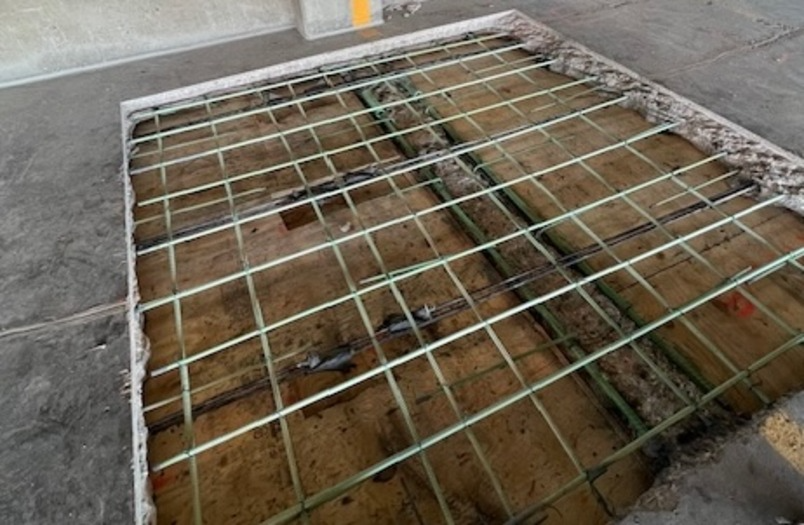
“Full depth means I got some serious problems and I need concrete replaced,” says Mike. When deterioration penetrates the entire slab thickness or structural integrity is compromised, full replacement becomes necessary. This is the most extensive—and expensive—repair type.
Complete slab section removal and replacement
Structural steel evaluation and repair
Post-tension cable repairs when applicable
New reinforcement installation
Proper curing and protection protocols
Pine Street Ramps in Green Bay, Wisconsin—a project requiring full and partial depth concrete repairs along with post-tension cable repairs, demonstrating the range of techniques RSI employs on complex structures.
Crack Injection: Choosing the Right Approach
Crack injection is one of the most misunderstood concrete repair techniques. The choice between epoxy and polyurethane injection isn’t arbitrary—it depends on the crack’s characteristics and what you’re trying to achieve.
Epoxy Injection
“Epoxy is pretty much a one and done deal. It’s cracks, floors that you want to glue together,” Mike explains. Epoxy creates a structural bond stronger than the surrounding concrete itself. It’s ideal for dormant cracks where you need to restore load-bearing capacity.
Polyurethane Injection
“Polyurethane injection is for stuff that is maybe moving or active water leaks. And there’s two types of polyurethane, hydrophobic and hydrophilic,” says Mike. Polyurethane foams expand when they contact water, making them perfect for sealing actively leaking cracks.
Factor
Epoxy
Polyurethane
Best For
Structural cracks, dry conditions
Active leaks, moving cracks
Bond Strength
Stronger than concrete
Flexible, accommodates movement
Water Conditions
Must be dry
Works with active water
Cure Time
Several hours
Minutes to hours
Common Mistake: “Common error is using epoxy to stop water leaks when, number one, the crack is still wet—epoxy won’t stick to water,” Mike warns. This is one of the most frequent mistakes we see from inexperienced contractors, resulting in failed repairs and wasted money.
Corrosion Protection: Extending the Life of Your Repairs
Concrete repair without corrosion protection is like fixing a leaky roof but leaving the hole in the ceiling—you’ve addressed the symptom but not the underlying cause. When reinforcing steel corrodes, it expands, creating internal pressure that cracks and spalls the surrounding concrete. Effective repair requires stopping this cycle.
Corrosion Inhibitors
Applied to exposed rebar during repairs, corrosion inhibitors create a protective barrier that slows or prevents future oxidation. These products work by either forming a physical coating on the steel or chemically altering the environment around the rebar to make corrosion less likely.
Modern migrating corrosion inhibitors (MCIs) can even penetrate existing concrete to reach embedded steel, providing protection beyond the immediate repair area. For structures with widespread corrosion potential, this technology can significantly extend service life.
Cathodic Protection: The Hockey Puck Approach
“The most common thing now is they use cathodic anodes, which are basically sacrificial pucks of material that take on the corrosion instead of the steel,” Mike explains. “They look like hockey pucks.”
These anodes work through electrochemistry—they’re made of metals (typically zinc) that corrode preferentially to steel. Embedded in the repair or attached to the structure, they essentially “sacrifice” themselves to protect the reinforcing steel. When the anode eventually depletes, you replace it rather than replacing the entire concrete section.
Galvanic anodes: Self-powered by the natural voltage difference between metals; no external power required
Impressed current systems: Use external power to drive protection; better for severe corrosion environments
Hybrid systems: Combine approaches for optimal protection in complex structures
The Waterproofing Connection
“What Restoration Systems sells is waterproofing. If water doesn’t get into the concrete, it doesn’t cause that corrosion path to occur. Period—without water, it isn’t going to happen.” — Mike Hintsala
This is why RSI approaches every concrete repair project holistically. Patching the visible damage without addressing water infiltration and corrosion protection is a temporary fix at best. Our repair specifications always consider the full deterioration mechanism—not just what you can see today, but what will cause problems tomorrow.
Midwest Climate: The Toughest Environment for Concrete
“Climate is the number one thing, you know—without the freeze-thaw cycles, concrete will generally last quite a bit longer,” Mike explains. The Midwest presents a perfect storm of conditions that accelerate concrete deterioration faster than almost anywhere else in the country.
“In the Midwest, they’re used for parking cars that carry salt in, and salt corrodes concrete reinforcement quicker than anything else,” he continues. This combination of extreme temperature swings, moisture infiltration, and chloride exposure creates a uniquely aggressive environment for parking structures and commercial buildings.
The Upper Midwest experiences more freeze-thaw cycles than almost any region in North America. Each cycle allows water to penetrate, freeze, expand, and crack concrete from within. Multiply that by dozens of times per year, and deterioration accelerates dramatically.
De-Icing Salt Exposure
Salt doesn’t just melt ice—chloride ions penetrate concrete and attack embedded steel. Parking structures see concentrated salt exposure as vehicles track in road chemicals. This creates corrosion that starts invisibly and reveals itself as sudden spalling.
Hidden Corrosion Damage
“Corrosion follows water, which follows cracks, which is caused by freeze-thaw, which can be hidden,” Mike explains. “Just like being a dentist, you can find more as soon as you start drilling.” Surface conditions often underrepresent the true extent of damage below.
Not Sure What Your Structure Needs?
Our team provides honest assessments with repair options at multiple price points—no pressure, just information.
From initial assessment to final quality verification, here’s how we approach every project.
1
Comprehensive Structural Assessment
“We generally do visual surveys—looking at the conditions of the existing structure, sealants, joints, and see what items need to be addressed,” Mike explains. “We’re looking at what items need to be repaired today, and then give them a forecast of what will need to be repaired tomorrow.” This dual-timeline approach helps owners plan and budget for both immediate needs and future maintenance.
2
Repair Options Development
“We’re able to do spot repairs. We’re able to do full restoration repairs that last a lot longer. We’re able to do full replacements, and we can price any of those out for you as an option,” Mike notes. Rather than presenting a single take-it-or-leave-it proposal, RSI provides multiple approaches at different price points so owners can make informed decisions based on their budget and long-term plans.
3
Surface Preparation to ICRI Standards
Proper surface preparation is arguably the most critical factor in repair longevity. RSI prepares surfaces to the exact concrete surface profile (CSP) required for each repair material—the same standards our team helped develop. This includes removing all unsound concrete, properly treating exposed reinforcement, and creating the surface texture needed for optimal bond.
4
Material Placement and Protection
Each repair type requires specific placement techniques, curing conditions, and protection protocols. Full-depth repairs need proper consolidation and curing. Overhead repairs require specialized form-and-pour or spray-applied methods. Post-tension work demands careful attention to tendon protection. RSI crews are trained in all techniques and understand when each is appropriate.
5
Quality Verification and Documentation
Before calling any repair complete, RSI verifies bond strength, dimensional accuracy, and surface finish. We document conditions before, during, and after repairs—providing owners with records that support future planning and demonstrate due diligence for liability purposes. This documentation often proves valuable during property transactions or insurance claims.
Commercial Concrete Repair by the Numbers
$45-150+/SF
Repair Cost Range
From basic spall repairs to full-depth concrete replacement, depending on severity and access
$15K-50K
Per Space Replacement
Full parking structure replacement costs, making timely repairs significantly more economical
30-60%
Labor Component
Skilled labor represents the largest portion of concrete repair costs—experience matters
5+ Years
Quality Repair Lifespan
Properly executed repairs should last at minimum five years—repeated failures indicate problems
100-140
Annual Freeze-Thaw Cycles
The Midwest experiences among the highest freeze-thaw exposure in North America
25+
Years RSI Experience
Founded in 1997, with principals averaging over 25 years in structural restoration
Quality Work vs. Low-Bid Contractors: An Honest Conversation
Let’s address something most contractors won’t say out loud: the construction industry has a trust problem, and concrete repair is no exception.
“Contractors are mistrusted in general. They believe everything’s a change order. They’re only out to make money. I will tell everybody, including my friends, that never trust a contractor because they’re only after their interests.”
— Mike Hintsala, RSI Expert
That’s a remarkably candid statement from someone who’s spent 21 years in this business. But Mike’s honesty reflects RSI’s philosophy: acknowledge the problem, then demonstrate through actions why we’re different.
Why Low Bids Often Cost More
When you receive multiple concrete repair proposals, the low bid might look attractive—until you consider what might be missing:
Inadequate surface preparation: Cutting corners on prep work saves time but guarantees premature failure
Inferior materials: Cheaper repair mortars may not perform in Midwest freeze-thaw conditions
Skipped corrosion protection: Without addressing the underlying cause, repairs become a recurring expense
Minimal scope: Some contractors bid only visible damage, knowing change orders will follow once work begins
Experience gaps: Workers unfamiliar with specific repair techniques produce substandard results
The Quality Test
“This is one that I believe people don’t really take seriously,” Mike explains. “If you’re repairing the same area over and over again, something’s wrong. If you’re constantly doing trip hazard repair or knocking off loose concrete, something’s wrong. Repairs should last.”
Quality concrete repair isn’t just about fixing today’s problems—it’s about reducing tomorrow’s. That requires understanding deterioration mechanisms, selecting appropriate materials, and executing repairs to standards that ensure longevity.
The RSI Difference: Long-Term Relationships Over One-Time Jobs
“What people often don’t realize about experienced restoration contractors is that we’re not building a house designed to last 100 years. We’re performing repairs that last about five years—and we want you to come back to us when it’s time for the next round of maintenance.”
— Mike Hintsala, RSI Expert
This is why RSI approaches every project as the start of a relationship, not a transaction. We provide accurate assessments because we want you to trust us for the next repair, and the one after that. We scope projects honestly because our reputation depends on satisfied clients, not inflated change orders.
When you work with RSI, you’re not just hiring a contractor—you’re partnering with a team that understands your structure will need ongoing maintenance and wants to be your trusted resource for decades to come.
Featured Commercial Concrete Repair Projects
From institutional facilities to municipal infrastructure, RSI delivers comprehensive concrete restoration across the Midwest.
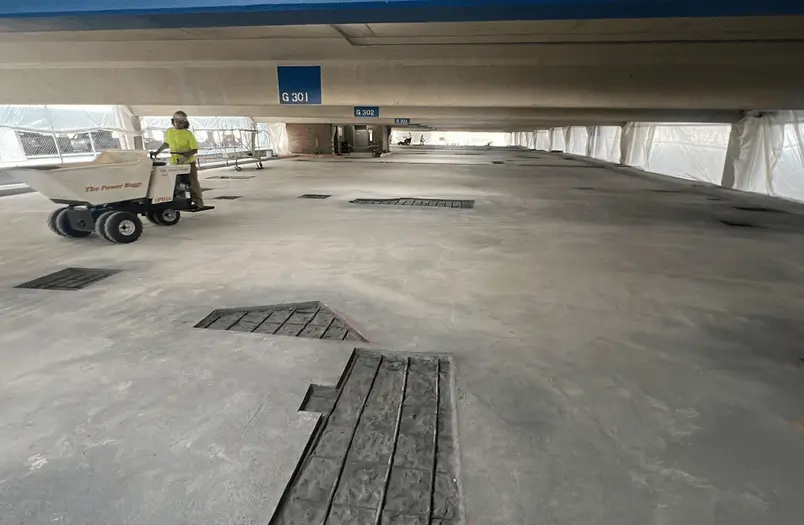
A 9-month comprehensive structural concrete and post-tension repair project for one of the university’s primary parking facilities. This institutional project demonstrated RSI’s full-scope capability, combining structural assessment, concrete repairs at all depth levels, and PT cable restoration.
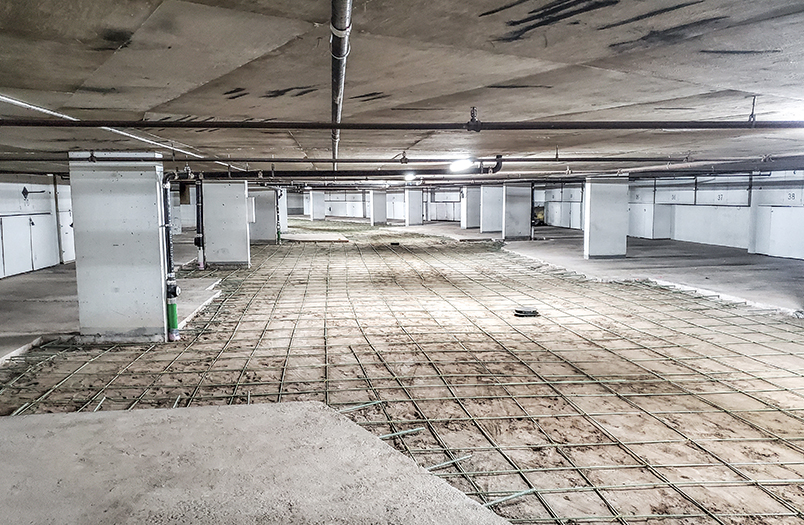
A comprehensive concrete restoration featuring 30,000 SF of media blasting coating removal, extensive epoxy injection crack repair, vertical and overhead concrete repairs, and full sealant replacement. This project showcases RSI’s ability to handle large-scale multi-family residential restoration.
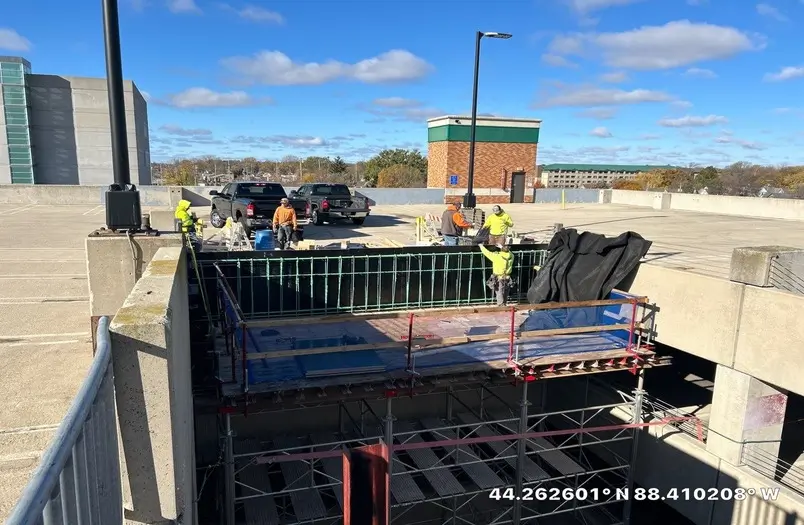
RSI’s flagship municipal project, completed ahead of schedule and under budget. Our design modifications during this project were later incorporated into the airport’s specifications for future repairs—testament to the value RSI brings beyond simple execution.
MunicipalParking StructureDesign-Build
Frequently Asked Questions
Common questions about commercial concrete repair, answered by our structural restoration experts.
How much does commercial concrete repair cost per square foot?
Commercial concrete repair costs typically range from $45-150+ per square foot, depending on the repair type and complexity. Minor repairs (surface patches) run $45-65/SF, partial depth repairs (like potholes) cost $65-85/SF, and full-depth replacement ranges from $85-150+/SF. These costs can vary based on access difficulty, project size, and regional labor rates. For context, complete parking structure replacement costs $15,000-50,000 per parking space, making timely repairs significantly more economical than deferring maintenance until replacement becomes necessary.
What’s the difference between epoxy and polyurethane crack injection?
Epoxy injection creates a rigid, structural bond that’s actually stronger than the surrounding concrete—ideal for cracks that are dormant (not moving) and dry. “Epoxy is pretty much a one and done deal,” explains Mike Hintsala. “It’s cracks, floors that you want to glue together.”
Polyurethane injection is flexible and can accommodate ongoing movement. It’s the right choice for active water leaks because it expands when contacting moisture. “Polyurethane injection is for stuff that is maybe moving or active water leaks,” Mike notes. Using epoxy on wet cracks is a common mistake—”epoxy won’t stick to water.”
How long should a concrete repair last?
Quality concrete repairs should last at least five years—often longer with proper waterproofing and maintenance. “If you’re repairing the same area over and over again, something’s wrong,” Mike explains. “If you’re constantly doing trip hazard repair or knocking off loose concrete, something’s wrong. Repairs should last.” Premature failure usually indicates either incorrect diagnosis of the underlying problem, improper surface preparation, wrong material selection, or inadequate curing and protection.
Why does Midwest concrete deteriorate faster than other regions?
“Climate is the number one thing,” Mike explains. “Without the freeze-thaw cycles, concrete will generally last quite a bit longer.” The Upper Midwest experiences 50–100+ freeze-thaw cycles annually—among the highest in North America. Each cycle allows water to penetrate concrete, freeze and expand, then thaw and leave behind larger voids for the next cycle.
Compounding this, “In the Midwest, they’re used for parking cars that carry salt in, and salt corrodes concrete reinforcement quicker than anything else.” This combination of freeze-thaw damage and chloride-induced corrosion creates the most aggressive environment for parking structures in the country.
What are cathodic anodes and how do they protect concrete?
“The most common thing now is they use cathodic anodes, which are basically sacrificial pucks of material that take on the corrosion instead of the steel,” Mike explains. “They look like hockey pucks.” These zinc or magnesium anodes are embedded in repairs or attached to structures. Through electrochemistry, they corrode preferentially to the reinforcing steel, essentially “sacrificing” themselves to protect the more valuable structural elements. When depleted, they can be replaced—far less expensive than replacing corroded concrete.
How do I know if my parking structure needs repairs or replacement?
This requires professional assessment, but general guidelines: if deterioration affects less than 5-10% of structural elements, repairs are usually appropriate. Between 10-25%, you’re in a gray area requiring cost analysis. Above 25% deterioration, replacement often becomes more economical. However, these percentages vary based on the structure’s design, access constraints, and remaining service life expectations. RSI provides assessments that include repair options at multiple price points, “We’re able to do spot repairs. We’re able to do full restoration repairs that last a lot longer. We’re able to do full replacements, and we can price any of those out for you as an option.”
What is ICRI and why does certification matter?
ICRI (International Concrete Repair Institute) is the leading authority on concrete repair standards and best practices. Their guidelines—including concrete surface profile (CSP) standards—define how quality repair work should be performed. These standards help owners evaluate contractor qualifications and ensure repairs meet industry benchmarks. RSI’s distinction: our team didn’t just learn ICRI standards, we helped create them. Mike Hintsala served on the technical committee that developed the CSP guidelines other contractors now reference.
Can concrete repairs be done in winter?
Yes, but with important considerations. Concrete repair materials require minimum temperatures to cure properly—typically 40-50°F for standard products. Winter work may require heated enclosures, rapid-set materials designed for cold weather, or project scheduling during warmer periods. Emergency repairs can almost always be accommodated, but planned restoration projects are often more economical when scheduled for spring through fall. RSI can assess your situation and recommend whether immediate winter repairs or scheduled warm-weather work makes more sense.
How does RSI prevent change orders and scope creep?
Mike acknowledges the industry’s trust problem directly: “Contractors are mistrusted in general. They believe everything’s a change order.” RSI’s approach starts with thorough upfront assessment—”We’re looking at what items need to be repaired today, and then give them a forecast of what will need to be repaired tomorrow.” We also acknowledge that concrete repair often reveals hidden damage: “Corrosion follows water, which follows cracks, which can be hidden—just like being a dentist, you can find more as soon as you start drilling.” Our proposals include contingency guidance and we communicate proactively when additional scope is discovered, with options rather than demands.
What should I look for when evaluating concrete repair bids?
Compare these elements across proposals: (1) Scope clarity—are repair quantities and methods specified, or vague? (2) Surface preparation—ICRI CSP specifications should be noted for each repair type. (3) Corrosion protection—is rebar treatment and cathodic protection included where appropriate? (4) Material specifications—product names and manufacturers, not just generic descriptions. (5) Warranties—what’s covered, for how long, and under what conditions? (6) Contractor qualifications—ICRI certification, relevant project experience, safety records. The low bid often lacks detail in these areas, setting up inevitable change orders or premature failure.
Ready to Discuss Your Concrete Repair Project?
Get an honest assessment from the team that helped write the industry standards. No pressure, no inflated scope—just straightforward expertise.