

Cost Drivers For Commercial Owners

Parking Garage Repair Cost: What Actually Drives The Price

For Minnesota and Wisconsin property owners and facility managers, a single per-square-foot figure rarely tells you what a parking structure repair will really cost. Here is what moves the number, and why responsible pricing starts with what is hidden below the surface.

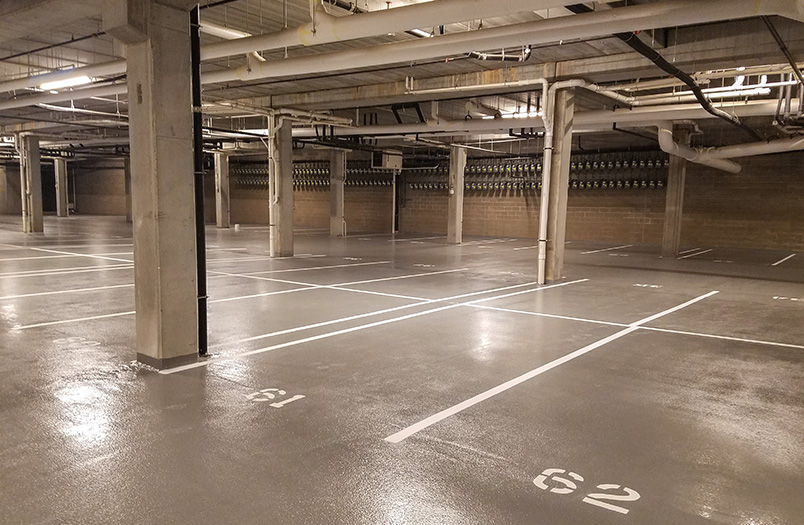
Interior of an empty concrete parking garage with numbered spaces, white support columns, and industrial ceiling infrastructure
An interior parking level shows the support columns, deck slab, and ceiling infrastructure that a restoration estimate has to account for.
Blake Dronen

Reviewed & Certified By

Blake Dronen · President, Restoration Systems Inc.

The Short Answer

What Drives Parking Garage Repair Cost

  • Repairs are priced against the damaged area, not the entire deck, so cost-per-total-building-square-foot math understates what focused work really runs.
  • Cost climbs sharply with deterioration depth. A surface patch, a partial-depth repair, and full-depth concrete replacement sit on very different rungs of the ladder.
  • Upper Midwest salt and freeze-thaw cycling push costs toward the upper end of national ranges and shape which materials and seasons the work demands.
  • The biggest variable is what is hidden below the surface, which is why an on-site inspection, not a website number, sets a real price.
The Per-Square-Foot Trap

Why The Per-Square-Foot Number Misleads

Most owners and facility managers think about their building in dollars per square foot, and that habit carries straight into repair budgeting. On a structure measured in the hundreds of thousands of square feet, the instinct is to spread any repair cost across the whole footprint. That math is where the confusion starts.

RSI’s team puts it plainly. Picture a very large ramp where only a small fraction of the deck actually needs concrete work. That focused repair carries a meaningful cost, because it is priced against the damaged area and the labor it takes to reach and rebuild it, not against the gross deck. Measured against the repair zone, the rate looks high. Measured against the whole building, the same dollars look like almost nothing. Same job, two very different impressions, and neither number means much on its own.

A price per square foot only tells you something once you know which square feet are being repaired and how deep the damage goes.

That is the practical argument of this article. Cost per square foot is not one number. It is a question about repair area, deterioration depth, regional climate, and what an inspection finds once the work begins. The sections below walk through each of those drivers so you can build a realistic capital budget and read a proposal with a sharper eye.
Restoration Is Not A Commodity

Restoration Isn’t Commodity Concrete Work

RSI sees commercial concrete construction and concrete restoration priced as if they were the same trade, and they are not. New construction follows predictable workflows with standardized quantities. You pour to a plan, and the parts and steps repeat. Restoration is forensic. The crew is investigating a structure that already failed in some way, working around traffic and tight access, and the efficiencies of labor, not a catalog of identical parts, are what move the price.

That is why the car-maintenance mental model breaks down. With a car, a fixed hourly rate swaps in an identical part, and the bill is predictable. A parking structure is not built that way. You are trusting a contractor to tell you what is actually wrong, how far it reaches, and what it takes to fix it correctly. Two ramps with the same deck area can carry very different repair costs depending on what the concrete is hiding.

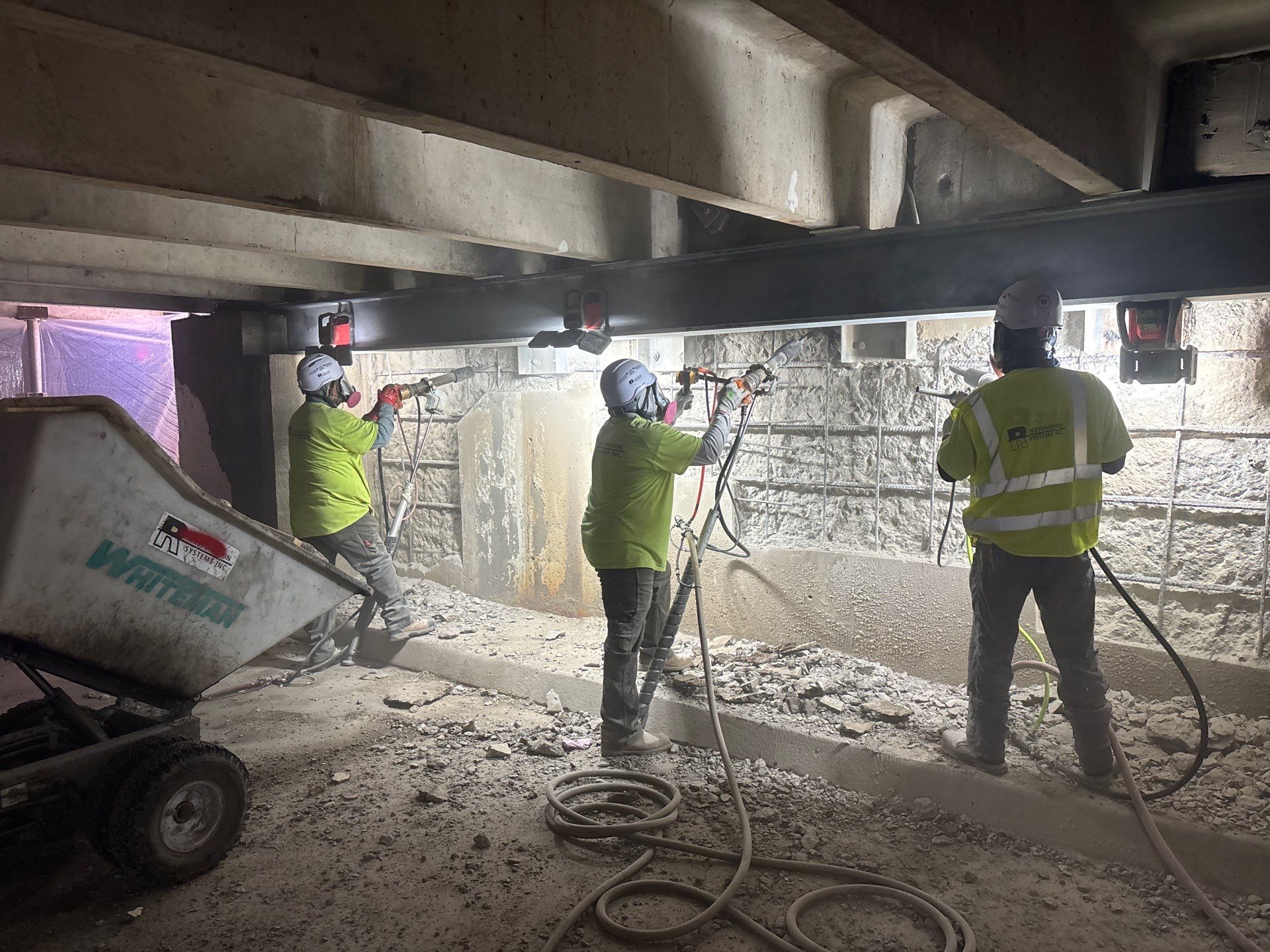
Three construction workers in safety gear using jackhammers to break up concrete beneath a parking structure during renovation
Removing deteriorated concrete is hands-on, labor-intensive work. The crew chases the damage until sound material is reached, and that effort is the cost.

Geography matters too. Upper Midwest labor and material rates benchmark somewhat higher than national averages before any climate premium is added, so national repair ranges tend to understate what the same scope costs in Minnesota and Wisconsin. RSI executes this work with union-trained craftsmen who are equipped to read a structure, not just patch a surface, and that distinction shows up in both the diagnosis and the durability of the result.

Depth Is The Driver

Cost Climbs With Depth: Surface, Partial, And Full

The single biggest reason two repairs on the same deck carry different price tags is how deep the damage goes. RSI sorts the work into three bands, and the cost rises with each step down into the slab.

Lowest Cost

Surface and small repairs

The loose or spalled areas you can see, often overhead or on walls, where something needs to be removed and patched. The scope is shallow, the access is usually straightforward, and this sits at the lower end of the cost range.

Steps Up

Partial-depth repairs

Think of a pothole forming in the driving surface, where a section of concrete has broken down but has not gone all the way through. More material comes out, the prep is heavier, and the cost steps up accordingly.

Highest Cost

Full-depth repairs

The serious end, where the problem reaches through the slab and concrete has to be replaced. Now you are into removal, structural repair, and often reinforcing steel work. The cost climbs steeply here, because the deeper the deterioration runs, the more there is to take out, support, and rebuild.

The deeper the problem, the more the cost climbs, and it climbs sharply rather than in a straight line. That is exactly why a credible estimate has to establish depth before it can put a number on the work.

Depth is rarely obvious from the surface. A repair that looks shallow on day one can reach further once the deteriorated concrete is opened up, which is the practical reason a contingency belongs in the budget from the start.

Inside The Budget

Where The Money Actually Goes

Owners tend to weight a restoration budget backwards. The intuition is that materials are the big line and labor is incidental. On a parking structure repair, it is the reverse.

As RSI breaks it down, the largest share of a restoration budget is labor. Materials are a meaningfully smaller share, and equipment is smaller still. The remainder is a contingency allowance for what the crew finds once the work begins. That ordering surprises people, but it follows directly from the forensic nature of the work. You are paying for skilled hands to investigate, remove, and rebuild, not for a pallet of product.

Don’t forget the soft costs

Two line items get left out of early budgets and then show up as surprises at proposal time. The first is an independent engineer or consultant fee. The second is permitting. Both belong in the capital budget from the planning stage, not bolted on at the end. When they are missing from a number you are comparing, you are not comparing the same job.

Contingency is normal, not padding. Restoration is forensic. Like a dentist, you find more once you start drilling, and a sound budget leaves room for it.

Building these components in from the start is the difference between a capital plan you can defend and a number that unravels the moment the first deteriorated section is opened up.

The Regional Cost Driver

The Midwest Climate Premium: Salt And Freeze-Thaw

RSI is direct about the number-one regional cost driver: climate. In the Upper Midwest, two forces work against a parking structure that coastal and southern decks largely escape. Vehicles track deicing salt onto the deck all winter, and that chloride corrodes reinforcing steel faster than almost anything else. At the same time, the deck cycles repeatedly through freezing and thawing.

The mechanism is straightforward and destructive. Water finds its way into cracks, freezes, expands, and spalls the concrete from within. If salty water reaches the reinforcing steel, the steel corrodes, expands, and bursts the concrete around it. Each season widens the damage that the season before left behind. Because Upper Midwest structures see heavy salt exposure and many freeze-thaw cycles, owners here are wise to budget toward the upper end of national ranges rather than the middle.

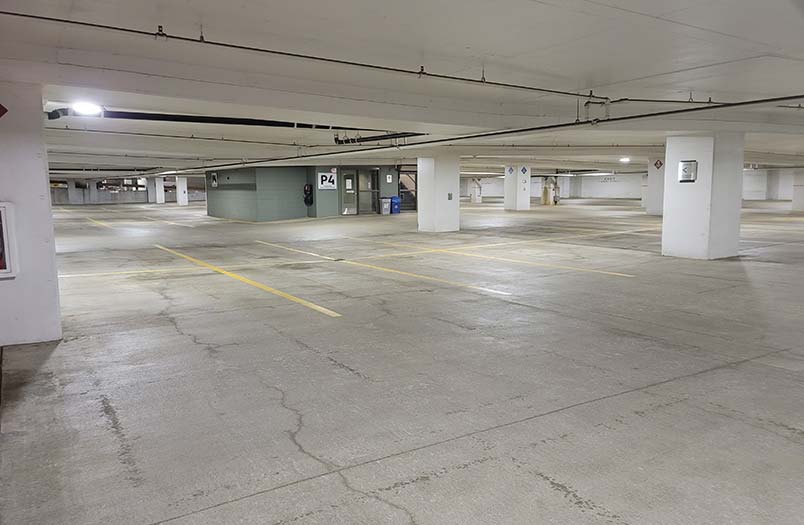
Empty parking garage level with concrete floor, white support columns, and yellow line markings under fluorescent ceiling lights
A working parking level in the Upper Midwest takes on salt and moisture every winter, the conditions that drive most of the deterioration RSI repairs.

That environment shapes how RSI works. Materials are selected deliberately for this climate, including high-performance repair mortars built for freeze-thaw durability, low-permeability products that limit water and chloride penetration, elastomeric sealants that tolerate movement and temperature swings, and waterproofing membrane and traffic coating systems. Many of those materials are temperature-sensitive and need conditions to hold above roughly 40 degrees, including overnight. In practice that makes winter the season for assessing and identifying structures, with spring, summer, and fall the window for executing the work.

The climate premium has a sharper edge when problems hide. RSI recalls a ramp in rough shape, with the owner in receivership and the city requiring repair or closure. An engineer estimated a figure simply to keep it open. Once the work began, the structure proved far worse than anyone had imagined. The repairs grew well beyond the original estimate and ultimately became a multimillion-dollar project. Had the owner come in early, the conversation about how costs escalate could have happened before the emergency, not during it.

Match Spend To Intent

What Your Repair Dollars Actually Buy

Price tracks the durability you choose, and that is a decision worth making on purpose. RSI frames it as a simple question before any number is set: what are you actually after? A repair can be built to carry a structure for a few years or for decades, and the cost moves with the answer.

  • A patch buys a few years. Typically in the range of two to five years, it treats the immediate symptom and keeps an area serviceable, which is the right call in some situations and a false economy in others.
  • A proper repair lasts longer. Depending on depth and method, a repair that addresses the underlying cause can serve anywhere from roughly five years up to many decades.
  • A full replacement carries its own service life. On the order of around 25 years, it resets the affected area rather than extending what is already there.
  • You pay for what you get. This is not car maintenance where a low price swaps an identical part. Speed has a cost too. Materials that cure faster tend to crack sooner, so a rushed job often gets done again.
Reading The Proposal

What A Credible Parking Garage Repair Proposal Should Include

A proposal is the best early signal of whether a contractor actually understands your structure. One RSI project makes the point better than any checklist. At Wells Fargo Plaza, what looked like a routine pothole repair turned out to be a warning. The property team had noticed localized concrete deterioration and a pothole forming in the driving surface of the ramp.

Once RSI began investigating and removing the deteriorated concrete, deeper concerns surfaced within the slab system, involving de-tensioned post-tension cables inside the structure. In a post-tension deck, those cables are a critical structural component that help carry loads and hold the slab system together. When they lose tension to corrosion or damage, the structural performance of the deck is affected, and post-tension cable repair becomes part of the scope. A localized pothole repair became a much broader structural assessment and restoration effort.

Visible surface deterioration should never automatically be viewed as “just a pothole.” In parking structures, those conditions can be early warning signs of hidden structural issues developing beneath the surface.

That is the lens to read a proposal through. A proper repair addresses root causes such as water intrusion, failed waterproofing, reinforcing steel corrosion, drainage deficiency, and joint failure, rather than smoothing over the symptom. A defensible proposal should show you the same discipline on paper.

What A Strong Proposal Shows

  • Line-item transparency, with each repair type priced in its correct unit of measure rather than rolled into one number.
  • A root-cause description of what is driving the deterioration, not just a list of surfaces to patch.
  • Durability options at different price postures, so you can match the work to how long you need it to last.
  • A sensible contingency, because a forensic process finds more once the work begins.

Red Flags To Question

  • A single flat price spread across the whole building square footage, with no breakout by repair type.
  • No investigation before the number, and no plan to confirm depth.
  • No contingency at all, which usually means the surprises are coming later as change orders.

RSI works to extend service life and ensure safety by fixing the cause, not the appearance. That is the standard a credible parking structure proposal should meet.

FAQ

Parking Garage Repair Cost: Common Questions

Quick answers to the questions owners and facility managers ask most when budgeting parking structure repairs.

Why doesn’t a single cost-per-square-foot number work for parking garage repairs?

Repairs are priced against the damaged area and the labor to reach and rebuild it, not against the gross deck. Measured against the repair zone the rate looks high, while spread across the whole building the same dollars look like almost nothing. A price per square foot only tells you something once you know which square feet are being repaired and how deep the damage goes.

What is the biggest driver of parking garage repair cost?

Deterioration depth. Surface and small repairs sit at the lower end of the cost range, partial-depth repairs step up because more material comes out and the prep is heavier, and full-depth repairs climb steeply because they involve removal, structural repair, and often reinforcing steel work. The cost rises sharply rather than in a straight line, which is why a credible estimate has to establish depth first.

Where does the money actually go in a parking garage restoration budget?

The largest share is labor, with materials a meaningfully smaller share and equipment smaller still, plus a contingency allowance for what the crew finds once the work begins. Soft costs also belong in the budget from the planning stage: an independent engineer or consultant fee and permitting. When those are missing from a number you are comparing, you are not comparing the same job.

Why are parking garage repairs more expensive in Minnesota and Wisconsin?

Deicing salt corrodes reinforcing steel while repeated freeze-thaw cycles let water enter cracks, freeze, expand, and spall the concrete from within. Upper Midwest labor and material rates also benchmark somewhat higher than national averages before any climate premium is added. That is why owners here are wise to budget toward the upper end of national ranges rather than the middle.

How long do different parking garage repairs last?

A patch typically buys two to five years and treats the immediate symptom. A proper repair that addresses the underlying cause can serve anywhere from roughly five years up to many decades depending on depth and method, while a full replacement carries a service life on the order of around 25 years. Speed has a cost too: materials that cure faster tend to crack sooner, so a rushed job often gets done again.

What should a credible parking garage repair proposal include?

A strong proposal shows line-item transparency with each repair type priced in its correct unit of measure, a root-cause description of what is driving the deterioration, durability options at different price postures, and a sensible contingency. Red flags include a single flat price spread across the whole building square footage, no investigation before the number, and no contingency at all, which usually means the surprises come later as change orders.

Get A Real Number

Request A Complimentary Assessment

Benchmark ranges only get you so far. The biggest cost variable is what is hidden below the surface, and the only way to turn a range into a real number is an on-site inspection. Backed by 28+ years of trusted restoration work across the Upper Midwest and union-trained craftsmen who address root causes, RSI delivers repair, restoration, and preservation on parking structures from St. Paul to Minneapolis to Bloomington.