
Industries We Serve
Government & Municipal Building Restoration in the Upper Midwest
The public depends on county libraries, airport parking ramps, and salt sheds. We restore their concrete and masonry for public owners, on public schedules, with self-performed crews that keep facilities open.
How Midwest Weather Damages Public Buildings
The buildings taxpayers depend on most are parking ramps, libraries, service centers, and salt storage. Those are the ones our climate attacks hardest.
Water that soaks into concrete and mortar swells about 9% as it freezes. An Upper Midwest winter delivers dozens of freeze-thaw cycles. A hairline crack in a courthouse plaza in November is a spall by April.
Your own operations add the chemistry: every plow route ends with chloride-laden slush dripping onto ramp decks. Those chlorides migrate to the reinforcing steel, and corrosion swells the steel and cracks the concrete from the inside out. Salt storage buildings face the same attack at full concentration.
Repairs compete for capital dollars annually, while deterioration compounds continuously. We make root-cause repairs and document them so you can defend the work at a council or board meeting.

The Constraints Public Owners Work Under
Public work runs on rules commercial work never sees. The rules, accountability, and constraints are different. A contractor who treats them as an afterthought becomes your problem.
Public Bidding & Prevailing Wage
Public work needs responsive, responsible bids against clear specifications, with prevailing-wage and payroll documentation handled as routine. We bid the scope as written and don’t treat the change-order log as a second profit center.
CIP and Levy Budget Cycles
Capital dollars get committed months or years before mobilization. Our condition documentation gives you defensible scopes and priorities for capital improvement planning, so the ask matches the deterioration.
Spending You Can Defend in Public
Every dollar you spend is publicly scrutinized. We document conditions before, during, and after the work with photos, quantities, and closeout records. You can show constituents what was repaired and why it will last.
Buildings That Can’t Close
A library or county service center serves the public every business day. At the Human Services Building in Albert Lea, a daily aerial drop map told tenants exactly where crews would be working, so operations never had to guess.
Engineer-Led Specifications
Most public restoration runs through a consulting engineer, and we work in that structure. At the MSP Airport ramps, expansion-joint details we proposed during construction were adopted into the owner’s future repair contracts.
Repairs for Full Service Life
A municipality doesn’t flip its buildings. We repair for full service life, the standard a public steward is held to.
What Road Salt Does to a Ramp Deck
The same salt program that keeps your streets safe is consuming your ramps, plazas, and storage structures. Waiting is the most expensive option.
Water expands approximately 9% when it freezes. When trapped in the pores of concrete and mortar, the expansion cracks public structures from the inside out, cycle after cycle, all winter long.
At a Green Bay municipal salt shed, we paired corrective concrete repairs with a 100% solids epoxy coating system. The system is engineered to resist chloride brines, acids, and alkalines: the full chemistry of a working salt storage environment.
Deferred maintenance costs compound at approximately 7% annually. A repair you push to the next budget cycle comes back larger every year it waits.
How Public Restoration Projects Get Done
The work runs from the first condition walk to the closeout binder. The sequence follows how public projects are funded, bid, and delivered.
Condition Assessment
A condition assessment documents what’s failing and why, spall by spall, joint by joint. Your engineer’s specification and your capital request rest on real quantities. The repair addresses the exposure that caused the damage.
Bid & Compliance
Public solicitations get complete, responsive bids, with prevailing-wage and payroll documentation included as standard practice. What we price is what we build.
Phased Execution
Self-performed crews work in phases that keep facilities and parking open. Daily communication, like the aerial drop maps used in Albert Lea, means staff and the public always know where the work is headed next.
Closeout & Planning
You receive documentation of every repair completed, plus prioritized recommendations for future phases. The next budget cycle starts with a plan instead of a surprise.
Documentation for the Capital Request
Get condition documentation you can take to your council or board. Deficiencies are prioritized by urgency, with a realistic picture of what waiting another cycle will cost.
Common Problems on Public Buildings
Municipal portfolios fail in predictable ways. These are the conditions we see most across city, county, and state facilities, and the services that correct them.
Chloride-Saturated Parking Ramps
Public ramps collect salt-laden slush all winter, and the deck takes the chlorides. Our parking deck restoration pairs concrete repair with traffic-bearing membranes that seal chlorides out of the slab. A structured inspection tells you which ramp needs it first.
Spalling Concrete & Exposed Rebar
Delaminated soffits over public walkways are a liability. Our concrete repair crews perform full-depth, partial-depth, vertical, and overhead repairs, treating the corroding steel that caused the spall.
Post-Tension System Damage
Many public ramps ride on post-tensioned slabs. Chloride attack on tendons is invisible until the damage appears. Our post-tension repair crews completed tendon, end-anchorage, and splice-coupling repairs on Green Bay’s Pine Street Ramps with minimal schedule impact.
Failed Expansion Joints & Sealants
Every failed joint funnels water and chlorides into the structure below. We replace expansion joints and perimeter sealants as a system, so the repair upstream protects the concrete downstream.
Weathered Civic Masonry
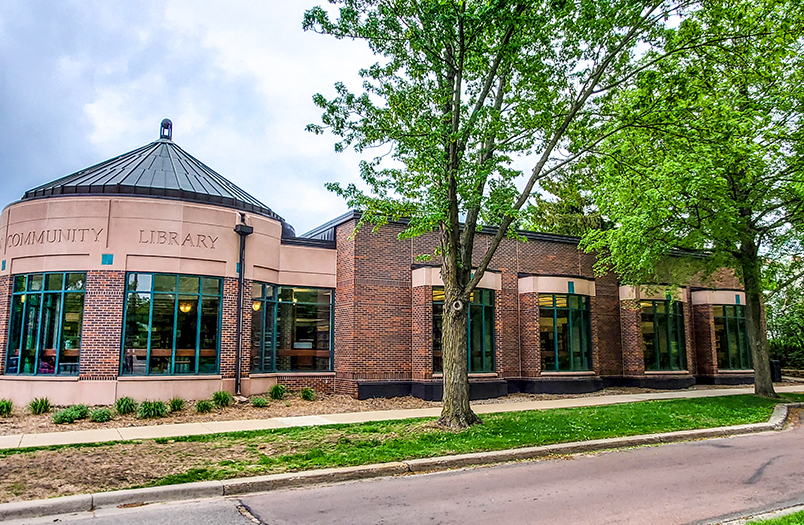
Libraries, courthouses, and county buildings shed mortar and brick like any Midwest masonry, just with more public visibility. Our tuckpointing and mortar repair crews restored the Washburn Library exterior for Hennepin County in a three-month season.
Salt Sheds & Harsh-Service Structures
Salt storage, wash bays, and treatment facilities expose concrete to brines, acids, and alkalines daily. Our industrial protective coatings seal repaired substrate under chemical-resistant systems built for that service environment.
Government & Municipal Projects
Airport ramps, city parking structures, salt storage, and occupied county facilities, plus exterior preventative maintenance at the Washburn Library for Hennepin County.
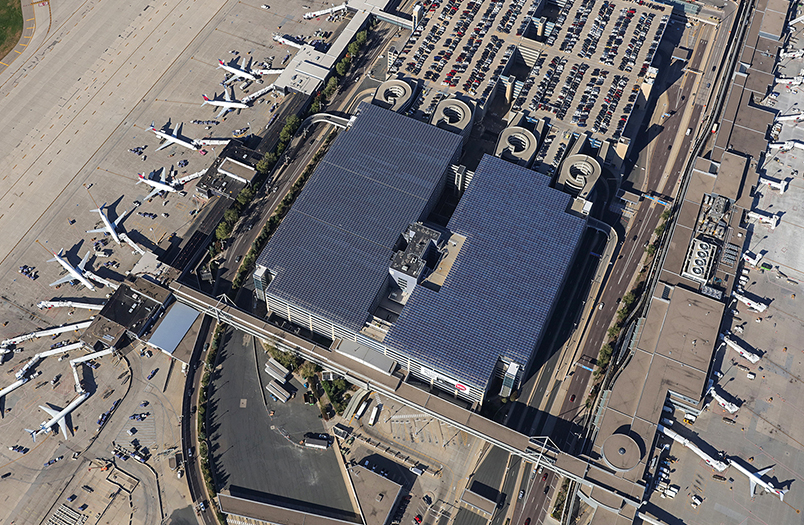
MSP International Airport
Two-year parking ramp restoration: sealant and expansion joint replacement, concrete repairs, corrosion-inhibitive sealer, inverted tee beam replacement, and 25 new post-tensioned concrete haunches at columns. The work finished ahead of schedule and under budget.
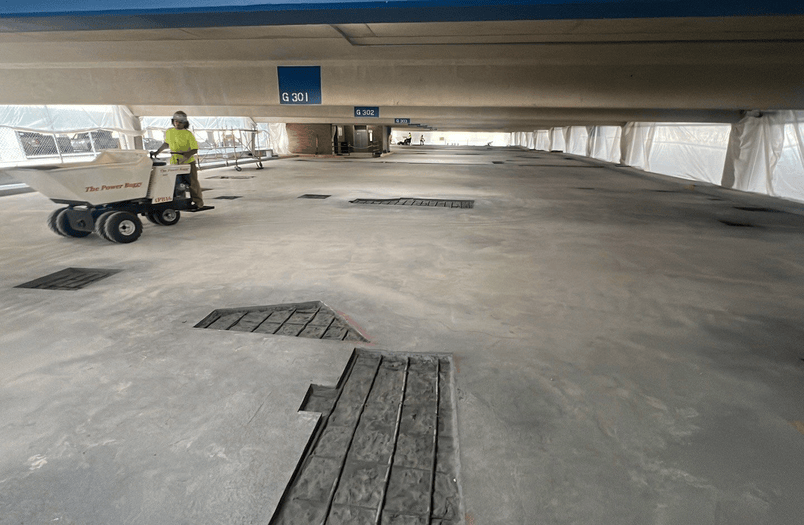
Pine Street Ramps
A four-month 2023 contract for the City of Green Bay: full and partial depth concrete repairs, expansion joint replacement, and a traffic-bearing membrane. Post-tension tendon, end-anchorage, and splice-coupling repairs were added with minimal change to schedule and phasing.
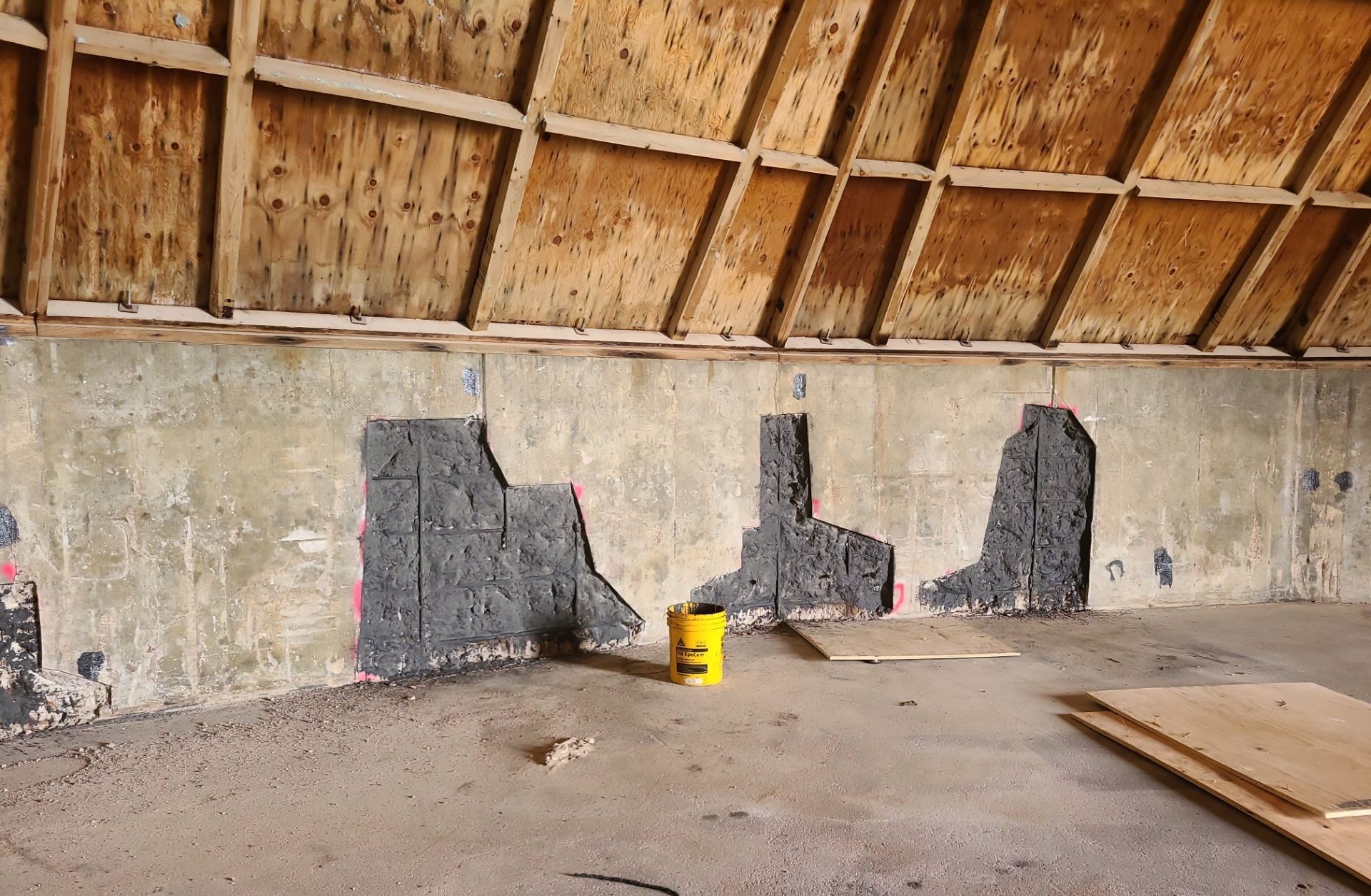
Municipal Salt Shed
The interior foundation wall of a Green Bay salt shed received corrective concrete repairs, then a 100% solids epoxy surfacer and coating engineered to resist water, oil, brines, acids, and alkalines. The work was completed in a two-month window.
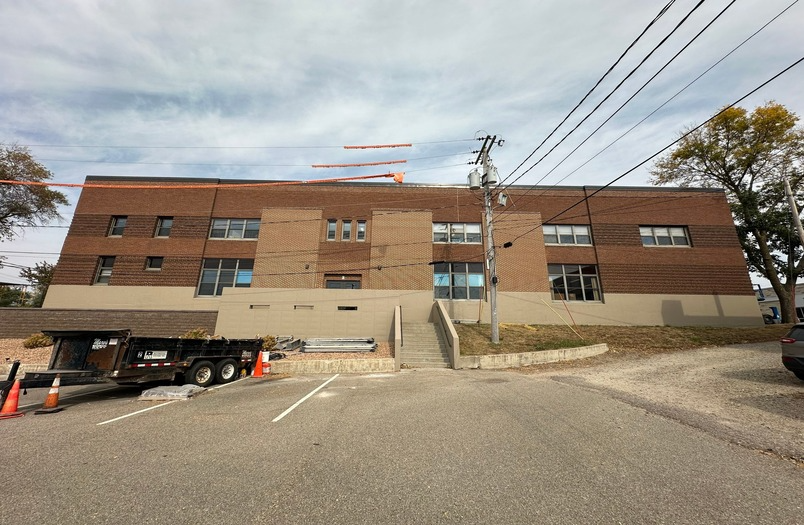
Human Services Building
A two-month exterior restoration in Albert Lea: tuckpointing, brick replacement, control-joint sealant replacement, facade cleaning, and waterproof coating. A daily aerial drop map kept tenants informed and operations uninterrupted.
Questions Public Owners Ask Us
Answers for facilities directors, public works staff, and procurement teams.
Yes. We have delivered restoration contracts for public owners including the Metropolitan Airports Commission and the City of Green Bay. We respond with complete, responsive bids, work under your engineer’s specification, and treat prevailing-wage and payroll documentation as standard practice.
In almost every case, yes. We phase the work so entrances, parking, and service counters stay usable. Your staff know where crews will be each day. The Human Services Building in Albert Lea never stopped serving the public during its two-month exterior restoration.
Start with a condition assessment well before the funding request is due. Documented deficiencies and quantities give your board a defensible number instead of a placeholder. Our guide to reading a condition assessment report explains the findings. For concealed conditions like post-tension damage, we structure scopes so discoveries don’t derail the schedule.
Concrete repair, mortar, sealants, and coatings all need adequate curing temperatures. That concentrates the productive season roughly April through October here. The practical rhythm: assess in fall, budget over winter, bid in late winter, mobilize in spring. Interior work, like salt shed coatings, is more flexible. Earlier solicitations get better calendars.
Restoration always uncovers something, and the contractor either absorbs it into the plan or turns it into leverage. On the Pine Street Ramps, embedded tendon and anchorage repairs were added to the post-tension system with minimal change to schedule and phasing. We document what we find, price it transparently, and keep the project moving.
Public-Sector Restoration Across the Upper Midwest
We have served public owners since 1997 from offices in Minneapolis and Cedar Rapids. Our crews cover Minnesota, Wisconsin, and Iowa: St. Paul, Rochester, Green Bay, Madison, and Des Moines. They also reach into Nebraska, the Dakotas, and northern Illinois.
Whichever county or city you serve, the problems are the same: freeze-thaw cycling, chloride exposure, and budget calendars slower than deterioration. We bring the same crews and documentation discipline to a small-town salt shed as to an international airport. Government work is one of several industries we serve.
One point of accountability: We self-perform our restoration work. The crew on your ramp deck works for us, so the finished work, safety, and compliance answer to a single contract.
Find Out What Your Buildings Need Before the Budget Request Is Due
Get a documented picture of your facilities’ condition: what needs attention now, what can wait a cycle, and what it takes to keep taxpayer assets in service for decades. For active hazards like falling concrete, our emergency support team responds immediately.