
Why Midwest Parking Structures Deteriorate Faster
In the Upper Midwest, parking decks take a beating most markets never see. Cars track in de-icing salt, winters swing above and below freezing for months, and water carries both into the concrete. The result is corrosion and spalling that move faster here than in warmer climates, and a repair bill that grows the longer it waits. This is a plain-language guide to why it happens, what to watch for, and why the timing of repairs matters before winter.
Request a complimentary assessment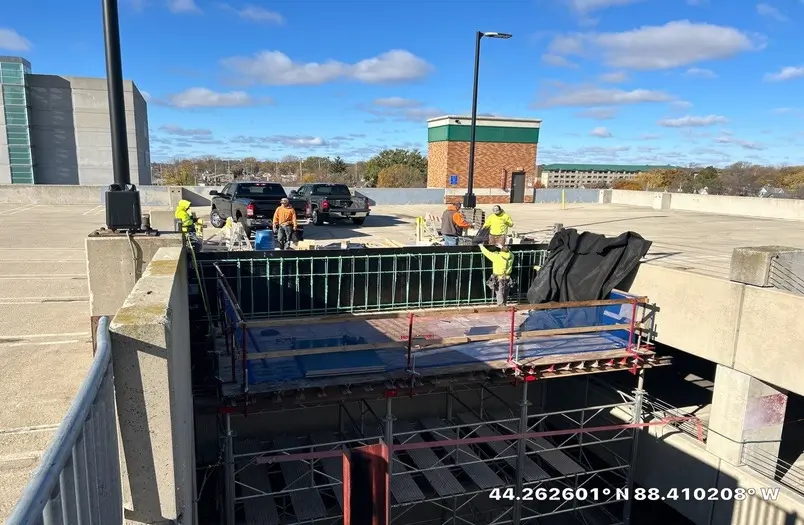

What an Owner or Facility Manager Needs to Know
- Salt-carrying cars plus repeated above- and below-freezing cycles each winter make Upper Midwest decks corrode and spall faster than decks in warmer markets.
- Water is the trigger. Dry, salt-saturated concrete sits inert until moisture activates it. Stop the water and you considerably slow corrosion, which is why waterproofing addresses the root cause.
- A handful of visible warning signs tell you when something is wrong: repeat patch failures, expanding cracks and water “diapers,” rust bleeding through paint, post-tension cable failures, and loose overhead concrete.
- The deeper a deferred problem runs, the more steeply cost climbs. Cheap surface fixes don’t buy long life.
- Treat the ramp like a managed asset. Inspect it annually, and schedule repairs before winter so water and freeze-thaw don’t compound the damage.
Salt + Water + Freeze-Thaw: The Regional Deterioration Equation
Decks fail faster here for a simple reason: how they are used and where they sit. In the Midwest, parking ramps store cars that carry de-icing salt in off the road, and salt corrodes embedded reinforcement faster than almost anything else. Layer that onto a climate that swings above and below freezing for months, and you have a structure under constant attack.
“Climate is the number one thing. Without the freeze-thaw cycles, concrete will generally last quite a bit longer. Without the heavy salt, it won’t corrode as fast.”
RSI Expert
The physics are plain. When saturated concrete freezes, the water trapped inside it expands by roughly 9 percent, and every cycle forces existing cracks a little wider through the season. In Minnesota, structures can see 80 to 100 or more freeze-thaw cycles a year. Spalling works the same way. If the concrete wasn’t air-entrained, water gets in, freezes, expands, and busts the surface off. If salty water reaches the reinforcing steel, the steel corrodes, the rust expands, and it pushes the concrete face off from the inside.
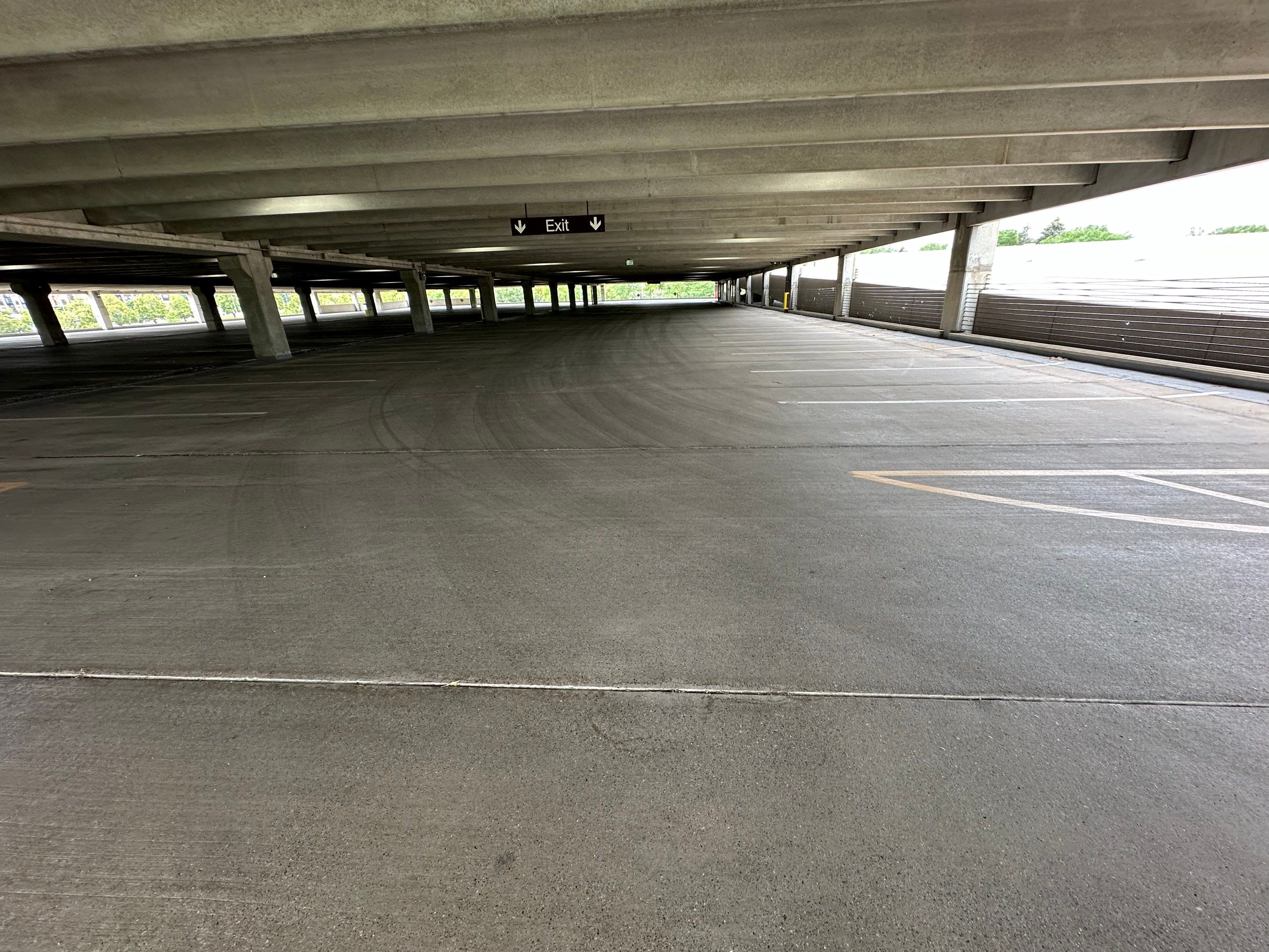
Here is the part owners often miss. Salt alone doesn’t have to keep doing damage. These older structures are salt-saturated from years of use, but dry salt just sits there. It’s water that turns it into a corrosion engine.
“You can have dry salt sit in your concrete, but if it doesn’t get wet, it’s not doing anything. If you stop the water from getting into this thing, we can considerably slow down corrosion.”
RSI ExpertThat is why what restoration really sells is waterproofing. Keep the water out of the concrete and the corrosion path never gets started. It is the one intervention that addresses the root cause rather than the symptom.
Five Warning Signs Owners Should Watch For
These are the field-observable signals an RSI expert looks for first. None requires an engineering degree to spot, and each one tells you something specific about what’s happening below the surface.
-
Repeat patch failures, and the five-year rule
Repairs should last. RSI’s benchmark is roughly five years for a sound repair. If you’re back fixing the same trip hazard or knocking off the same loose concrete sooner than that, something underneath is wrong and the patch is treating a symptom, not the cause.
-
Expanding cracks and water “diapers”
Bigger cracks and more of them point to excessive movement or a structural problem that can’t be diagnosed without investigation. The clearest tell is a “diaper” — a plastic tarp hung to keep dripping water off the cars below. If someone has resorted to that, there’s a serious moisture problem that needs attention, not a bucket.
-
Rust that bleeds back through paint
Painting over rusted beams and joints hides the problem for a season, then the rust bleeds right back through. On one job, RSI replaced an expansion joint to stop a leak, but the steel plates the joint slides on were embedded in the concrete and stayed. Concrete absorbs moisture, so those plates keep corroding whether water is actively present or not.
-
Post-tension cable failure indicators
PT cables can’t be seen, so damage is hard to catch early. Evidence of prior PT repairs is itself a clue that remaining cables may be under attack. More often, the repair only happens once a cable lets go and the concrete bubbles where it failed. By then, the failure has already announced itself.
-
Trip hazards and loose overhead concrete
Potholes and broken slab edges are trip hazards. Look up, and a loose chunk of concrete on a beam or ceiling can fall and hit someone. Removing that material is relatively cheap. An injury settlement is not. These are the items to address on sight.
Post-Tension Cables, and How RSI Protects Steel
Post-tension slabs carry their load through high-strength steel cables tensioned inside the concrete. In chloride-heavy Midwest decks, that makes them uniquely difficult, because the danger is largely invisible. You can’t look at a slab and see whether a cable is corroding.
“PT slab inspection is really difficult because you can’t see it. You can see evidence of past repairs that would clue you in that the cables may be under attack, but generally we do the repairs when you can actually see a failure, because those cables let go and the concrete bubbled for those cables.”
RSI ExpertThat is the trap. A PT system often gives no useful warning until a cable releases and the concrete bubbles or blows out where it failed. Evidence of prior PT repairs in a structure’s history is one of the few early diagnostic clues that the remaining cables may already be under active attack.
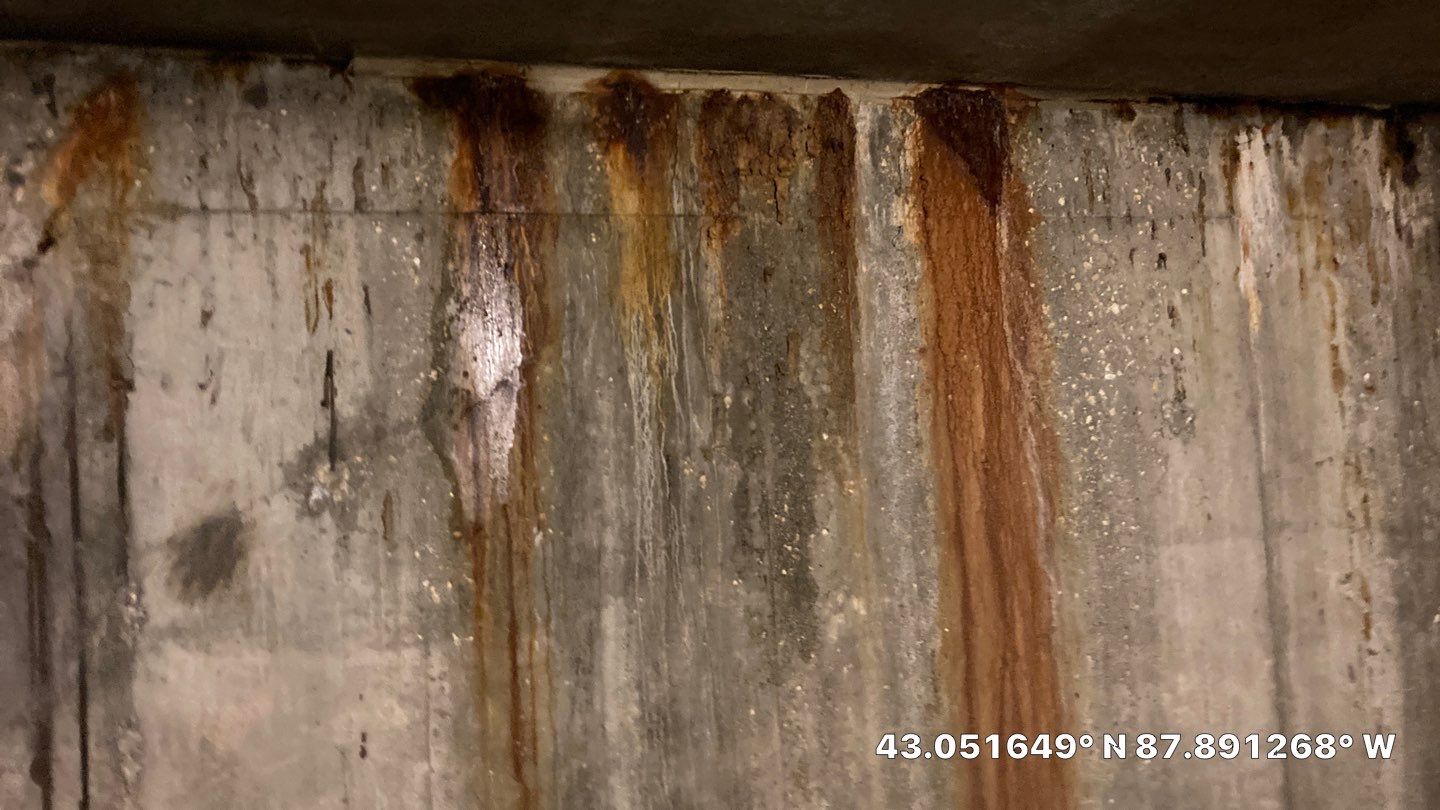
The corrosion itself is electrochemical. Steel corrodes as electrons move from one area to another, the same process that attacks ordinary rebar. To redirect it, RSI ties cathodic anodes to the steel, sacrificial pucks of material that look like hockey pucks. The corrosive electrons get absorbed by the puck instead of the structural steel, so the puck disintegrates over time while the steel is spared.
Materials have improved alongside the methods. Air-entrained concrete has long handled freeze-thaw better, and over the last 20 years corrosion inhibitors have become a bigger player in slowing rebar corrosion within the deck. Every one of these interventions works best when paired with the root-cause fix: keeping water out in the first place.
One boundary matters here. RSI performs repair assessments, not professional-engineer-level structural capacity assessments. For load-bearing and capacity questions on a PT system, RSI teams hand in hand with licensed engineers rather than crossing that line.
What Deferred Attention Really Costs
The clearest illustration of why timing matters comes from a single project. RSI arrived at a parking ramp in Rockford, Illinois, under contract for concrete repairs and an estimated six post-tension cable repairs. The structure was in far worse shape than anyone realized.
Rockford, IL
By the time the crew left Rockford, they had performed over 1,000 cable repairs against the six that were scoped. On one level, every cable was broken and the whole section needed full replacement. The owner ran out of money, had to stop work, and faced the threat of closing the ramp.
Nobody set out to let it get that bad. The damage didn’t appear overnight. It accumulated quietly, cable by cable, until the cost to address it outran the budget. That is what deferred attention looks like at the far end, and it is the reason this guide keeps returning to one practical argument: find problems while they’re shallow, address the root cause, and don’t let a winter compound a small repair into a large one.
The economics behind that story are straightforward. Parking garage repair cost is driven by depth and extent, not by the size of the deck alone. The deeper a problem runs into the slab, the more sharply the price climbs. As one RSI expert puts it, concrete costs climb steeply the deeper the problem goes. A surface fix is one thing. Once deterioration reaches the reinforcing steel or the cables, the work and the cost change category.
There’s a second limit owners tend to overlook. You can replace a full deck, but the rest of the structure is still there. You’re always bounded by the lifespan of the elements around the part you fixed, which is why a deep repair never fully resets the clock the way a brand-new structure would. That is also why cheap surface fixes don’t buy long life: spending a little to mask a problem now usually means spending much more to correct it later, after a season of water and freeze-thaw has driven it deeper.
Repair Lifespan at a Glance
| Repair Approach | Typical Service Life | What It Tells You |
|---|---|---|
| Surface patching | About 2–5 years | A short-term fix. If you’re re-patching the same area sooner than five years, the underlying cause hasn’t been addressed. |
| Component replacement | About 5–50 years | A wide range that depends on what is replaced and the condition of everything around it. |
| Full replacement | Around 25 years | Even a full deck replacement is finite, and it does not reset the clock on the surrounding structure. |
This is a durability reference, not a price list. Note the key limit: even after a full deck replacement, you remain bounded by the lifespan of the surrounding structural elements that were not replaced.
Inspection Cadence and Timing
A parking ramp is a managed asset, but it rarely gets treated like one. As an RSI expert frames it, you wouldn’t leave a large investment portfolio unreviewed for years and assume nothing changed. Ramps are a small line item next to the building they serve, so they become an afterthought. With a regular inspection routine, the same structure can last a long time. In the Midwest, this is a yearly job. You can forecast cost out five, ten, or fifteen years, but like a financial plan, you have to revisit it, because conditions change.
- Inspect annually. Northern-climate structures warrant a yearly visual review, ideally timed so repairs can be scheduled and completed before winter.
- Survey the right things. RSI visual surveys look at the existing structure, sealants, and joints, quantifying what needs attention. Often only a small fraction of the structure needs work, and far less on a newer deck.
- Forecast two horizons. The survey separates what needs repair today from what will need repair tomorrow, so you can budget instead of react.
- Time it before the cold. Completing repairs before winter keeps water and freeze-thaw cycles from compounding small problems over the season.
Where RSI’s scope ends
RSI performs repair assessments — what it will cost to fix the deterioration you have. RSI does not perform structural capacity assessments, which require professional engineering credentials. For load-bearing and capacity questions, RSI teams hand in hand with licensed engineers.
A Regional Restoration Project
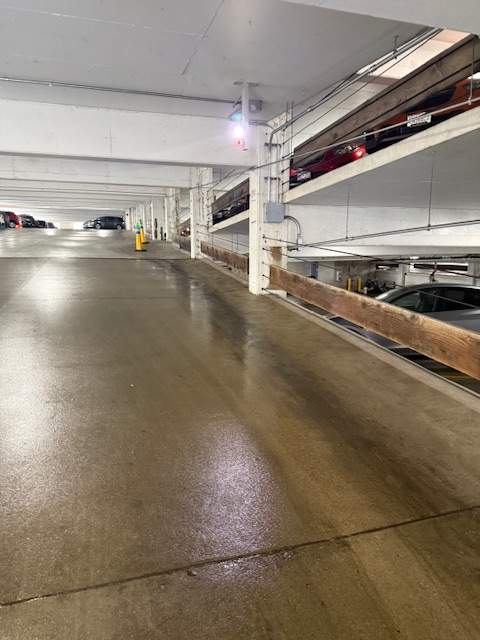
U of M Prospect Park Ramp
An integrated scope covering post-tension cable repair, structural concrete, traffic coating, and structural steel — the full range of systems a chloride-exposed Midwest deck needs addressed at once. It is the kind of multi-system restoration this guide has been describing, carried out by union-trained craftsmen focused on repair, restoration, and preservation that extend service life and ensure safety.
RSI brings decades of trusted restoration work across the Upper Midwest. We address root causes rather than masking symptoms, so repairs last and structures stay safe for the people who use them.
How to Read This Guide
The guidance here reflects RSI’s hands-on repair experience across Upper Midwest parking structures and the field perspective of an RSI expert. It is a practical field guide, not a published regional dataset or annual study, and the deterioration mechanisms described are general to the climate and to how these structures are used.
Scope boundary: RSI performs repair assessments only. RSI evaluates what it will cost to repair the deterioration present in a structure. RSI does not perform structural capacity assessments, which require professional engineering credentials, and partners with licensed engineers for load-bearing and capacity questions.
Privacy: No client-identifiable project data is published here. The project referenced is described only by location, scope, and approximate duration to illustrate the kind of work involved, without financial detail or identifying specifics.
Midwest Parking Structure Deterioration: Common Questions
Quick answers for owners and facility managers on why Upper Midwest decks fail faster and what to do about it.
Why do parking structures deteriorate faster in the Midwest?
Two factors compound here: cars track in de-icing salt that corrodes embedded reinforcement, and the climate swings above and below freezing for months. When saturated concrete freezes, the trapped water expands by roughly 9 percent, forcing cracks wider with every cycle. In Minnesota, structures can see 80 to 100 or more freeze-thaw cycles a year.
How often should a Midwest parking ramp be inspected?
Northern-climate structures warrant an annual visual review, ideally timed so repairs can be scheduled and completed before winter. A visual survey looks at the existing structure, sealants, and joints, separating what needs repair today from what will need repair tomorrow so you can budget instead of react. Often only a small fraction of the structure needs work, and far less on a newer deck.
What are the warning signs of parking structure deterioration?
Five field-observable signals stand out: repeat patch failures inside the roughly five-year benchmark a sound repair should last, expanding cracks and plastic “diapers” hung to catch dripping water, rust bleeding back through paint, evidence of post-tension cable failures, and trip hazards or loose overhead concrete. Loose overhead material should be addressed on sight, since removing it is relatively cheap and an injury settlement is not.
Does waterproofing really stop salt corrosion in a parking deck?
Yes, because water is the trigger. Older structures are salt-saturated from years of use, but dry salt just sits in the concrete doing nothing; it takes moisture to turn it into a corrosion engine. Stopping water from getting in considerably slows corrosion, which is why waterproofing is the one intervention that addresses the root cause rather than the symptom.
How long do parking structure repairs last?
Surface patching typically lasts about 2–5 years, component replacement about 5–50 years depending on what is replaced, and even a full deck replacement runs around 25 years. If you are re-patching the same area sooner than five years, the underlying cause has not been addressed. No repair fully resets the clock, because you remain bounded by the lifespan of the surrounding elements that were not replaced.
What happens if parking structure repairs are deferred?
Cost climbs steeply the deeper a problem runs into the slab, and once deterioration reaches the reinforcing steel or post-tension cables, the work changes category. At a ramp in Rockford, Illinois, RSI was contracted for an estimated six post-tension cable repairs and ended up performing over 1,000, until the owner ran out of money and faced closing the ramp. Finding problems while they are shallow, before a winter compounds them, is far cheaper.
Don’t wait for winter
See Your Structure in the Warning Signs?
Catch the problem while it’s still shallow. RSI’s union-trained craftsmen address root causes through repair, restoration, and preservation that extend service life and ensure safety — scheduled before winter compounds the damage.