
Industries We Serve
Restoring Historic Buildings Across the Upper Midwest
Your building survived a century of Minnesota winters because someone built it right. Keeping it standing takes a contractor who matches lime mortars, sources compatible brick and stone, and earns preservation commission approval. Patching a landmark with store-bought Portland cement is exactlywhat our crews don’t do.
Why Historic Masonry Fails in Midwest Winters
A building from 1895 wasn’t built worse than one from 1995. It was built differently. Soft-fired brick, lime mortar, hand-set limestone, and glazed terra cotta manage moisture in ways modern materials don’t. They fail fast when repaired with the wrong ones.
A past repair that filled soft lime-mortar joints with hard Portland cement drives moisture into the brick. That moisture once escaped through the joint. Each Minnesota winter, that trapped water freezes, expands roughly 9%, and pops the faces off brick that survived a hundred winters before the “repair.”
“Mortar acts as both the bonding agent and a sacrificial material: it holds the masonry units together while accommodating minor movement and moisture transfer. Ideally, the mortar should deteriorate before the brick or stone does, protecting the more permanent materials.”— Tayton Eggenberger, Branch Manager, Minnesota, RSI
The same physics punishes terra cotta once its glaze crazes. It punishes limestone as hidden anchors rust and jack the stone loose. Painted masonry fares no better: old coatings (like the red paint we stripped at 801 Washington) seal moisture into a wall built to breathe.
Your building needs a contractor who understands historic lime mortars, terra cotta systems, and how these walls were meant to breathe.
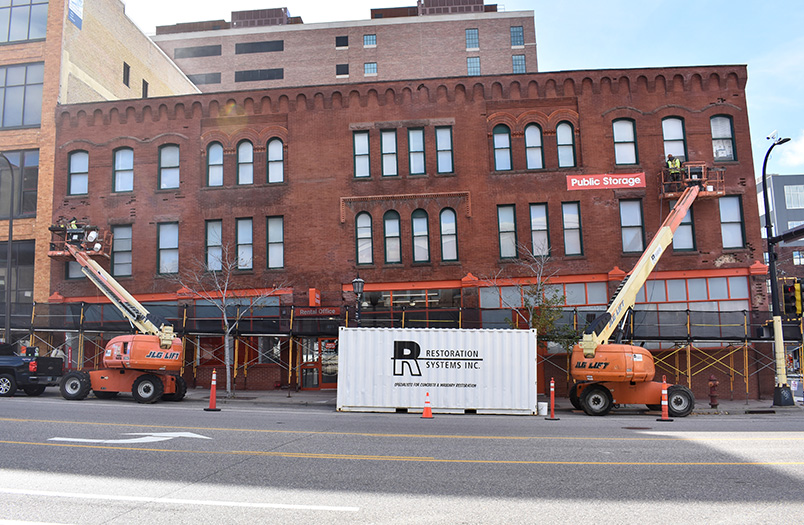
Constraints on Landmark and Character Buildings
Owning a landmarked or character building means answering to more than a budget. These are the realities we plan around.
Approvals Before Scaffolding
On designated buildings, scope, materials, and methods need commission sign-off first. Vague submittals get sent back, while scopes that specify exact mortar formulations and methods get approved.
Matching the Original Wall
A sound repair that reads as a patch from the sidewalk is a failed repair. Brick color and texture, joint profile, mortar and aggregate, and stone finish each have to disappear into the original wall.
Original Materials Take Lead Time
You can’t order 1902 brick from a catalog. Salvage sourcing, custom brick runs, and fabricated stone all take lead time. We identify material needs during assessment, not mid-project.
The Building Stays Occupied
Historic buildings house tenants, congregations, theaters, and hotels. We sequence work at occupied landmarks like the W Hotel at the Foshay Tower so operations keep running while repairs proceed.
Common Problems on Historic Buildings
Self-performed crews match methods to the original materials and specify repairs to preservation standards.
Receding Lime Mortar Joints
Receding joints on pre-war masonry need tuckpointing with a compatible mortar. The mortar has to be softer than the masonry, and matched in color, aggregate, and joint profile.
Spalled and Failed Brick
We cut out failed units and perform brick replacement with salvaged or custom-matched brick, laid to the original bond pattern.
Failed Limestone and Terra Cotta
Eroded sills, cracked cornices, and crazed terra cotta call for stone repair or in-kind replacement. Use dutchman repairs where the original can be saved, and replication where it can’t. See our guide to limestone repair vs. replacement.
Paint That Traps Moisture
Old paint suffocates historic masonry. Our coating removal methods, like the wet media blasting used at 801 Washington, lift the coating without scarring irreplaceable brick.
Leaks With No Obvious Source
Water in a mass-masonry wall rarely enters where it shows up. Our leak investigation traces the actual path (flashings, open joints, saturated parapets) before any repair is specified.
Condition Assessment Before You Spend
Get a preservation-minded condition assessment before you commit a dollar. It names what can be repaired, what must be replaced in kind, and what a commission will likely require.
How Work Proceeds on a Landmark
Understand the wall, match the materials, and secure the approvals. Only then put trowels on the building.
Examine & Document
Hands-on examination from swing stage or scaffold documents original materials, prior repairs, and active deterioration. That is the record your consultant and commission will want.
Match Original Materials
Mortar analysis replicates composition, color, and aggregate. Brick and stone come from salvage, custom runs, or replication, so every repair is compatible with the original wall.
Prepare Approval Submittals
We supply the specifics reviews run on: exact scopes, methods, and material submittals for your architect’s application.
Phase the Approved Work
Self-performed crews work in approved sections with full containment, around your tenants and hours. Multi-year scopes are phased so budgets and buildings both hold up.
Repair Versus Replacement on Historic Walls
Preservation is the durable path, and usually the cheaper one. Original material that can be stabilized stays in the wall.
What Replacement-First Contractors Do
- Tear out sound original brick instead of matching individual units
- Grind joints wide and fill them with gray Portland mortar, which sets up the next round of spalling
- Swap limestone for precast and coat “problem” walls with sealers that read wrong and trap moisture
How the Same Wall Gets Stabilized
- Stabilize original fabric first with pinning, patching, and dutchman repairs, replacing in kind only when repair can’t hold
- Repoint with compatible mortar tooled to the original joint profile
- Fix the moisture path (flashings, copings, drainage) so the repair lasts
Getting Through Preservation Review Before the Season
If your building is designated or sits in a historic district, exterior repairs typically need approval before work begins. An unprepared application stalls the review. Commissions approve scopes that name the mortar formulation, repair method, and replacement material. We write ours that way because that is how we build.
On the 425 Washington Avenue restoration, we worked directly with the Minneapolis Heritage Preservation Commission. Tuckpointing, brick replacement, and stone patching followed the Warehouse Historic Design Guidelines and the Secretary of the Interior’s Standards. We repeated that process in 2023 at Stone Arch Lofts.
Planning tip: Minnesota’s masonry season is short because mortar needs sustained above-freezing temperatures to cure. Start review in winter so approvals are in hand when the weather opens. Our guide to Minneapolis preservation review walks through the process.
Historic Restoration Project Examples
Four landmarks, four different problems, plus the 2019 exterior masonry and stone rehabilitation at the Suburban World Theater.
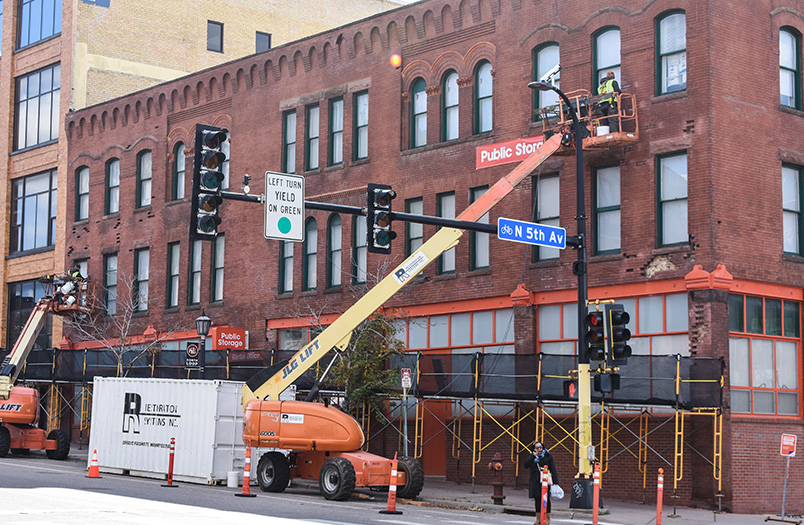
425 Washington Avenue
Tuckpointing, brick replacement, and stone patching finished in two months in 2019. The work was coordinated with the Minneapolis Heritage Preservation Commission under the Warehouse Historic Design Guidelines.
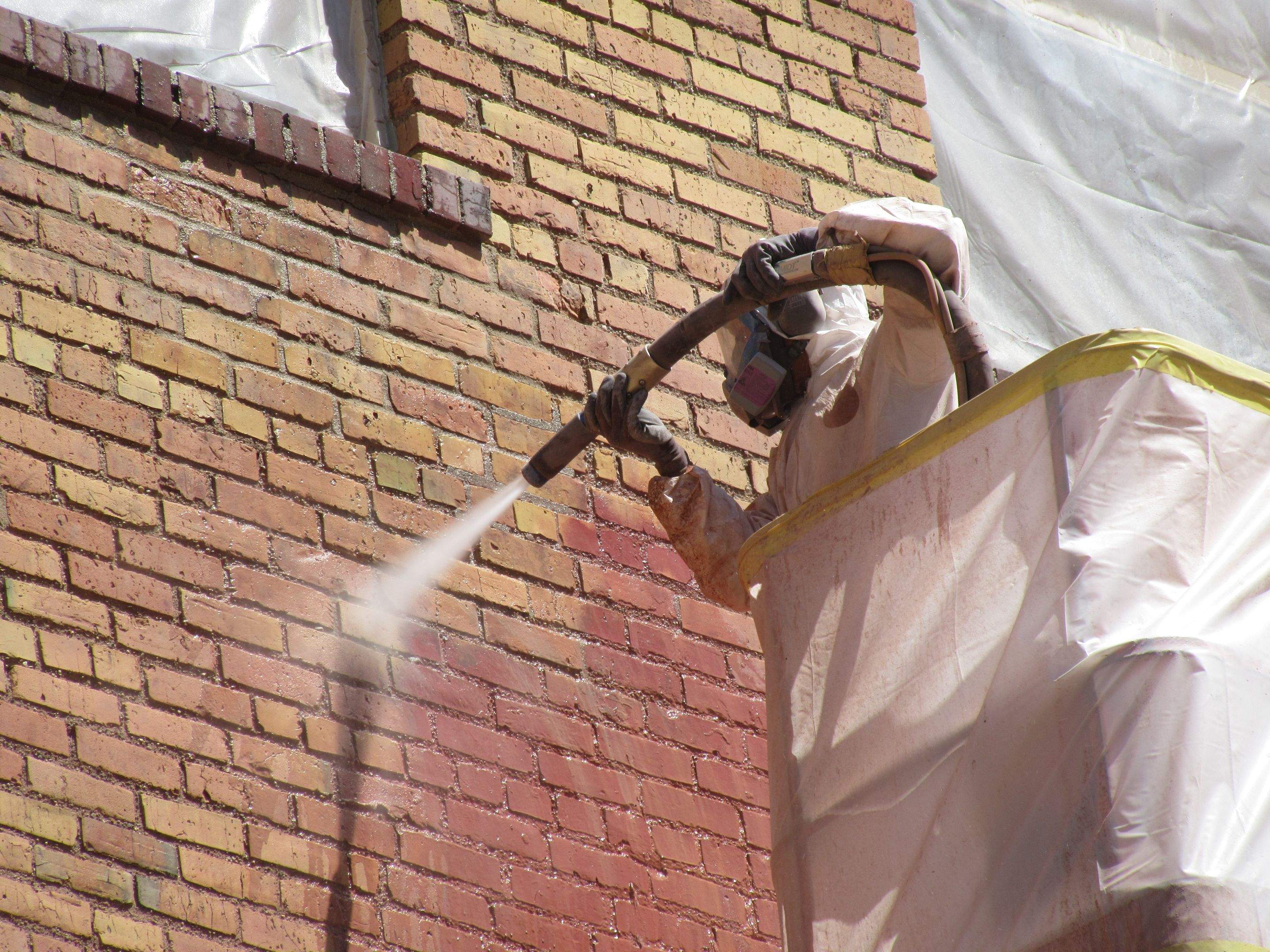
801 Washington
Six months in the North Loop went into removing decades of moisture-trapping red paint. Wet media (vapor) blasting from swing stages with full containment revealed the original brick without scarring it.
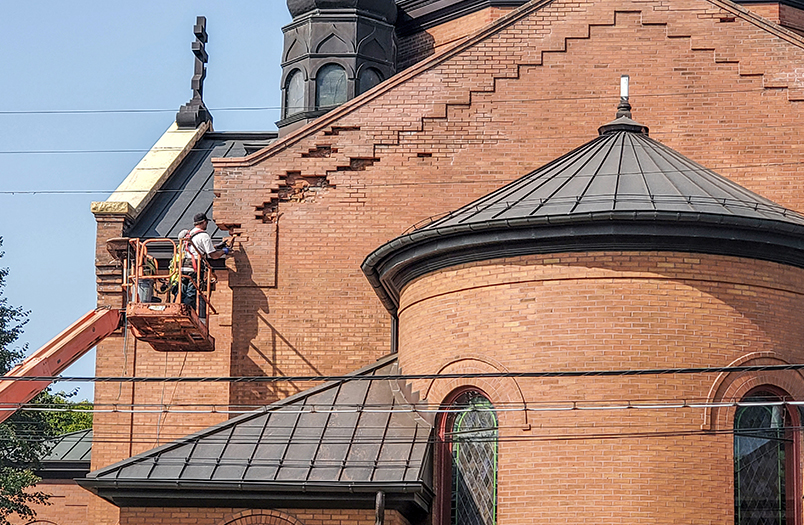
St. Mary’s Orthodox Cathedral
A multi-year contract begun in 2020 covers tuckpointing, brick replacement, stone repair and replacement, and stainless steel through-wall flashing with custom-fabricated copper counter flashing.
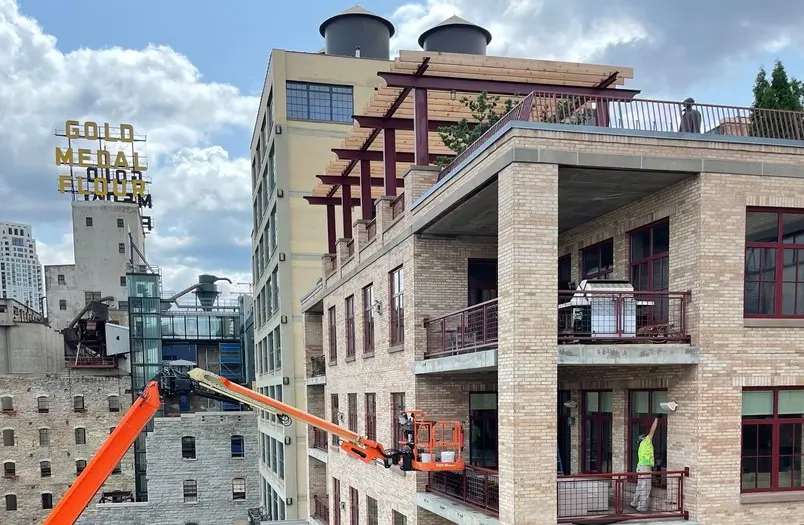
Stone Arch Lofts
A five-month 2023 rehabilitation: tuckpointing, brick replacement, sealant replacement, and concrete repairs. The work was executed with the Heritage Preservation Commission under the Warehouse Historic Design Guidelines.
Questions Historic Building Owners Ask
Direct answers for landmark owners, building committees, and preservation consultants.
Yes, matching is the specification. We analyze the existing mortar to replicate composition, color, and aggregate, then match joint width, profile, and tooling. The mix is usually a softer, lime-rich one (Type O or Type K), never one stronger than the surrounding brick.
We support it directly, as we did with the Minneapolis Heritage Preservation Commission at 425 Washington Avenue and Stone Arch Lofts. Your architect typically leads the application, and we supply the detailed scopes, methods, and material submittals it depends on.
Often, yes, with the right method. Dry sandblasting permanently scars historic brick, so at 801 Washington we used wet media (vapor) blasting instead. Decades of paint came off with the original brick intact.
No, historic restoration is routinely phased by elevation, material system, or urgency. Our St. Mary’s Orthodox Cathedral contract is multi-year for that reason. Safety and active water come first, then whatever protects original material before it’s lost.
Tell Us About Your Historic Building
We restore historic and landmark buildings across the Upper Midwest from our Minneapolis headquarters and Cedar Rapids office. We serve Minneapolis, St. Paul, Duluth, Milwaukee, Madison, Dubuque, Cedar Rapids, and historic districts throughout Minnesota, Wisconsin, Iowa, Nebraska, the Dakotas, and northern Illinois. Historic work is one of several industries we serve. Tell us about your building and we’ll walk it with you.