
Industries We Serve
Restoring Religious Buildings Across the Upper Midwest
People built your sanctuary expecting it to outlast them. We diagnose historic masonry and exterior repairs at the root cause, phase them to fit donor-funded budgets, and schedule around every service, wedding, and funeral.
Why Church Masonry Fails in This Climate
A church is usually the oldest, tallest masonry structure in its neighborhood. The geometry that makes it beautiful is also what makes it vulnerable here.
Towers, steeples, and parapets take wind-driven rain on all four faces, with nothing to shelter them. Water that gets past a failed cap stone or open joint at the top of a bell tower travels down inside the wall. It saturates masonry that stays cold for months.
“The freeze-thaw cycle damages masonry by trapping water in its pores. When that water freezes, it expands by approximately 9%, and the pressure cracks and weakens brick, stone, and mortar.”— Dylan Reynolds, Project Manager, RSI
Most sanctuaries here were built between the 1880s and the 1950s with soft, lime-based mortar. That mortar is sacrificial by design: it is meant to erode first and be renewed every few generations. On many congregations’ buildings, that renewal is decades overdue. Each winter’s freeze-thaw cycling widens the openings water uses to get in.
Steep roofs concentrate runoff onto small areas of masonry. Stone tracery and sills around stained glass hold water in every horizontal joint. The result is a building type that deteriorates in predictable ways. Predictable damage can be diagnosed, prioritized, and repaired before it becomes an emergency.
Typical Problems on Religious Buildings
These are the conditions building committees bring us most often. Our self-performed trades correct them permanently.
Eroded Mortar on Towers and Parapets
The highest masonry weathers fastest and is inspected least, so open joints there let water into the wall core. Our tuckpointing crews repoint with mortar matched to the original, which is critical on lime-mortar walls. A too-hard mix destroys the brick around it.
Spalled Brick and Deteriorated Stone
Freeze-thaw cycling pops the faces off saturated brick and fractures limestone sills and carved detail. We do brick replacement with matched units and stone repair and replacement. We save original material where we can and replace in kind where we can’t.
Leaks Around Stained-Glass Openings
The perimeter sealants that protect irreplaceable windows fail long before the glass does. Our sealant replacement work puts that protection back. We keep the window openings fully protected while we work.
Water Stains You Cannot Trace
Water on a sanctuary ceiling rarely enters where it appears, because it travels far inside a thick masonry wall. Our leak investigation finds the actual entry point before you spend money on the wrong elevation.
Damp Basements and Undercrofts
Fellowship halls, classrooms, and undercrofts get wet when century-old foundation waterproofing gives out. We install modern commercial waterproofing that keeps the spaces your congregation uses every week dry.
Crumbling Entry Steps and Railings
Wide entry stairs are both the church’s front door and the biggest trip hazard for aging members. Our step repair and railing repair crews restore a safe entry without closing the doors on a Sunday.
How Church Restoration Projects Run
A church restoration succeeds on planning and communication as much as on craftsmanship. This is how these projects run.
Assessment the Whole Committee Can Read
Tower masonry nobody has examined in years gets a hands-on inspection. We document findings in plain language with photographs, so every member can read the report and vote with confidence.
Priorities Matched to Your Funding
Some conditions threaten safety or let water in now, and others can wait. We separate those, then phase the scope. An urgent tower repair proceeds this season while the full campaign follows the capital drive.
Work Scheduled Around Worship
Weekend services need open entries and clean grounds, so our self-performed crews plan noisy work for midweek. They stand down on short notice for a funeral. The building stays a place of worship the whole time.
Records for the Next Trustees
We close out with a record of what was repaired, with what materials, and what to watch for. That way the knowledge doesn’t leave when today’s trustees rotate off.
Complimentary Assessment for Your Committee
Get a complimentary building assessment: what’s urgent, what can wait, and what each phase should cost. You get a report your trustees and congregation can act on.
Constraints Congregations Work Under
A congregation is not an ordinary property owner. Nobody budgeted for this building: people gave for it, and people give to keep it. We have done this work for building committees and congregations for 28 years. How a contractor handles that reality matters as much as how they handle a trowel.
Every Dollar Comes From a Gift
Pledge drives, memorial gifts, and capital campaigns take years to raise. We scope work in phases that match how the money arrives. We tell you when one combined scaffolding mobilization will stretch those gifts further.
Committees Make These Decisions
No single owner signs change orders. There’s a volunteer committee, a council or vestry above it, sometimes a diocese above that. We write proposals laypeople can read, question, and defend to the congregation.
The Building Never Really Closes
The calendar holds Sunday worship, school programs, weddings booked a year out, and funerals booked three days out. We plan access, noise, and protection around that calendar, and we adjust when it changes.
The Materials Aren’t at the Supply Yard
Hand-molded brick, quarried limestone, and historic lime mortars: a century-old sanctuary can’t be matched from a catalog. We analyze what’s there and source what belongs, as in our historic building work.
Repair Original Material First
On a religious building, the original material is the heritage, so our default is to conserve. We patch a limestone sill before cutting it out, salvage brick before ordering new, and repoint before rebuilding. Our thinking on repairing versus replacing limestone applies to sanctuaries more than any building we serve.
Worth knowing: Scaffolding a tower is a major share of any church restoration budget. When access is up, complete every repair that elevation needs: tuckpointing, stone, sealants, and flashings. Do not pay to scaffold the same tower twice a decade apart.
St. Mary’s Orthodox Cathedral in Minneapolis
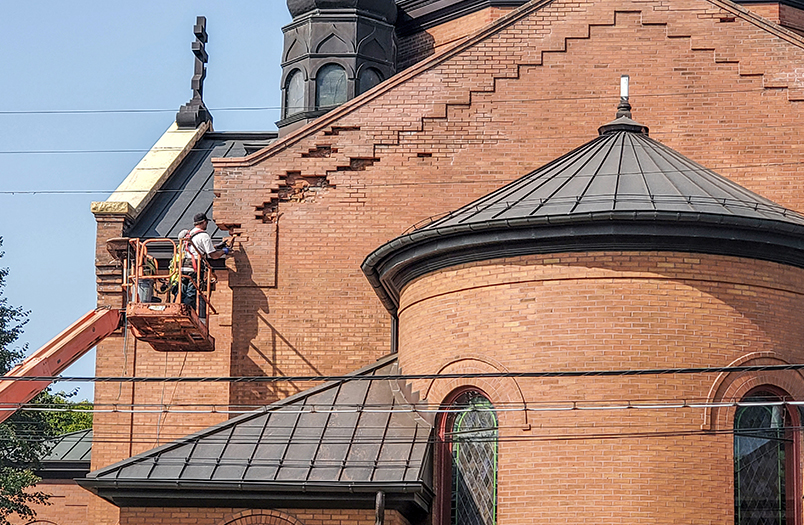
In summer 2020, we were contracted for exterior stone and masonry repairs at St. Mary’s Orthodox Cathedral in Minneapolis. It is a working cathedral, restored while it remained one.
The scope was a complete envelope campaign: tuckpointing the facade, replacing deteriorated brick, repairing and replacing exterior stone, replacing sealants, and power washing facade elements. Just as important was what went in behind the masonry. Stainless steel through-wall flashing and custom-fabricated copper counter flashing are the details that determine whether visible repairs last.
The Masonry Work
The work included facade tuckpointing, brick replacement, stone repairs, and stone replacement. That is the full masonry envelope in one mobilization.
Through-Wall and Counter Flashing
Stainless steel through-wall flashing and custom-fabricated copper counter flashing, installed to keep water out of the wall system.
Read the full case study, or browse all RSI projects.
Questions Building Committees Ask
Straight answers to what congregations, trustees, and dioceses ask us.
Yes. This is how nearly all of our religious work is performed. Loud cutting is scheduled midweek, entrances stay open and protected, and the site is cleaned before every weekend. Weddings and funerals take precedence over our schedule, not the other way around.
Yes. We routinely phase church restorations: safety-critical and active-leak repairs first, the broader campaign following as pledges come in. We’ll also tell you where phasing costs money. Scaffolding the same tower twice is expensive, so your committee can weigh the trade honestly.
Historic sanctuaries used soft, lime-based mortars. A hard modern mix traps moisture and destroys the surrounding brick. We analyze your existing mortar, specify a compatible formulation, and source or salvage matching brick and stone, so repairs read as part of the building.
Openings are rigidly protected before any cutting begins nearby. We plan the work to minimize vibration. Our scope is the masonry, sills, tracery, and perimeter sealants around the glass. Those failing joints are usually behind leaks blamed on the windows. For the leaded glass itself, we coordinate with your conservator.
It changes the paperwork more than the craftsmanship. Where approvals are required, we have direct experience working with the Minneapolis Historic Preservation Committee. We support your architect or preservation consultant with the material documentation that review boards expect.
Churches and Cathedrals Across the Upper Midwest
The climate that damages masonry is the same in St. Paul, Madison, or Dubuque, and so is the crew we send. From offices in Minneapolis and Cedar Rapids, we restore churches, cathedrals, and worship spaces across Minnesota, Wisconsin, and Iowa. We also work into Nebraska, the Dakotas, and northern Illinois. Explore the communities we serve or our other industries.
Schedule a Complimentary Building Assessment
Somebody raised the money for that tower once. Keeping it standing is now your committee’s job. Schedule a complimentary assessment and get a clear, prioritized picture of your building’s condition: what’s urgent, what can wait, and what it will take.